EU vs US e-mobility: Policy shifts and moving markets
Yusuf Latief
Posted on: 14 February 2025
In this week's Power Playbook: US shifts back on EV funds; EU policy potential to boost the market; BNEF labels e-mobility as leading investment driver.
In this week’s Power Playbook: Less than two weeks after research confirmed e-mobility as the largest driver of global low carbon investment, US President Trump moved to halt a $5 billion EV charging programme as analysis from T&E revealed EU plans that could deliver 2 million EV sales for the continent.
Well, folks, it looks like e-mobility might be in for a bit of a turnaround.
A week ago, US President Trump’s administration announced it is rescinding guidance for a $5 billion programme that funds EV charging installations across the US.
The announcement follows Trump’s move on day one of his time in office, saying he would halt the distribution of unspent government funds for EV charging stations from the National Electric Vehicle Infrastructure Fund (NEVI).
Now, via a memo from the Federal Highway Administration (FHWA) to state transportation departments, the FHWA has said they are “immediately suspending the approval” of these state plans pending a Department of Transportation review.
According to this memo, until such new guidance is issued, reimbursement of existing obligations will be allowed not to disrupt current financial commitments, although “no new obligations may occur.”
Unsurprisingly, the move is not being received well, with some going so far as to call it out as illegal.
Sierra Club Clean Transportation for All Director Katherine García released the following statement a day after the memo was issued: “Freezing these EV charging funds is yet another one of the Trump administration’s unsound and illegal moves.
“This is an attack on bipartisan funding that Congress approved years ago and is driving investment and innovation in every state, with Texas as the largest beneficiary.
“Throwing out states’ plans, which were carefully built together with business, utilities, and communities, only hurts America’s growing clean energy economy."
More from the Power Playbook:
Energy finances 2025: US slow-down & rising European utility investments
DeepSeek: What tumbling energy stocks say about AI’s power consumption
Potential positive developments on the European front
This hit to the US’s EV market comes at the same time that favourable policy is being discussed in Europe, with a potential boost to the market.
According to the European Federation for Transport and Environment (T&E), the EU Commission is planning legislation to electrify large company fleets more quickly, as Commission President Ursula von der Leyen will come forward with her Automotive Industrial Action Plan in early March.
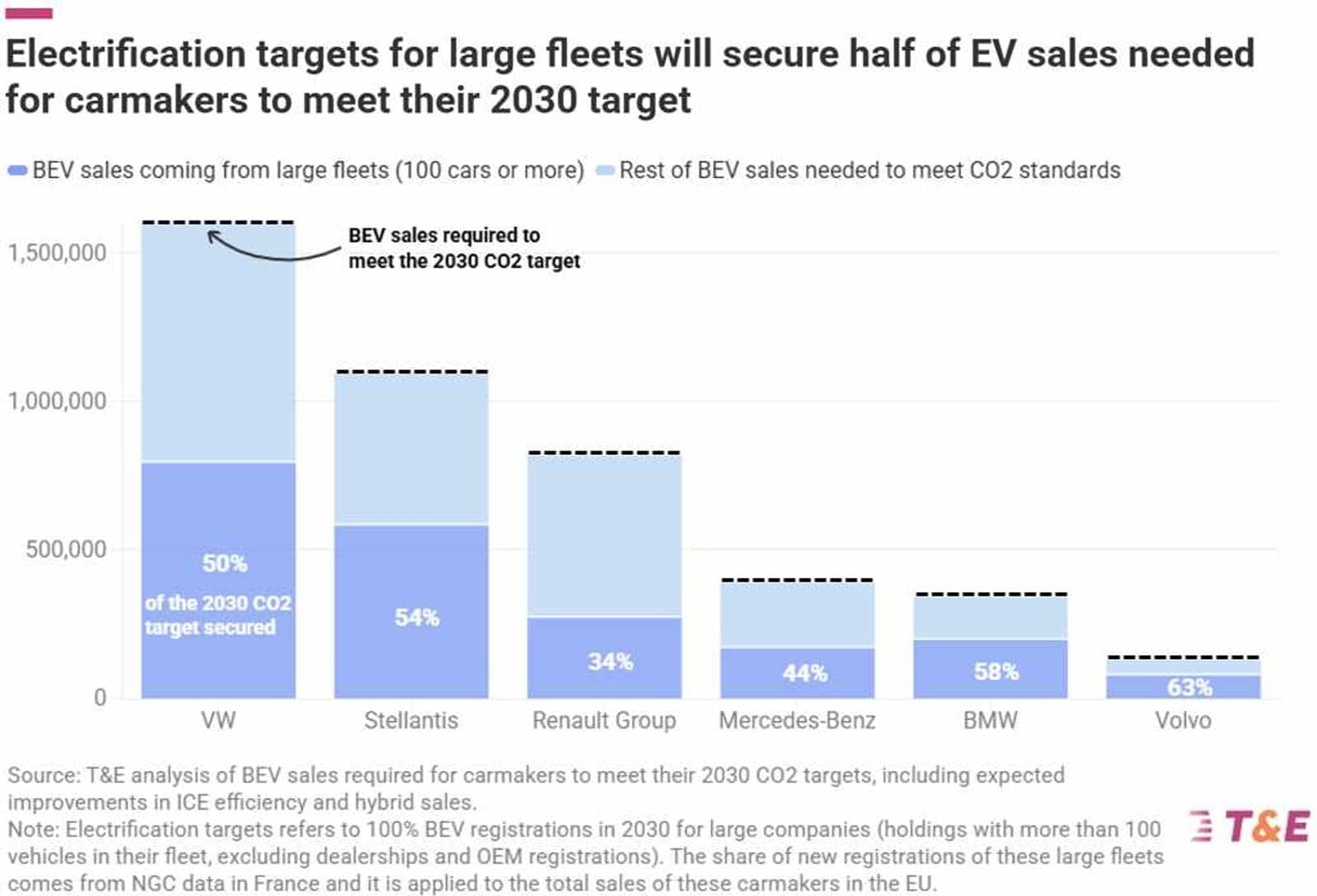
This law, says T&E, could guarantee demand for more than 2 million electric cars for European carmakers in 2030, delivering on average half of the EV sales that European carmakers need to meet their CO2 targets. For carmakers such as Stellantis or BMW this goes up to 54% and 58%.
Fleet electrification targets would especially benefit European automotive groups as 62% of their car sales are in the corporate market compared to only 49% for non-European carmakers.
But how would such targets impact the broader market and Europe’s competitiveness, especially considering the US and their own changing gears in the market?
Commenting to me over email was Stef Cornelis, director electric fleets programme at T&E: "Companies are hardly buying any more electric cars than households, as national incentives do not favour EVs and leasing companies have been reluctant to embrace the new technology.
“Today more than ever before Europe needs climate policies that also strengthen our competitiveness. Electrification targets for large fleets are doing exactly that: we ask large companies to go faster on electric and as such boost demand for more than 2 million EVs made by European car manufacturers.
“Instead of lobbying to weaken emissions rules, European carmakers should advocate for a European fleets law that will actually support them in meeting their targets.”
Further, Cornelis said in a statement: “As a next step the European Commission needs to move forward quickly by announcing binding electrification targets for large fleets.”
And this would not only benefit carmakers, according to Cornelis:
“This will create investment certainty, not only for carmakers but also other key sectors such as the charging infrastructure industry in helping them to plan grid infrastructure roll-out and investments.”
Fleet electrification as an investment driver
Don’t only take it from T&E though.
Weeks before the announcements out of the US and the EU, research company BloombergNEF released its Energy Transition Investment Trends 2025, finding that in last year global investment towards a zero carbon economy exceeded $2 trillion for the first time.
Growth was driven by numerous factors. Renewables and power grid reached new highs, alongside energy storage. But it was electrified transport that remained the largest investment driver, reaching $757 billion.
This figure includes spending on passenger EVs, electric two- and three-wheelers, commercial electric vehicles, public charging infrastructure and fuel cell vehicles.
Trump’s moves in the US are being called illegal, meaning that the future of the NEVI programme and the EV charging market is yet uncertain.
And in the EU, T&E’s comments come for a policy yet to be introduced.
But what it all does signal is that the coming year will likely see big changes for the e-mobility market on both sides of the pond.
As the year develops, what are some key trends and changes in the sector we need to be on the lookout for, and how will they affect your work in the energy sector?
Reach out and let me know.
Cheers,
Yusuf Latief
Content Producer
Smart Energy International