Why the UK needs to rethink its carbon capture policy
Guest/partner contributor
Posted on: 17 December 2024
According to Carbon Tracker, now is the time to reconsider the role that carbon capture, utilisation and storage can play in the UK’s transition to net zero.

According to independent financial think tank Carbon Tracker, now is the time to reconsider the role that carbon capture, utilisation and storage (CCUS) can play in the UK’s transition to net zero.
Once again, writes Lorenzo Sani of Carbon Tracker, carbon capture is high on the UK’s energy policy agenda and features prominently in new Energy Secretary Ed Miliband’s in-tray.
The UK risks investing public money in an overly wide array of projects, with some carrying the risk of locking in high costs and emissions. Moreover, Carbon Tracker research suggests the UK will struggle to achieve its decarbonisation targets if it doesn’t also fix its carbon markets.
Unmet expectations
The UK’s quest to establish a CCUS industry started in 2007 when it launched its first competitive process to support CCUS, followed by a second in 2012. However, both programmes failed to deliver any project, above all because of affordability and risk concerns.
Fast forward to 2020, and the UK government is trying another approach which focuses on de-risking the supply chain and promoting competition to bring the best projects forward.
The new plan, which in March 2023 was backed by the former Conservative government with funding of “up to £20 billion”, aims to kickstart CCUS in four industrial clusters towards the target of capturing between 20 and 30 million tonnes of CO2 (Mt CO2) per year by 2030.
Have you read?
What have carbon capture and the Ford Motor Company got in common?
Putting carbon intensity on the map with electricity consumption data
The capture capacity is planned to rise further to 50Mt CO2 by 2035, with an ambition to create a self-sustaining CCUS market in the longer term.
While there have been some significant improvements – such as de-risking the supply chain and diversifying the capture industry – after the two previous attempts in 2007 and 2012, there are still serious flaws in the government’s plan.
The root problem
The problem with the UK’s CCUS strategy is that its targets are derived from energy models that overemphasise the role of CCUS by relying on overly optimistic and outdated cost assumptions for the technology.
Our report, Curb Your Enthusiasm, demonstrates that the cost assumptions used to inform the UK’s targets, i.e., The Sixth Climate Budget, are significantly lower than what market data suggests. For example, we found that the cost assumption for gas power plants with carbon capture was between 25% and 63% lower than real-world costs, while carbon removal costs (for both DACCS and BECCS) were underestimated by 50% or more.
The UK has just ten years to deploy CCUS capacity equivalent to the current global total, all while facing the added challenge of relying on first-of-a-kind projects across many sectors and striving to keep costs down. The National Audit Office has already warned that the £20 billion allocation is unlikely to be enough to meet the government’s ambition.
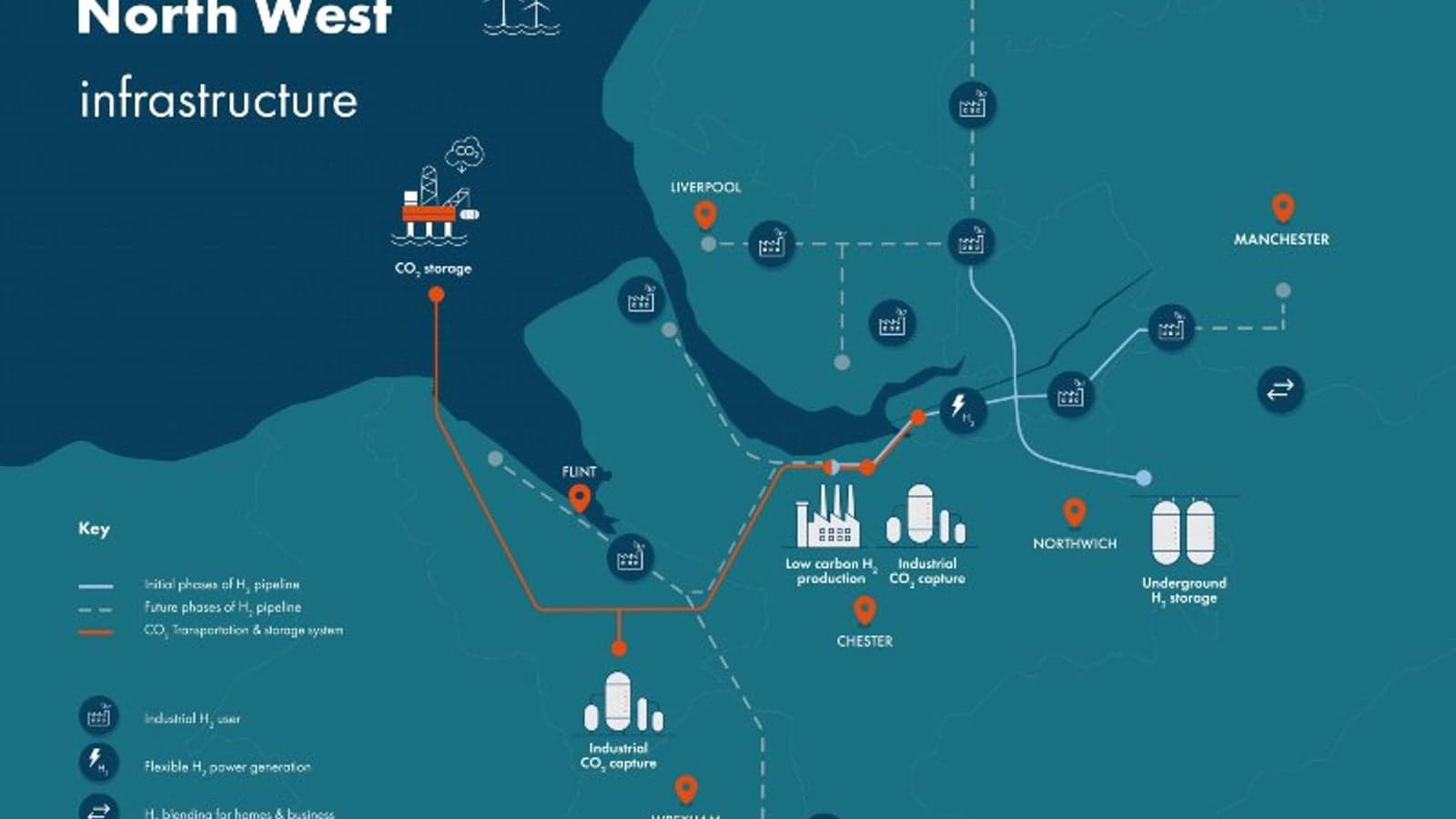
The UK’s first two clusters, known as Track-1 – HyNet and the East Coast Cluster – are expected to come online by the end of 2027 and provide a useful example. Among the eight projects included in the report, only one-third of the total capacity – estimated at around six million tonnes – is focused on industrial applications. The largest share of the capacity is concentrated in gas-based CCUS projects, either for hydrogen production or for capturing emissions from new gas-fired power plants.
Gas-based CCUS
Kind of Blue, a sister report by Carbon Tracker examining the climate impact of blue hydrogen and gas-CCS, warns that gas-based CCUS projects not only carry high delivery and stranded-asset risks, but could also lock in a significant increase in CO2 emissions.
This is due to the new demand for fossil gas generated by these projects, which would necessitate increased LNG imports. These imports, aside from energy security and cost risks, are five times more carbon intensive than domestic supply.
Also of interest: Key technologies to drive Europe’s industrial decarbonisation
Amidst the inevitable decline of gas production from the North Sea, we estimate that if all the gas-based projects contained in the UK strategy are built by 2035, they could generate new gas demand that would be more than double the domestic production capacity. This significantly increases the need for LNG imports.
Consequently, even with the best technology, blue hydrogen (i.e., CCUSbased) from imported LNG could emit up to 2.5 times more than the UK’s low-carbon hydrogen standard. Similar results would apply to gas power plants with CCS, in which case their carbon emissions could be two to three times higher than reported.
This raises an important question for the new Labour government: How do we solve the contradiction between extending fossil gas consumption via CCUS, while North Sea policy seems to be about winding down domestic production?
We believe that efforts should be aligned in the same direction: towards a reduction of fossil gas.
Industrial use cases
Turning to other sectors, we found that the deployment of CCUS can play an important, albeit limited, role in reducing emissions from the industrial sector. For example, in the cement sector, CCUS is the only mature technology that can slash emissions without incurring a hefty cost premium.
We also found that energy-from-waste could be another interesting application for CCUS, in parallel with increased efforts to improve waste recycling and reduction strategies. CCUS offers the opportunity to capture the emissions from the combustion of non-recyclable waste while producing some negative emissions by storing the emissions underground.
It should, however, be emphasised that these applications in aggregate would deliver just a fraction of the UK’s targets.
Against this background, while the UK government has made reasonable progress in designing business models to support CCUS projects, a key factor remains underutilised: the carbon price.
Addressing the carbon price challenge
Achieving a strong and stable carbon price is, in our view, the single most important action that can create a self-sustaining CCUS market.
It is therefore unfortunate that the UK’s ETS market is underperforming, plagued by high volatility and decreasing liquidity. Throughout 2024, the UK ETS price has consistently traded at an average discount of 30% to its European counterpart.
The upcoming implementation of the Carbon Border Adjustment Mechanism (CBAM) could exacerbate this problem, creating a barrier to trade with the EU. These conditions and uncertainties weaken a crucial mechanism that could otherwise drive private sector investment in decarbonisation solutions.
Recommendations
At the time of writing, the new Labour government has not yet updated its stance on CCUS. However, an important milestone will come in Autumn 2024 when the government is expected to make a Final Investment Decision on the Track-1 CCUS projects.
Our main recommendation for the new government is to go back to the drawing board and redefine what role CCUS could realistically and feasibly play in the UK’s overall decarbonisation strategy as part of its industrial plan. A more targeted and practical approach would allow focusing the limited resources on low-regret and high-value projects in industrial sectors.
An important step to improve the quality of projects would be to require gas-based projects to report upstream emissions and halt any final decision until they are correctly considered in the climate budget.
In parallel, the government should develop strategies to deal with the gas supply chain, such as increasing reporting standards, including upstream emissions in CBAM and introducing maximum carbon intensity levels for imported fossil fuels.
Another important question the Labour government still needs to answer is how to deal with negative emissions, given the very ambitious target of 5Mt of engineered greenhouse gas removals by 2030.
Curb Your Enthusiasm explains how the current plan of relying on biomass with CCS (BECCS) is misguided. Aside from well-known sustainability issues, BECCS would require huge subsidies in excess of £25 billion, while still facing high delivery risks. Once again, our recommendation is to go back to the drawing board and set more realistic targets while focusing on smaller-scale and lower-risk projects.
Finally, the government should focus on fixing carbon markets, which could be one of the most effective tools to unlock investments into the still hardtoabate sectors. The main objectives should be reducing price volatility and providing investors with a long-term price signal.
One option could be considering rejoining the EU ETS market, which is already characterised by stronger prices, lower volatility, and higher liquidity. Useful immediate actions would be to increase the floor price for allowances, i.e., ETS Auction Reserve Price, to be more aligned with the EU ETS price, as well as to tighten the alignment with net-zero pathways.
In conclusion, the government needs to reevaluate its strategy so that it focuses on prioritising sectors that can deliver the highest emissions reduction at the best value for taxpayers. At a time when domestic energy prices might again be on the rise, a focus on costs and value-for-money will be vital.
Author

Lorenzo Sani is an analyst at Carbon Tracker and author of the reports ‘Curb Your Enthusiasm’ and ‘Kind of Blue’.