Sweden – a national strategy for green hydrogen
Jonathan Spencer Jones
Posted on: 10 December 2021
Hydrogen will play an important role in supporting the drive to net zero greenhouse gas emissions in Sweden by 2045, the Swedish Energy Agency promises in its newly launched ‘national strategy for fossil-free hydrogen, electro-fuels and ammonia’.
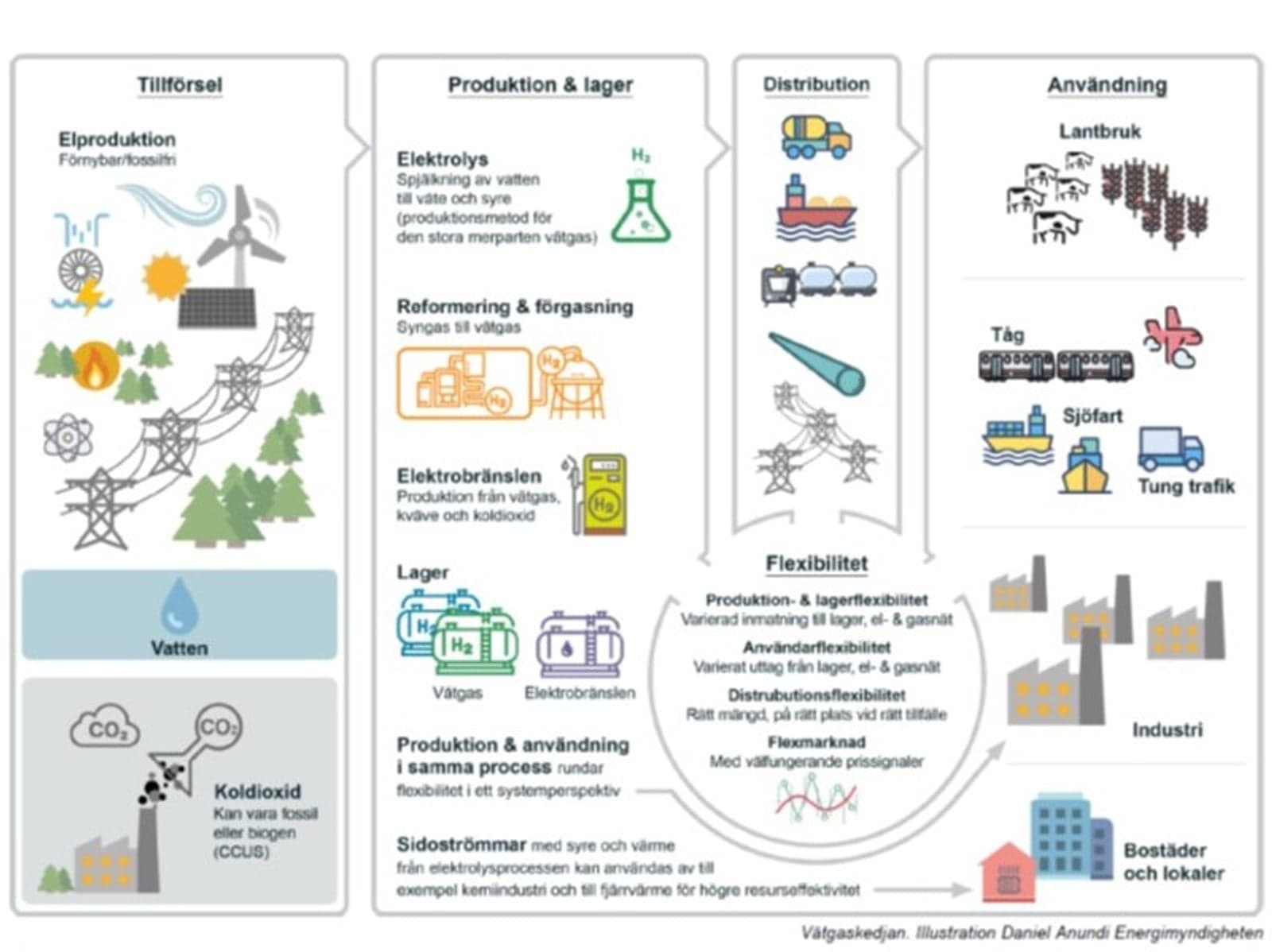
Hydrogen will play an important role in supporting the drive to net zero greenhouse gas emissions in Sweden by 2045 – five years ahead of the rest of the EU, the Swedish Energy Agency promises in its newly launched ‘national strategy for fossil-free hydrogen, electro-fuels and ammonia’.
In particular in the industrial sector, where hydrogen can solve problems where other technologies are limited, while the investments also will in turn impact other sectors such as transportation through sector integration.
Hydrogen storage also is considered a potential source of future flexibility for the grid.
The Agency has proposed a two-phase strategy with a total of 15GW of hydrogen electrolyser capacity in the country by 2045. Of this 5GW should be implemented in the first phase by 2030.
These capacities would supply the expected demand of 22-42TWh of green hydrogen in the first phase, increasing to 44-84TWh by 2045.
This capacity indicates increased electricity demand of from 60 to 126TWh/year, while CO2 emissions reductions could reach 1.5-3Mt by 2030 and 7-15Mt by 2045, respectively from 3-6% and 15-30% of Sweden’s present day total emissions.
“The strategy sets a direction that can be common to the state and business,” says Robert Andrén, Director General of the Swedish Energy Agency.
“It also makes clear what conditions need to be put in place in order for us to be able to utilise the potential of the use of hydrogen and electro-fuels.”
The strategy (in Swedish) also notes an urgency to limit climate change with a phasing out of the use of fossil fuels over time.
Hydrogen for aviation
In parallel with the hydrogen strategy, the Swedish Energy Agency has awarded funding for hydrogen projects that can lead to fossil-free aviation.
Among these is an award to GKN Aerospace to develop engine subsystems in the national H2JET project, which is investigating hydrogen combustion-powered turboprop or turbofan engines for the single-aisle market with a targeted entry into service within Europe in 2035.
Alongside this GKN also has been awarded funding for its work on an electric fan for turbofan engines.
Another award has been made to RISE SICOMP AB, which is focused on the development of ultralight liquid hydrogen fuel tanks for aircraft. Issues of interest include gas permeability and the emergence of micro-cracks at the extremely low temperature, -255oC, of liquid hydrogen.
The E-THRUST project led by Mälardalen University, which is investigating the design optimisation of hybrid electric and hydrogen-powered aircraft, also has been awarded funding.