Atlas Copco hybrid generator to cut emissions and costs
Nigel Blackaby
Posted on: 24 March 2026
New integrated hybrid generator will also reduce fuel consumption and was designed and unveiled at company’s facility near Zaragoza in Spain.
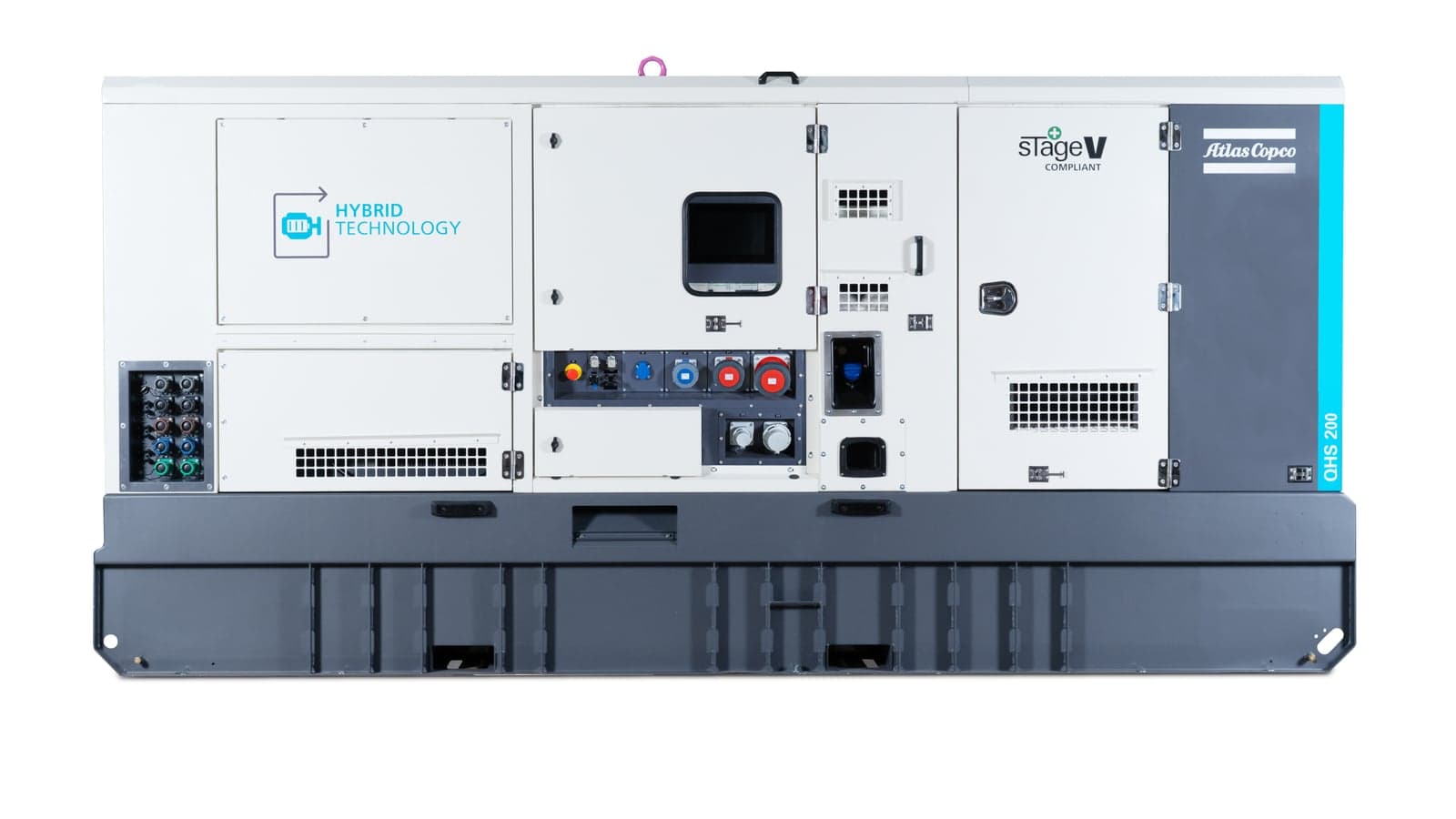
Industrial equipment manufacturer Atlas Copco has launched an integrated hybrid generator range aimed at reducing fuel consumption, carbon emissions and total cost of ownership across rental and temporary power applications.
The new QHS Integrated Hybrid Generators combine a conventional diesel engine with onboard battery storage and intelligent energy management in a single canopy unit.
The company positions the system as a response to growing regulatory and commercial pressure on contractors, utilities and event operators to decarbonise operations without sacrificing reliability or ease of deployment.
According to Sergio Salvador, Vice-President of Marketing for Portable Power, the challenge lies in balancing sustainability targets with real-world operating constraints. “Attitudes to energy consumption are changing rapidly, but customers still need solutions that work in the real world,” he said, noting that uptime, transport efficiency, and simplicity remain critical for rental fleets.
The new integrated hybrid generator was designed at Atlas Copco’s facility near Zaragoza, Spain, which is where manufacturer and assembly take place.
Hybridisation of power
The QHS platform addresses a longstanding inefficiency in diesel-powered generation: oversizing equipment to meet peak loads while operating most of the time at partial capacity. By integrating battery storage, the system can handle load fluctuations without requiring continuous engine operation.
In practice, the generator automatically switches between battery and engine power, significantly reducing runtime under low-load conditions.
Atlas Copco claims the system can deliver up to 80% fuel savings and CO₂ reductions compared with diesel-only units, while cutting engine runtime by more than 95%.
Have you read?
Can hybrid power systems ease the strain on Europe’s power grid?
Hybridisation drives the next leap in Iberian renewables
Marco Gravina, President of the Portable Power and Flow division, emphasised that hybridisation fundamentally changes utilisation dynamics. Diesel engines, he explained, typically operate inefficiently when sized for peak demand.
Battery integration allows energy to be stored and dispatched as needed, reducing mechanical stress and extending service intervals. “This is the big revolution, the big change - you only get the power you need.”
Rental-focused design
The QHS range has been engineered specifically for the rental market, where utilisation rates and lifecycle economics are key performance indicators. By consolidating core components—engine, battery, power electronics and control systems—into a single transportable unit, Atlas Copco aims to simplify logistics and deployment.
Features such as multiple socket configurations, external fuel connections and terminal boards are complemented by the company’s FleetLink telemetry system, which enables remote monitoring, diagnostics and software updates.
Crucially, the connectivity architecture uses independent SIM-based communication, ensuring separation from customer networks and addressing cybersecurity concerns.
Gravina highlighted that ease of use is a major differentiator. Hybrid systems have historically required specialised knowledge, but the QHS units are designed for near plug-and-play operation, with one-click start/stop and autonomous load management.
Improved economics
Reduced engine runtime translates directly into lower maintenance requirements. Fewer operating hours mean extended service intervals, less wear and tear, and decreased downtime—factors that improve fleet availability and overall profitability.
Tony Calippe, Marketing Manager for Power & Light, said the integration strategy was intended to “make hybrid power easier to deploy, easier to operate and easier to rent,” while delivering measurable reductions in operating expenditure.
Battery longevity is also a key consideration. Atlas Copco indicates that its systems are designed for up to 6,000 charge cycles, potentially supporting operational lifespans of up to two decades depending on usage patterns.
The company plans to introduce the new hybrid generator across European markets, including the UK, Germany, Benelux, Spain and Italy, where demand for low-emission solutions is accelerating. A subsequent launch in the United States is planned, targeting high-growth segments such as construction.
Applications extend beyond construction to events, utilities and mining, where hybrid systems offer additional benefits including noise reduction and reduced refuelling requirements: all critical in remote or sensitive environments.
Gravina noted that hybrid generators are likely to become the default solution in applications with highly variable loads within the next decade.
Hydrogen readiness
Looking ahead, Atlas Copco is also preparing for alternative fuels. The QHS units are already compatible with hydrotreated vegetable oil (HVO), and the company is developing hydrogen-capable prototypes.
However, Gravina cautioned that widespread adoption of hydrogen in portable power will depend on infrastructure development. “The moment the infrastructure is there, we will be ready,” he said.
As regulatory pressure intensifies and hybridisation gains traction, integrated systems like the QHS range signal a broader shift in the temporary power sector, from standalone diesel generation toward digitally managed, multi-source energy solutions.