Why Europe’s energy future may depend on SMRs
Nigel Blackaby
Posted on: 8 December 2025
Enlit Europe conference director Nigel Blackaby unpacks the key messages emerging from the nuclear energy sessions in Bilbao.
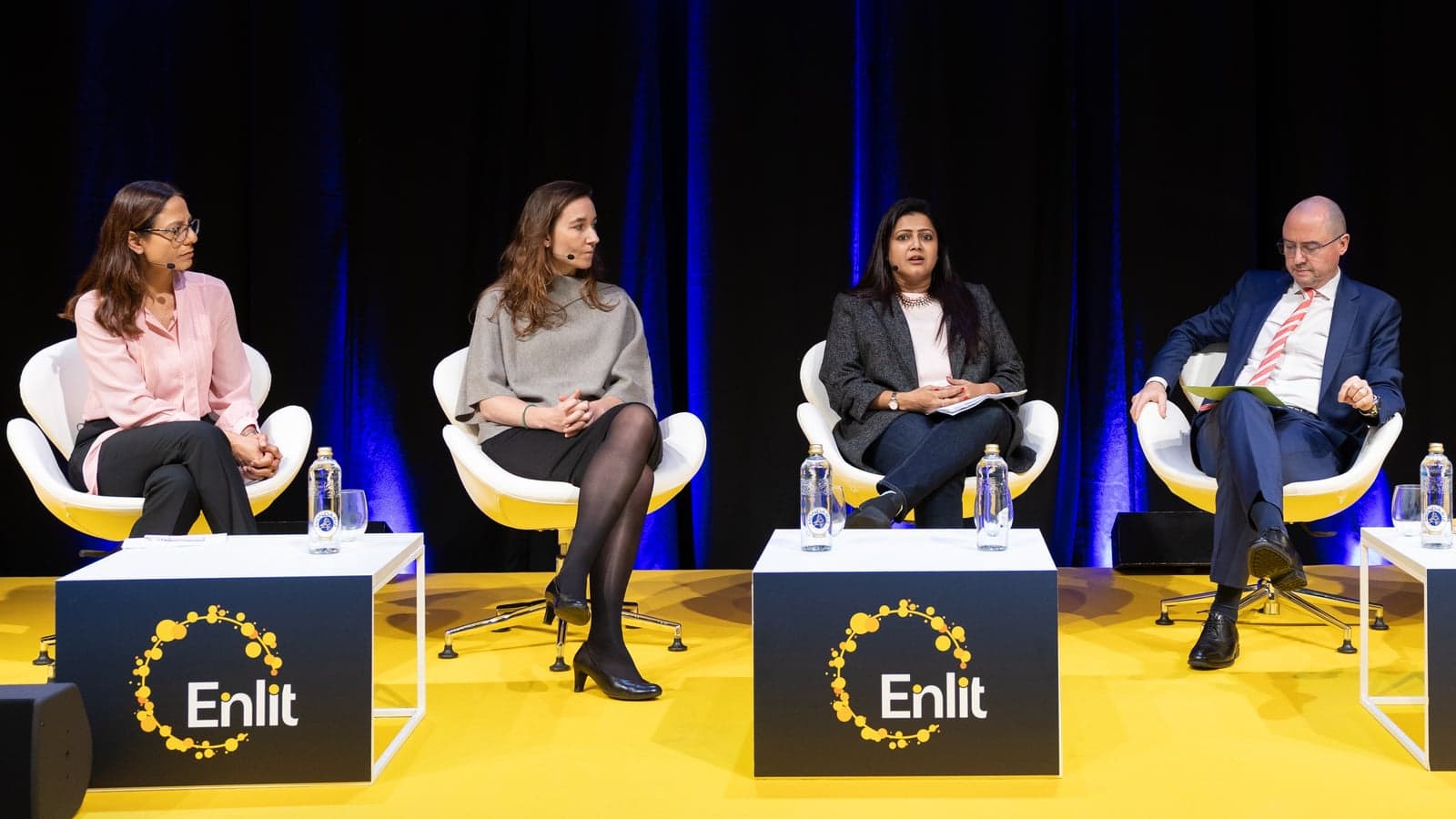
When delegates gathered in Bilbao for Enlit Europe 2025, nuclear energy – long the most contested pillar of the energy transition – was no longer a peripheral conversation.
It stood squarely at the centre of discussions about sovereignty, security, and decarbonisation.
Across panel rooms and exhibition halls, one message rang clear: Europe’s climate and industrial ambitions cannot be met without nuclear power. Yet the path to unlocking that potential remains obstructed by political hesitation, investment inertia, and decades of public misperception.
Nuclear energy, once heralded as the continent’s ticket to energy independence, has spent the past two decades restrained by shifting policies and fractured public trust. Still, the mood in Bilbao hinted at a turning point.
With the electrification of everything – from transport to heating to artificial intelligence – straining electricity grids, and with geopolitical tensions reshaping global fuel dynamics, nuclear generation’s reliable, low-carbon baseload now looks less like an optional extra and more like a strategic necessity.
But beyond the renewed attention on large, gigawatt-scale power stations, another technology commanded the spotlight: small modular reactors.
Compact, flexible, and designed for rapid deployment, SMRs are being framed as one of the most promising innovations in Europe’s energy future. They were the subject of one of the most well-attended sessions at Enlit Europe, capturing the imagination of engineers, policymakers, and investors alike.
This is the story of a continent attempting to rediscover nuclear not as a relic of the past, but as a sovereign tool for the future, and the role SMRs could play in rewriting the political and technological narrative around atomic energy.
Edge of reinvention
Europe’s energy landscape has been transformed by the dual pressures of climate commitments and geopolitical instability.
Despite impressive gains in renewables, the intermittency of solar and wind necessitates complementary power sources that are both dispatchable and clean. Nuclear, on paper, meets those criteria better than any other option.
Yet, as speakers at Enlit Europe repeatedly noted, nuclear energy’s biggest problems are not technical: they are psychological and political.
For decades, public debate around nuclear energy has been dominated by images of Three Mile Island, Chernobyl, and Fukushima. Risk-centric storytelling embedded itself in European culture, shaping political platforms and regulatory frameworks that often treat nuclear not as an engineering challenge but as an existential hazard.
This sentiment has translated into three persistent challenges:
NIMBY resistance
Nuclear facilities, no matter how safe, confront a deeply embedded “not in my backyard” mentality. Legacy fears, misinformation, and memories of past accidents continue to outweigh data about nuclear energy’s strong safety record in Europe. Panellists stressed that transparency, community engagement, and the communication of economic benefits are essential for rebuilding trust.
Financing and investment culture
While institutions like the European Investment Bank and the U.S. Department of Energy have begun extending support to nuclear innovation, Europe still lags behind other markets. Highly cautious investment cultures, stringent regulatory classifications, and a lack of unified strategy leave innovative projects—particularly early-stage ones—struggling to secure capital.
Fragmented political will
Perhaps most frustratingly for industry leaders, Europe has no consistent nuclear strategy. While France and Finland push forward, Germany remains anti-nuclear, and several member states oscillate between interest and disengagement. Without policy stability, projects cannot advance with the speed needed to meet climate targets.
Panellists argued that the solution lies in reframing nuclear not as a risk but as a proven, sovereign resource—one that can deliver energy independence, support industrial competitiveness, and integrate smoothly with renewables.
The waste debate
If any single topic has shaped nuclear scepticism, it is the handling and legacy of waste. Yet, as multiple speakers pointed out, nuclear waste is one of the most misunderstood issues in the energy debate.
Thanks to advances in fuel recycling and waste minimisation, the volume of spent fuel is dramatically lower than most people imagine. Modern reprocessing technologies allow for far more efficient use of uranium, meaning the energy extracted per unit of fuel continues to increase.
The message in Bilbao was clear: Waste is a manageable engineering issue, not an unsolvable environmental crisis.
Innovation is moving fast—and transparency will be the key to helping the public understand that.
One theme echoed throughout the week was urgency. Europe cannot afford long timelines or dependency on foreign technologies. With the electrification of industry accelerating and AI-driven data centres drawing gigawatts of new demand, the race is on to build domestic capacity.
Experts warned that without investment in nuclear—both large plants and modular reactors—Europe risks ceding industrial competitiveness to nations with cheaper and more reliable energy supplies.
A coordinated, cross-continental nuclear strategy, they argued, is the only way to achieve sovereignty in an increasingly multipolar world.
The SMR spotlight
While large reactors retain an essential role, it was Small Modular Reactors that energised the Bilbao audience. The SMR session brought together leaders from SNETP, the Nuclear Energy Agency, Stellaria, and the innovative community-based energy group Atom Cooperative.
The promise of SMRs lies in three fundamental strengths:
1. Modular, rapid deployment
Traditional nuclear plants take a decade or more to build. SMRs, by contrast, are designed for factory-based production and on-site assembly. This reduces:
- construction time
- capital risk
- cost overruns
- supply-chain complexity
It also opens the door for smaller nations or regions to consider nuclear without committing to a multi-billion-euro megaproject.
2. Enhanced safety features
Most SMR designs incorporate passive safety systems, meaning they rely on natural processes like gravity or convection, not mechanical or human intervention. This makes them inherently safe and easier to license.
Current European efforts focus on light-water reactors, leveraging decades of operational experience and easing regulatory pathways.
3. Flexible applications for industry
SMRs are not just for electricity generation. They can provide:
- high-temperature heat for industrial processes
- hydrogen production
- district heating
- desalination
- on-site power for remote or energy-intensive facilities
A point that resonated strongly in Bilbao was their potential to serve data centres, especially as AI and cloud computing drive unprecedented electricity demand. On-site SMRs could make Europe a more attractive destination for tech investment by delivering stable, low-carbon power directly to digital infrastructure.
More insights from Enlit Europe:
Why it's time for Europe to create a level playing field for CCS
How Basque Country is shaping a sustainable energy future
Will public perception derail Europe's nuclear renaissance?
Europe’s cooperative approach
A standout theme from the SMR session was the value of collaborative innovation. The Atom Cooperative in the Netherlands is pioneering a community-ownership model designed to increase local acceptance and share economic benefits. For an industry long challenged by NIMBYism, such cooperative frameworks may be transformational.
Similarly, the EasySMR project, involving 38 partners across 16 countries, was highlighted as a proof of Europe’s ability to coordinate research, harmonise licensing, and accelerate commercialisation even on limited funding.
Key focus areas include passive safety validation; digitalisation for autonomous control; sustainability through fuel cycle closure; and harmonised regulatory processes.
Although funding remains a challenge, the initiative demonstrates Europe’s growing technical momentum.
Speakers warned that without a harmonised regulatory framework, SMR momentum could stall. Today, national licensing differences create duplicative work, slow down deployment, and inflate costs.
A streamlined, pan-European regulatory approach—similar to aviation or pharmaceuticals—would allow developers to bring SMR designs to market more quickly and encourage private investment.
A harmonised framework, the audience heard, is not just a technical requirement—it is a political necessity.
Commercial SMR deployment will depend on four parallel efforts:
1. R&D acceleration
Particularly in autonomous passive safety systems, which must be rigorously validated to support fast-track licensing.
2. Financial innovation
Europe must adopt more sophisticated financing models—combining public guarantees, private investment, and creative instruments—to de-risk projects.
3. Public narrative reset
The industry must actively shift the conversation from fear to facts. Evidence-based communication, community ownership, and transparency will be critical.
4. A unified industrial strategy
Without coordinated policies and shared European infrastructure, deployment will remain slow and fragmented.
A new era in sight
The tone in Bilbao was not one of naïve optimism, but of pragmatic determination. Nuclear energy—whether large reactors or SMRs—is not a silver bullet, but it is an indispensable tool in meeting Europe’s climate goals and ensuring energy sovereignty.
The industry’s future will depend on its ability to embrace innovation, rebuild trust, and articulate a balanced narrative: nuclear carries risks, but so does inaction.
Small Modular Reactors, with their versatility and rapid deployment potential, are emerging as a bridge to a new era—one where nuclear energy can be integrated more flexibly, financed more sustainably, and accepted more widely.
In the coming decade, Europe’s energy identity will be shaped by the decisions made today. As Enlit Europe 2026 showed, the continent stands at a crossroads. If Europe can align politics, finance, and public sentiment behind nuclear, SMRs could become not just a technical development, but a defining chapter in the European energy transition.