Australia bets big on renewables – but can the grid cope?
Guest/partner contributor
Posted on: 10 June 2025
Australia’s Clean Energy Regulator projects the average annual renewables share of the electricity market will reach 45% in 2025 on the way to a goal of 82% by 2030.
Australia’s Clean Energy Regulator projects the average annual renewables share of the electricity market will reach 45% in 2025 on the way to a goal of 82% by 2030. These grand plans are one thing. But can the grid cope?
By Drew Robb, consultant at Robb Editorial
The government of New South Wales, by far the most populous state, had to recently ask businesses and households to conserve power between 3pm and 8pm due to the likelihood there would be insufficient generation available to meet demand.
In response, massive transmission and generation build out is happening across the nation.
Western Australia (WA), a state that is largely empty yet covers a third of the land with a population of less than 3 million (mostly in and around Perth on the west coast).
The state’s grid is split into two parts that only cover a fraction of the area. By far the largest is the Southwest Integrated System (SWIS) that spans from Perth and as fast east as the Kalgoorlie mining region in the interior. The most recent Australian Integrated System Plan (ISP) recommended investing in almost 5,000 km of new transmission lines to ensure the supply of reliable and secure energy.
WA is receiving about AUS$3 billion (US$2 billion) in “Rewiring the Nation” investment. That money won’t be enough to ensure stable delivery of power to consumers and businesses and forward the ongoing energy transition plans.
Have you read?
Grid connection granted to 1.3GW solar farm and storage system in Australia
CIP bags AU$814m for 1.5GW green hydrogen project in Australia
“Risks to the transition are emerging and must be carefully managed,” said Daniel Westerman, chief executive officer of the Australian Energy Market Operator (AEMO).
Coal plant retirements are moving ahead at pace. Natural gas plants are being shifted from combined cycle operation to standby or peaking mode. Installed rooftop solar is now the biggest single source of generation capacity during the middle of the day, with more than 30% of homes in SWIS having rooftop photovoltaic (PV) systems. The rest of the time, the region relies largely on coal and gas, though wind power is steadily adding to its share of the total.
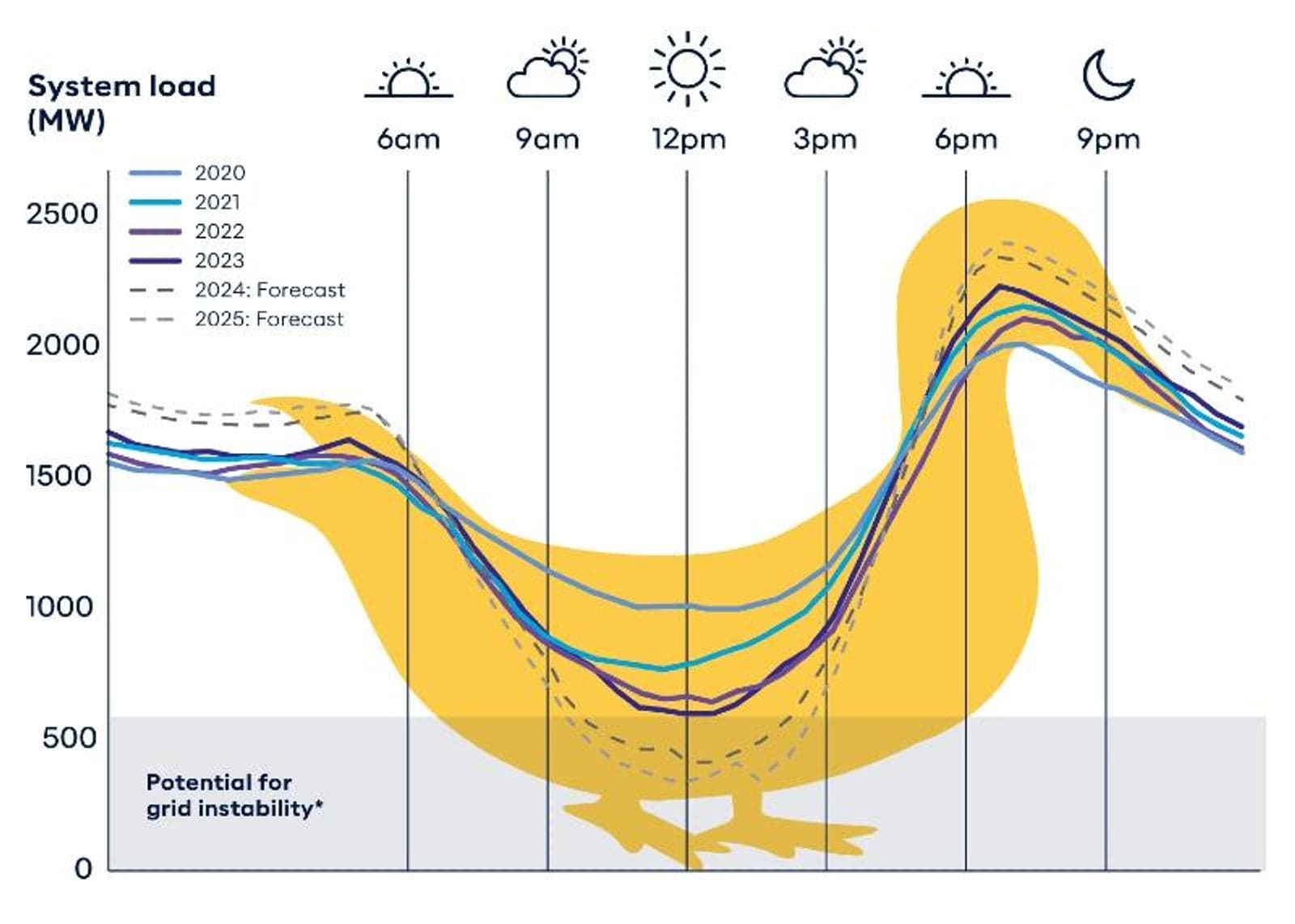
The result is a grid pattern eerily reminiscent of the famous California Duck Curve – about 1.5GW of grid demand in the morning, falling to less than 1GW at midday as homes and businesses operate on their own solar, then ramping up to more than 2GW during evening peaks.
That was in 2020.
Each year, the midday slump has deepened. By 2023, it fell to around 500MW, then around 400MW in 2024 and is forecast to drop further in 2025.
If anything, the situation is deteriorating in the Perth metro area. The Merredin Solar Farm, 260 km east of Perth is now online. Its 360,000 solar panels generate up to 281GWh of electricity annually.
To cope with what can be a serious excess of solar energy during the day, utility provider Synergy has deployed more than 100MW/200MWh of battery energy storage systems (BESS) including the Kwinana Big Battery. That helps, but it can only power 160,000 homes for up to two hours.
The strategy to support the solar build out as more coal is retired has several elements:
- Investment in natural gas infrastructure to provide firming to the energy system. Existing gas generation plants gained a 10-year exemption from new emission thresholds.
- Encouraging businesses and consumers to move some consumption to the middle of the day and the adoption of an Emergency Solar Management (ESM) system that enables the grid operator to shut off rooftop solar being fed to the grid during a surplus.
- The addition of a lot more BESS.
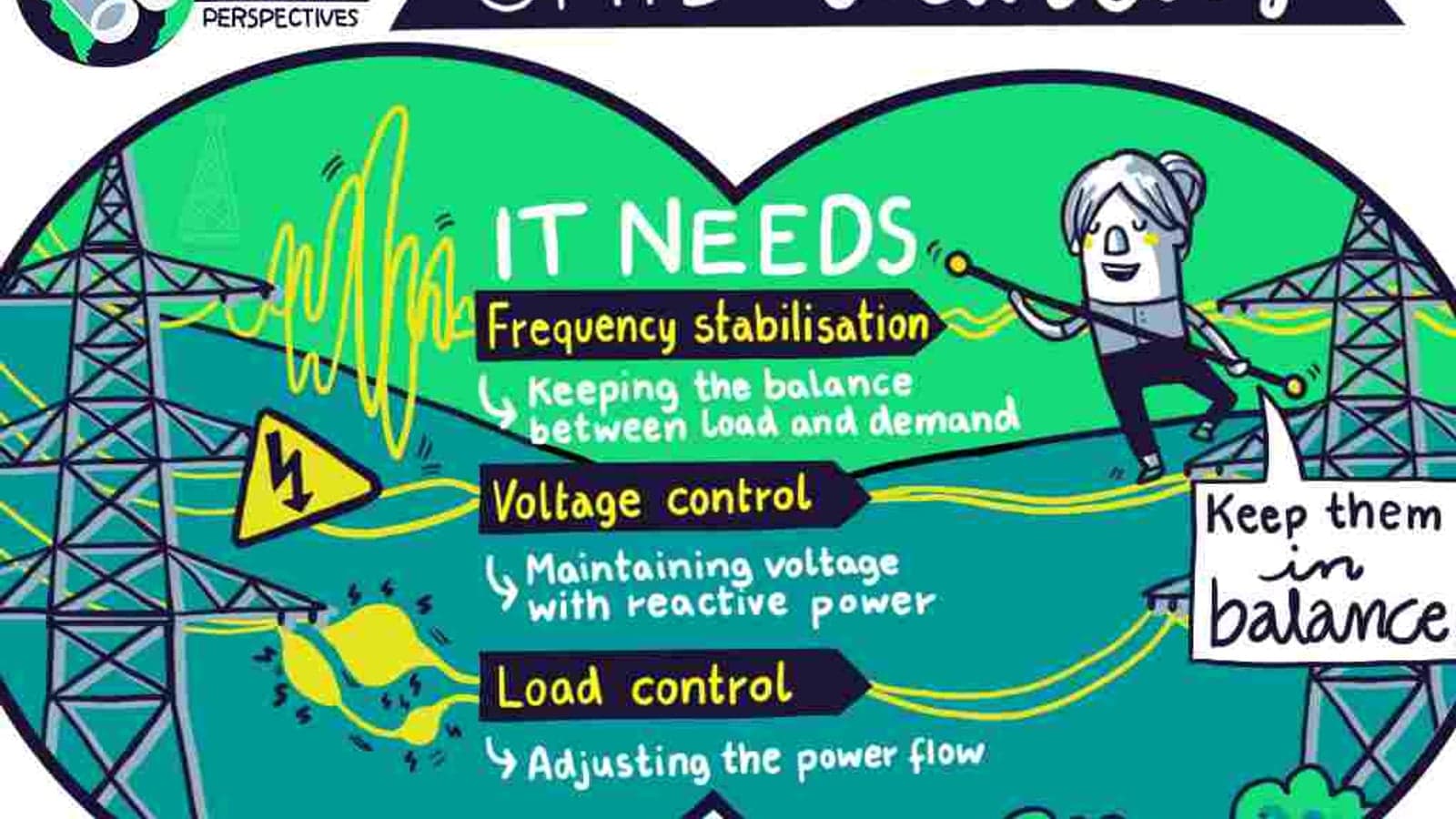
- Policy changes to compensate natural gas plants for the provision of ancillary services such as short-circuit power, reactive power, and grid stability.
“As coal-fired power stations retire, renewable energy connected with transmission and distribution, firmed with storage, and backed up by gas-powered generation is the lowest-cost way to supply electricity to homes and businesses through Australia’s transition to a net zero economy,” said Westerman. "New generation, storage and firming must be in place before coal power stations retire, and to meet Australia’s growing demand for electricity.”
Also of interest: Rooftop solar boom continues in Australia with 3GW installed in 2024
Upgrading existing natural gas plants
SWIS has realized the benefit of retaining as many natural gas plants online as possible.
These units provide vital rotating inertia to safeguard the grid against major events. However, many of these units are aging and they are being forced to switch from baseload to peaking generation. That fact alone means that a) the funds aren’t there for upgrades and b) the facilities may not be able to justify continuance if they are only going to operate a few hours a week at the discretion of the grid operator.
Fortunately, Australia has seen the wisdom of rewarding gas generation plants for the provision of ancillary services. This has enabled facilities to make the necessary investments and remain profitable.
Synergy’s 576MW Pinjar Power Station, 50 km north of Perth, for example, consists of nine GE Vernova gas turbines (six Frame 6s and three Frame 9s). They produce power mainly during emergencies and in response to the morning/late afternoon duck curve pattern. The turbines can be online and available to the grid within 15 minutes when requested.
But peaking power isn’t enough to achieve viability. Several of the units are installed with synchronous self-shifting (SSS) clutches from SSS Gears Ltd., UK, to provide system stability and grid support. These clutches are designed so that when the turbine is moving faster than the generator, the clutch automatically is engaged, and the turbine drives the generator.
Once the generator is synchronised to the grid, the turbine slows down and the clutch automatically disconnects from the generator, turning it into a synchronous condenser. These SSS clutches are incorporated into the load gears made by Flender-Graffenstaden of Strasbourg, France. This synchronous condensing upgrade provides a number of benefits to the grid.
Reactive power provided by a synchronous condenser offers voltage stability. While real power accomplishes useful work from voltage and current, reactive power (measured in volts amperes, reactive or VARs) provides much needed voltage support. In addition to inhibiting the possibility of a catastrophic voltage collapse, reactive power increases transmission efficiency and boosts the amount of real power that can be transmitted over a line.
Read more: Ticking the boxes to make green hydrogen viable at scale
Due to the large distances involved in WA, plenty of reactive power support is needed. With coal plants retirements moving forward, the need for system stability is only going to increase. Synergy owns two coal power stations, both of which are scheduled for closure. The 854MW Muja plant and the 340MW Collie plant are both in the SWIS region about 200km south of Perth. Collie will be closed by 2027 while Muja will be shuttered in 2029.
With so much system inertia coming offline in the region, the work of the generators at Pinjar becomes more critical. Hence, Synergy is taking steps to maintain reliability across its territory. This includes placing an order for a critical spare load gear and SSS Clutch to ensure that unexpected faults, failures, or routine maintenance do not diminish the ability of the system to supply real and reactive power.