Building decarbonisation solutions with an eye to the future
Pamela Largue
Posted on: 9 January 2025
Pamela Largue finds out how Baker Hughes is tackling the decarbonisation challenge by delivering affordable and reliable solutions.

Pamela Largue finds out how Baker Hughes is tackling the decarbonisation challenge by delivering affordable and reliable solutions.
For Simone Marchetti, the energy transition is about discovering the main techno-economical drivers of the customer and identifying the new and existing technologies that can meet the customers' needs.
The Clean Power Strategy and Growth Senior Manager for Clean Power Solutions at Baker Hughes has spent over 10 years in the sector tackling some of the toughest decarbonisation challenges and tailoring solutions to help abate emissions in a way that’s affordable and reliable. For him, it is all about delivering a balanced solution, one that can withstand future challenges but also makes sound business sense in the short term.
How is Baker Hughes enabling the achievement of net-zero targets?
As an energy technology company, we are transforming our core technology to offer efficiency and emissions abatement solutions across a broad array of energy and industrial sectors.
We are very active across several areas, including energy efficiency, electrification, clean power generation and energy management.
We believe in presenting a fully tailored portfolio-based solution, recognising an array of different options rather than a single solution, given various geographical constraints and policy supports.
We create the solutions by learning from our customers and allowing them to learn from us. Listening to the voices of our customers and translating them into their requirements allows us to iterate, pivot and improve on the solution while directing our R&D spend.
In 2023 alone, Baker Hughes invested $658m million in R&D to deliver several advancements across our portfolio.
What trends are you noticing in terms of clients’ decarbonisation journey?
Overall, the pressure to decarbonise is growing, but the trends are different depending on which industry or region, and the policy and geographical constraints that you are looking at.
Hard-to-abate industries, such as chemical and petrochemical, iron and steel, cement, and the transportation sector, are facing the challenge in very diverse ways. Some are looking at increasing the efficiency of their processes or changing fuels, while others are looking at totally new technologies or processes to continue their production depending on their capital intensity and technological risk appetites.
What role is Baker Hughes playing in helping clients meet decarbonisation targets?
We are digging deep into our engineering and market know-how, collaborating with our customers on new technologies and business models that aim to meet decarbonisation targets.
Here are a few ways we are supporting our clients:
For emission abatement, we have technology available today to cost-effectively reduce methane emissions, utilising associated gas otherwise flared as fuel; improving flare combustion efficiency, or upgrading equipment to reduce venting during ordinary operations.
For CCUS, we have capabilities in several areas including post-combustion capture, compression, subsurface storage, and long-term integrity and monitoring.
For hydrogen, we have technologies that span from production, utilisation, transportation and storage, leveraging our know-how in turbomachinery and infrastructure know-how.
For clean power generation, we are creating a portfolio of efficient and integrated power generation solutions spanning low—to no-carbon turbomachinery-based power generation technologies, heat recovery, energy storage, and integration with renewables.
You might be interested in:
Baker Hughes backs green hydrogen tech manufacturer
5 things you should know about compressor technology
‘This is the decade of energy efficiency’ says Baker Hughes boss Simonelli
How important are partnerships for achieving climate goals and spurring innovation?
We believe we need to integrate know-how and solutions from all sides of the business.
The clean power generation portfolio of solutions is made by leveraging both organic and inorganic moves, and for such inorganic moves, we count strongly on partnerships.
In February 2022, Baker Hughes joined a strategic partnership with and invested in Net Power Inc. to advance the technical and commercial deployment of Net Power’s low-cost, electric power system that generates no atmospheric emissions and inherently captures all carbon dioxide (CO2).
We are applying advanced technical capability to develop an integrated suite of key process equipment, including a first-of-a-kind supercritical CO2 turboexpander, with our legacy compression technology at the heart of Net Power plants.
We have been working on the project for more than two years and are on track to complete our test programme by 2026 in a demonstrator plant located in La Porte (Texas).
The FEED of the first utility-scale project (in the Permian basin) is well underway by Zachry Group and expected to be completed this year, with the first fire by 2H 2028.
Another partnership we have in place is for our geothermal offering. It’s a collaboration between two Baker Hughes companies that work in different spaces.
We are leveraging our subsurface technology, developed over decades of working in the oil and gas business, and putting it together with our surface turbomachinery technology to deliver a turnkey solution.
We are developing a wide range of technologies to increase the overall efficiency of geothermal power generation, including specifically designed steam turbines and organic rankine cycles for low enthalpy resources.
What role will corporate PPAs play in reaching decarbonisation goals?
Power Purchase Agreements (PPAs) are an increasingly attractive option, both for Baker Hughes' internal operations and for our customers.
In 2019, we committed to reduce Scope 1 and 2 emissions from our operations by 50% by 2030 and achieve net-zero emissions by 2050.
PPAs for renewable power procurement is one of the solutions that Baker Hughes is adopting to reduce emissions associated with energy usage at our facilities.
In September 2023, Baker Hughes entered an eight-year PPA with Shell Energy Italia to supply seven of our Industrial & Energy Technology facilities in Italy with renewable power. This power is sourced from Shell’s solar photovoltaic farm in the Apulia region, in southern Italy.
Thanks to this agreement and the one we concluded in Texas two years ago, our scope 1 and 2 greenhouse gas (GHG) emissions decreased 28.3% from our 2019 base year.
However, PPAs are also a viable solution for our customers. Customers have the option of using our solutions in a PPA, but without owning the asset. It’s a pay-as-you-use system that allows them to use the electrons without having to deal with the power generation assets.
How is energy efficiency perceived when looking at how to decarbonise our energy system?
Energy efficiency is one of the first and easiest levers to decarbonise and sometimes we forget what we can do with existing assets, simply by enhancing performance and consequently lowering emissions.
There are dozens of proven technologies involving more efficient machinery, that are a substantial upgrade with respect to the installed machinery that some customers have installed in the past.
This means in the short term that we can leverage our proven technologies that enable significant emissions reductions across the value chain.
What are the latest microgrid and energy storage developments that Baker Hughes has been involved in?
For microgrids, we take care of the bankable feasibility studies, tailoring the solution around the customer needs, and putting together our technology with the best-in-class renewables and storage.
To support this offering, we have invested in BRUSH Power Generation solutions, developing technology around grid balancing, such as synchronous condensers, a must in a strong renewable-based grid, as well as long-duration energy storage (LDES).
For LDES, Baker Hughes is developing specifically designed turbomachinery fostering technology such as liquid air and compressed air energy storage and thermal energy storage.
Hybrid, decentralised solutions are becoming more popular, and our solution architects work to tailor together these systems with a controller, ensuring maximum efficiency and minimal emissions.
Is hydrogen seen as a disrupter or an enabler in the power generation sector?
There is no credible net-zero scenario that does not feature hydrogen as a critical decarbonisation solution.
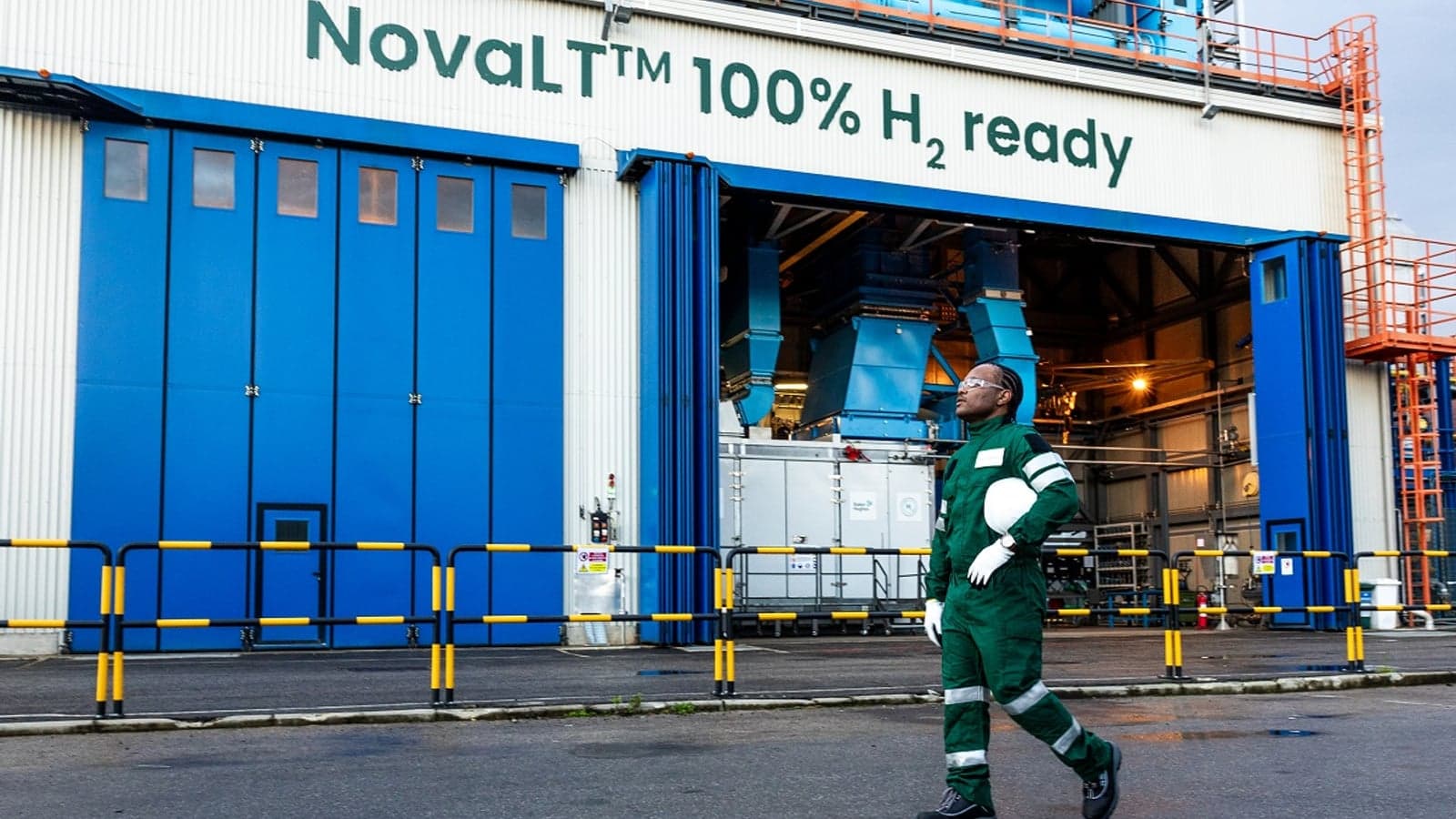
Hydrogen has not yet achieved its full potential, however, investing in scaling the value chain will address challenges around the cost and availability of hydrogen, resulting in a more cost-effective solution. We recently completed manufacturing and testing our NovaLT™ 16 hydrogen turbines for Air Products’ Net-Zero Hydrogen Energy Complex in Edmonton, Canada. The NovaLT™16 turbines underwent full load testing at our newly unveiled Hydrogen Testing Facility in Italy. This family of turbines can be deployed for a variety of industrial applications, including combined heat and power, as well as for pipeline and gas storage operations.
We also delivered the first two trains of advanced hydrogen compression solutions for the NEOM project in Saudi Arabia, the equal joint venture of ACWA Power, Air Products and NEOM.
Watch: Achieving net-zero targets through digitally enhanced technology solutions
How are different regional markets equipped to manage this sort of disruption/enablement?
Policy has the potential to drive technologies and make them more easily adoptable.
To advance these policy discussions, we are engaging more directly to ensure governments make decisions based on the best available facts and data.
Governments and industries must work together, with a regulatory framework that allows for rapid qualification, permitting, and deployment of new energy technologies.
In summary, whether working with policymakers or customers, we value opening doors and having good technical and commercial conversations.
It’s through these conversations that ideas are born, business cases are proven, and new technologies are discovered and applied both by the institutions and by the customers.
It’s a dynamic way of solving problems that drives us at Baker Hughes.
About Baker Hughes
Baker Hughes (NASDAQ: BKR) is an energy technology company that provides solutions to energy and industrial customers worldwide. Built on a century of experience and conducting business in over 120 countries, our innovative technologies and services are taking energy forward – making it safer, cleaner and more efficient for people and the planet.
Visit us at bakerhughes.com