Compact thermal energy storage of the future: from the home to the workplace
Guest/partner contributor
Posted on: 5 June 2025
The primary goal of the ThumbsUp project is to unlock the potential of compact thermal energy storage solutions at a building level in order to stimulate a decentralised approach to grid flexibility.

The primary goal of the ThumbsUp project is to unlock the potential of compact thermal energy storage (TES) solutions at a building level in order to stimulate a decentralised approach to grid flexibility.
The transition to electrified heating and cooling systems powered by renewable energy sources is a key step towards achieving carbon-neutral buildings in the EU.
This is a reason why it is crucial to maximise on-site renewables self-consumption and increase the use of grid supplied renewable energy when available.
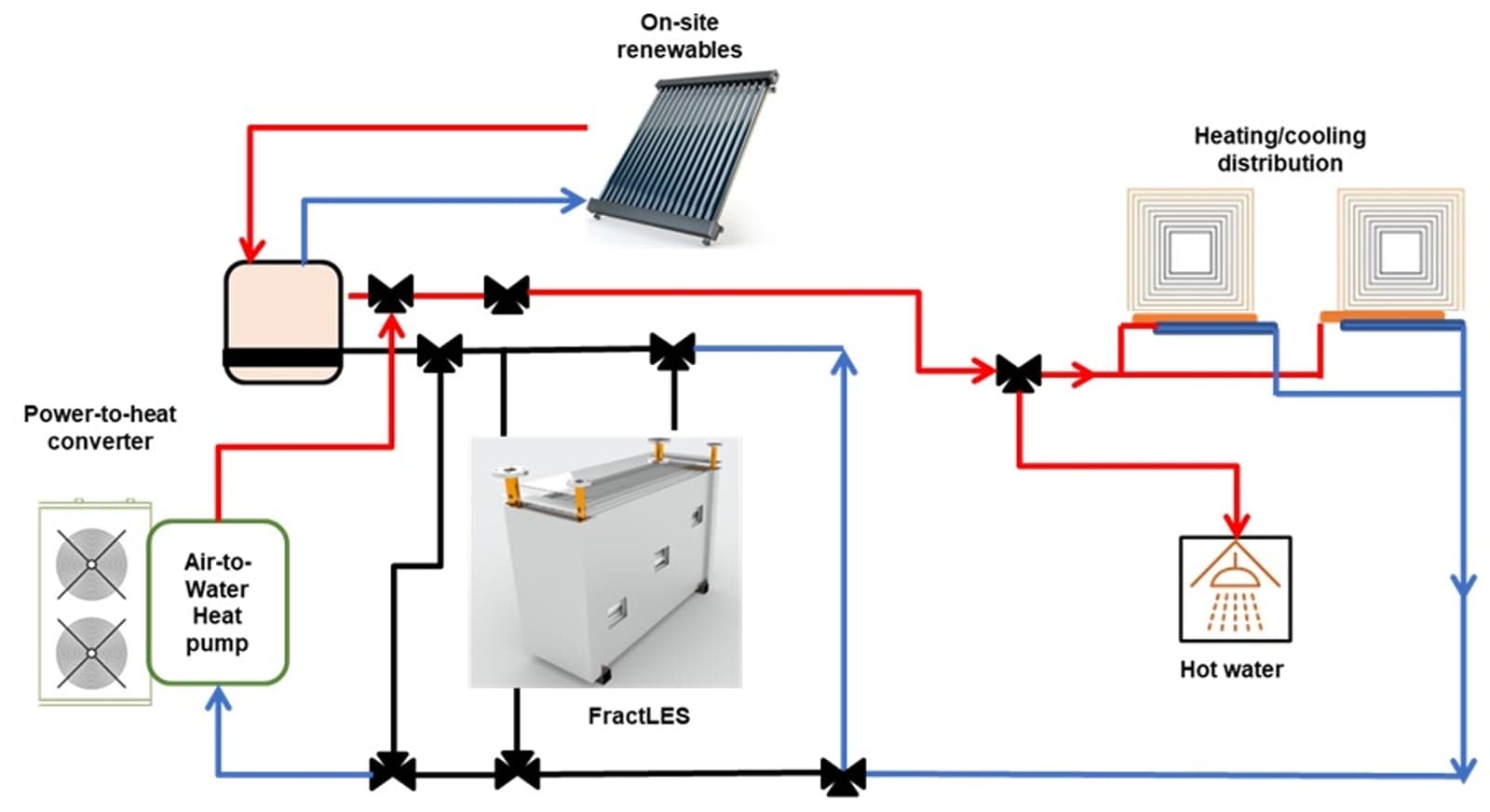
To enhance building energy efficiency, ThumbsUp project partners are developing two modular solutions: FractLES and SorTES technologies.
FractLES, based on phase change materials, is designed for heating, cooling or domestic hot water, with each unit dedicated to a specific function.
SorTES, utilising thermochemical materials, operates in both heating and cooling modes. By reducing electricity consumption and balancing heat pump demand, both systems enhance energy efficiency and improve system flexibility.
However, developing TES systems that are both compact and high performing is a significant challenge. In residential settings in particular, space availability is extremely limited, which means the systems must be not only efficient, but also modular, easily installable and able to operate with minimal user intervention.
Furthermore, compact TES must maintain sufficient storage capacity to be truly effective in daily and seasonal applications – a difficult balance to achieve.
To ensure high product quality, our innovation assessment and validation strategy includes advanced control rules that are under development to ensure the effective integration of these TES technologies. These rules must consider dynamic demand, PV surplus fluctuations and the timing of heat pump operation to minimise grid stress and energy waste.
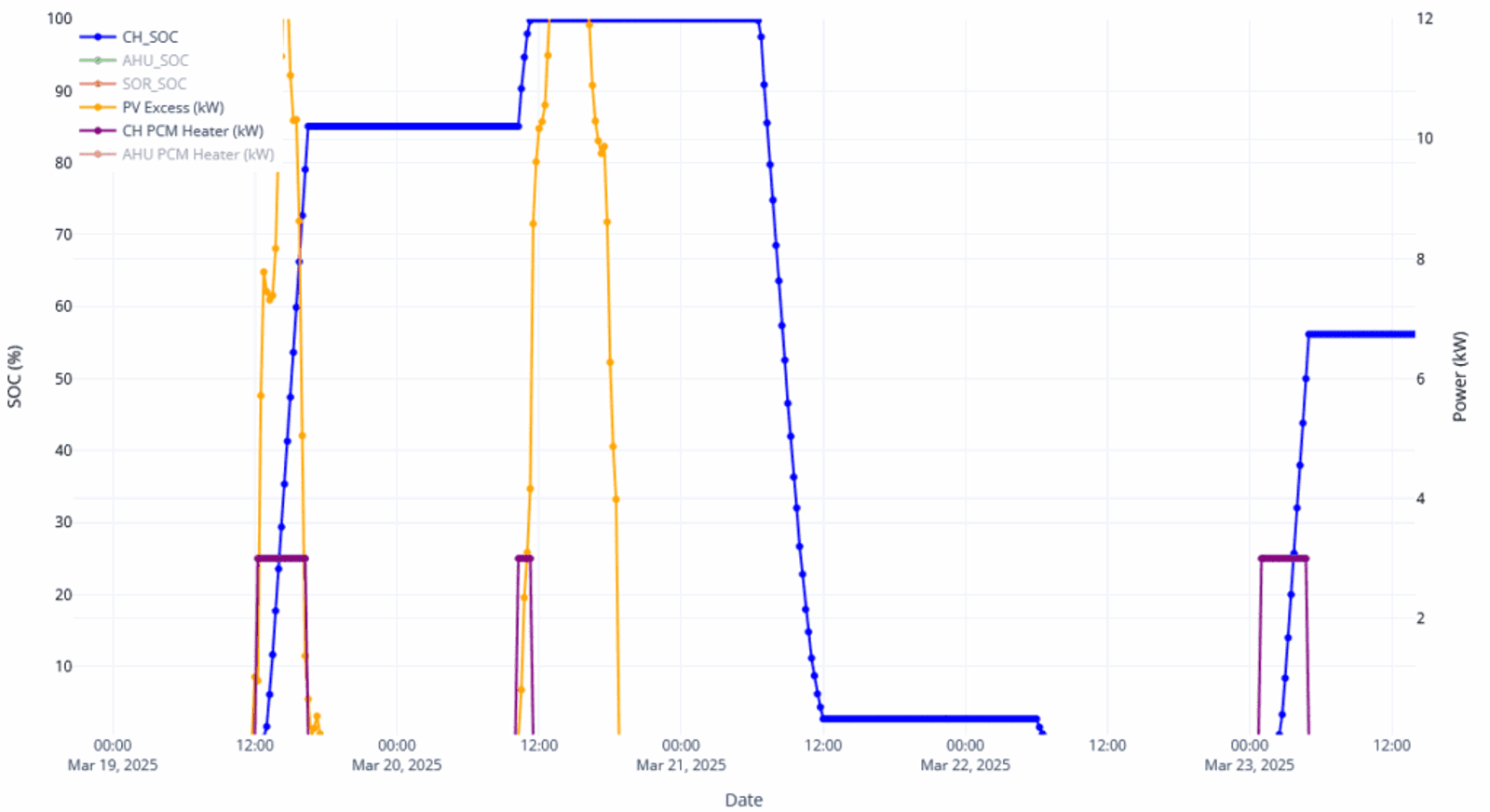
By using modular units of equal capacity, the modeling and simulation process is streamlined, allowing the number of TES modules to be adapted according to the specific thermal demands of each building, optimising energy management and improving overall system performance.
The optimisation process aims to minimise heat pump and grid electricity consumption by maximising the utilisation of PV surplus and low electricity tariffs for charging and strategically managing discharge periods as illustrated in the graph above.
From a technical standpoint, the project currently faces several key challenges:
- Ensuring thermal stability and long-term reliability of both phase change and thermochemical materials, especially under repeated charge/discharge cycles.
- Material compatibility, particularly between the storage materials and heat exchanger components such as aluminum.
- Designing control algorithms that not only maximise self-consumption of PV energy but also ensure system responsiveness to real-time demand and variable operating conditions.
To overcome the abovementioned challenges, the team is adopting a multi-pronged approach: material development, component-level testing and system-level simulations are being conducted in parallel. This allows early identification of issues and fast iteration in both the FractLES and SorTES tracks.
Moreover, the collaboration with our sister projects in the TES Cluster has been key as they are facing similar challenges. Hence, a joint workshop being organised in the framework of the ISCET Conference aims to provide the technical coordinators and other project partners the opportunity to raise common challenges and brainstorm around possible solutions – or at least compare notes on the strategies and solutions to be implemented.
This information comes from the research activities developed within the framework of the EU project THUMBS UP by all Consortium partners. THUMBS UP is an Horizon Europe project funded by the European Commission under Grant Agreement Nº 101096921.
About the author

Juan Carlos del Castillo holds a BSc and MSc in Engineering from the University of Valladolid. He is a researcher at CARTIF Technology Centre, working on national and European R&D projects focused on district heating networks, energy modeling and facility design, with six years of experience in particle analysis within EU projects.
Most popular
Join the community for freeAnd get access to all content
Related projects
THUMBS UP
1 January 2023 - 31 December 2026
View project