Costa Rica and Panama lead green hydrogen ambitions in central America
Jonathan Spencer Jones
Posted on: 25 January 2022
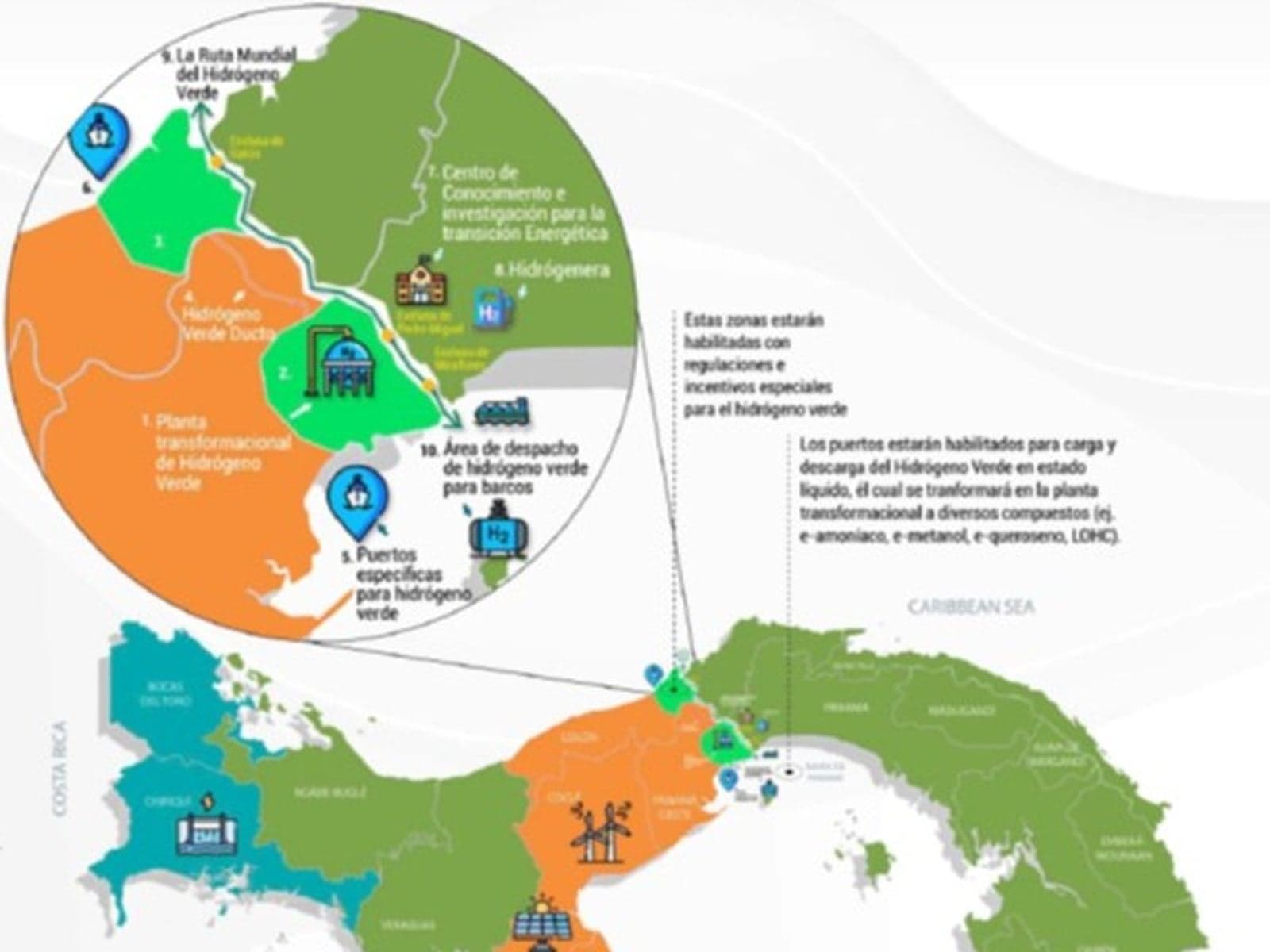
Panama is looking to become a leading player as a 'hub' and 'route' in the future global green hydrogen market.
Panama is looking to become a leading player as a 'hub' and 'route' in the future global green hydrogen market.
In a new Green Hydrogen Roadmap, Panama’s energy ministry indicates that with its location and the availability of the Panama Canal, the country can position itself as a ‘global green hydrogen route of excellence’ with Panama itself as a hydrogen ‘hub’.
This Panama H2UB would include facilities for the production of green hydrogen and other derivative products such as ammonia and methanol coupled to storage facilities in free zones at the two ends of the Panama Canal for export to Europe and Asia via the Atlantic and Pacific oceans respectively.
Possible volumes of green hydrogen and derivatives that could be shipped via the Panama Canal are suggested at 81.8Mt by 2030 rising to almost 191Mt by 2050.
“Hydrogen is a commercial opportunity for the country and the region in a market with expectations of the development of new technologies,” says National Secretary of Energy, Jorge Rivera Staff.
Have you read?
Chile – $50 million for green hydrogen development
Pink hydrogen – OKG to supply out of Sweden
The Hydrogen Factor – changing global energy dynamics
“In addition, it will allow decarbonising other sectors of the economy, such as industry, agriculture, land and air transport, supporting the fulfilment of the objectives of reducing greenhouse gas emissions of the Panamanian state."
The Green Hydrogen Roadmap sets out the intention to develop a hydrogen strategy in Q3 of 2022 and to start planning of the infrastructure, with the detailed analysis to be completed by the end of 2023.
In addition, work will be undertaken on issues such as policy, regulation and standards, and education and research initiatives will be launched.
Proposed pilots for green hydrogen include the powering of city buses and a test station for bunkering.
The Roadmap, which was supported by the Inter-American Development Bank (IDB), states the intention to involve a wide range of stakeholders in the plan and also to seek cooperation for its ambitions with other countries in Latin America and the Caribbean.
Costa Rica – green hydrogen for decarbonisation
While Panama has its eye on the export market alongside the internal requirements, Costa Rica’s proposals are focussed on national decarbonisation with an export potential a possibility in the longer term.
A decree signed just before Christmas seeks to encourage and take advantage of hydrogen to spur a green economy utilising surpluses in the National Electric System.
In particular, the focus is on the transport sector, which is responsible for about two-thirds of the country’s greenhouse gas emissions, as well as industry.
Commenting on the initiative at the decree signing, Andrea Meza, Minister of Environment and Energy, stressing the importance of hydrogen in the country's decarbonisation, said: “Costa Rica has the talent and the human and natural resources to accelerate its decarbonisation processes and what we do in this decade is decisive.”
She added that as part of the national strategy, the possibility of insertion of Costa Rica in the global hydrogen chain will be contemplated.
Have you watched?
Leipzig coal power station turned into hydrogen-ready CHP plant
Stimulating the growth of Europe’s green hydrogen economy
In terms of the decree, the public services regulator ARESEP is required to develop a regulatory framework to enable the distribution companies to take advantage of the surpluses, while the distribution companies are required to design the requisite commercial management models.
Support for the development of Costa Rica’s green hydrogen activities is expected from Masdar, following A recent meeting between the country’s President Carlos Alvarado and Masdar CEO Mohamed Jameel Al Ramahi.
With these developments Panama and Costa Rica are leading the green hydrogen charge in central America, joining Brazil, Chile, Colombia and Uruguay which are advancing in the southern Cone. The main proponent so far in the Caribbean is Trinidad and Tobago, which has a long-standing ammonia production and export industry.