How digitalisation is pushing the envelope of conventional energy engineering
Louise Davis
Posted on: 28 October 2025
Traditional disciplines are being transformed into state-of-the-art, data-driven methodologies.
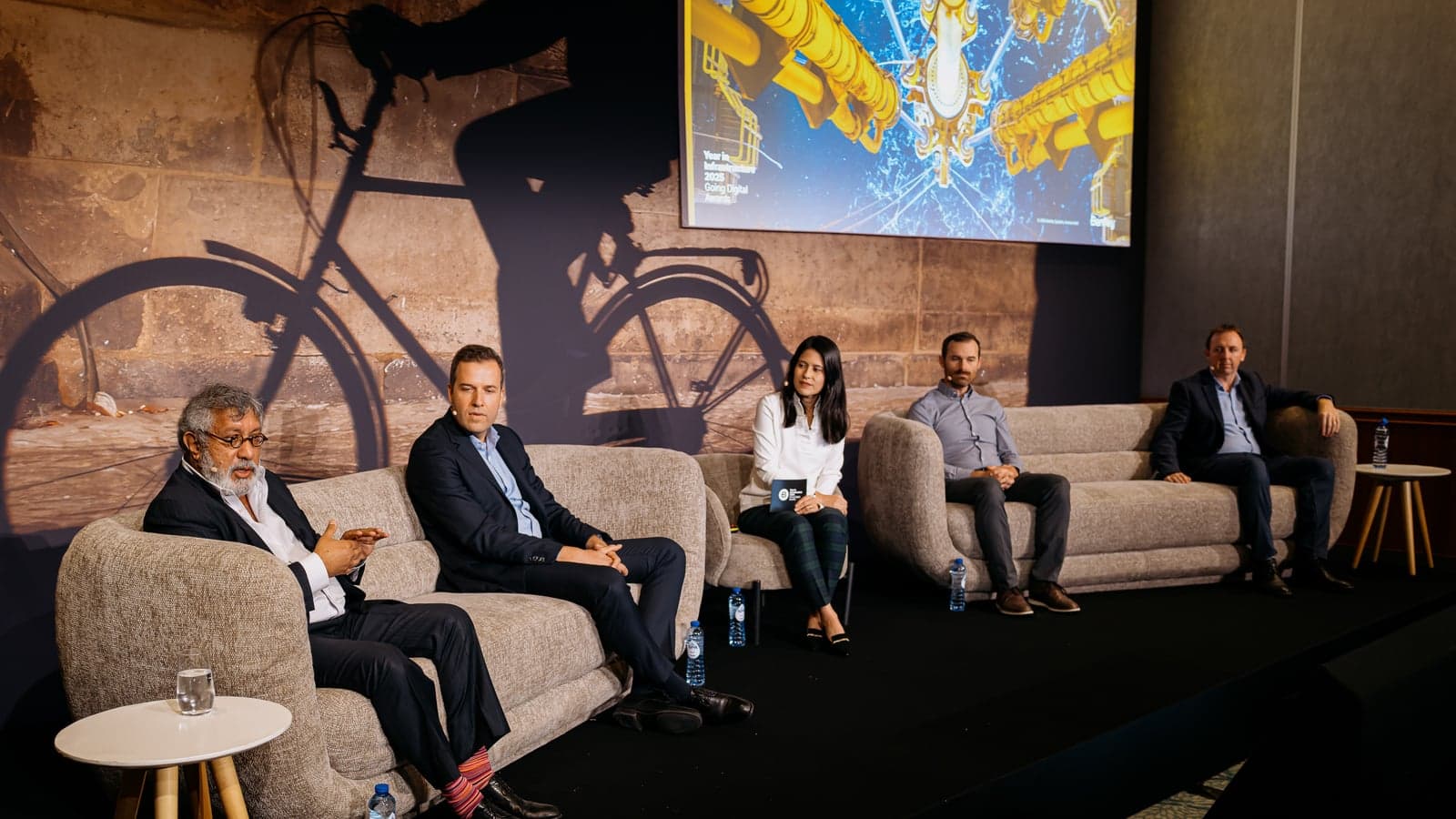
The ways in which digitalisation is transforming and advancing traditional forms of energy generation was highlighted at Bentley Systems Year in Infrastructure 2025 event in Amsterdam.
Graham Openshaw, digital operations director at engineering consultancy Assystem, was particularly enthusiastic about the opportunities the energy transition is presenting in the nuclear sector.
“It’s a very exciting time to be in the nuclear industry. In the time that I've been involved in nuclear, it's gone from a very static, almost declining industry, to one that's presented as the cornerstone and the great hope for the future of the planet.”
Openshaw highlighted a project close to home as a prime example of the modern approach to nuclear power: “In the UK, Hinkley Point C is the gigawatt-scale plant that we're currently building.
“It was due to be delivered this year and although there have been a few headwinds associated with Brexit, Covid and number of design changes, this project really is the pathfinder across the whole industry in terms of digital innovation.”
Putting his last comment into context, Openshaw noted: “The last time the UK commissioned a nuclear power plant was 1995. Back then, email was just emerging, and we didn’t even have digital imaging capabilities everywhere.”
In contrast, he detailed: “The Hinkley Point C team is fully committed to digital. And their information architecture is now such that the idea is they’ll effectively be able to ‘copy and paste’ their designs to roll out other new nuclear plants in the future.”
Wary of making this digital revolution sound easy, Openshaw did concede that success with digital tools depends firmly on high-quality data – and its interoperability.
“One nuclear site can have 7,000 rooms in it, each with a distinct system or purpose. The complexity is enormous and making sure data is interoperable is critical.”
He also observed that alongside data, regulation is also extremely important: “A 7,000-room site means people put together 7,000 design changes for that site. As the industry moves into a more innovative space where replication is planned, we have a regulator that bases their decisions on empirical data – for instance, how do you make it a safe decision or something that's never been done before?
“So, we have to start using more digital technology and conducting more simulations to answer those types of questions across the value chain.”
Nuclear has gone from a very static, almost declining industry, to one that's presented as the great hope for the future of the planet.
Replicating success stories from elsewhere is an area of focus for Steven Fercho, exploration geoscience manager at Fervo Energy. Fercho described how Fervo is “taking many innovations that have been developed in the oil and gas industry – such as horizontal drilling and hydraulic simulation – and applying them in a new way to geothermal, to help us open up the number of places where geothermal energy is viable.”
Like the other leaders presenting at Bentley’s event, Fercho cites digital tools as being the technology enablers of the energy transition. “When I first entered the industry almost two decades ago, many people were still using maps and cross sections to model the subsurface,” he recalled.
“Although this can work for smaller projects and similar geologies, at Fervo, we're building large-scale projects with dozens and dozens of horizontal wells spread out across an area.”
Summarising the overall benefit of this new approach to data and modelling, he stated: “It reduces costs on our projects, which ultimately makes this clean energy more available to everyone.”
Alberto Iniesta Serrano also focused on the sustainability benefits that digitalising the energy sector can bring. The digital twin director for EMEA and APAC at Worley Consulting reported that his company has been involved with around 6,000 projects related to sustainability.
“They span everything from green hydrogen to blue hydrogen, offshore wind and solar. Next year, 75% of our revenues will come from sustainability related projects.”
More insights from Bentley Systems Year in Infrastructure 2025:
Digital drivers of the future energy mix and workforce
Bentley Systems betting on AI for collaboration-enabled grid resilience
Iniesta Serrano believes that digital twins are currently the most valuable part of Worley’s digital toolbox. “Digital twins are helping to take different data sources and provide better contextualised information at the right time.
“We are seeing large impacts in terms of efficiencies regarding how engineers interact with each other. When all disciplines are able to have a single view of a design, then that design becomes less prone to errors,” he stated.
Processes also become much quicker: “Engineering design rates can go faster, and we also see a hastening of progress during the move from engineering design to procurement and construction.”
Efficiency is another significant gain, according to the digital twin expert: “Across the board, we are much more effective in how we manage resources – whether those are personnel or materials. Also, if any unplanned scenarios happen in the field, we're able to react much faster and better.”
We are seeing large impacts in terms of efficiencies regarding how engineers interact with each other. When all disciplines are able to have a single view of a design, then that design becomes less prone to errors.
And these speed and efficiency gains can be found throughout a project’s lifetime, as Vaseem Khan used his presentation to point out. Khan is senior vice-president for global operations at McDermott, an engineering and construction company whose tagline, ‘Building energy’s future’, nicely explains its focus.
Khan observed that what has changed most in recent years “is that technology today allows us to create a continuum in engineering, rather than discrete working, and it allows us to use this digital thread to collaborate across projects”.
Khan cited a real-world project in British Columbia as an example of such progress. “It's an LNG project in a very remote location – the only way to get there is by boat. The project is being managed out of Houston, Texas. The engineering is in Mexico City and New Delhi. The supply chain is global: we're buying compressors from Germany and big substation equipment from China and India,” he explained.
“How do we manage all of these stakeholders and how do we ensure that everyone is looking at the same data? By setting up a digital thread that allows everyone to share and to collaborate in the same environment right from the start of the project. Without that, the approximately 7,000 people we have on this project from British Columbia to Qingdao, China would not be able to access information in real time.”
Although he praises the work already being done, Khan’s global outlook makes him well equipped to spot weaker links in the digital chain, such as those players who aren’t yet relying on advanced software tools.
He noted: “In a typical energy project, what's not working is the data interface; what we send the supplier and then what we get back from the supplier. It doesn't work because we don't always have interoperability – we don't have an open network. Some of the suppliers are not sophisticated; data comes in as AutoCAD COIN, a PDF or a Word doc.”
In terms of getting all players on side with the digital revolution, Khan says it’s important for those who are already deploying digital solutions to continue using them – as well as shouting about their benefits.
“We need to keep these digital tools alive for a project’s lifecycle. It’s not only about using the earlier stage process simulation tools; we also need to use digital tools with appropriate sensors built in to improve production.
“And we need to clearly explain to all stakeholders the results being achieved – in terms of improved production and cost savings – by the use of such tools.”
Looking ahead, Khan also emphasised the need to deploy more predictive software solutions. “It’s always easier to keep a train on the tracks than it is to put it back on the track after it's fallen off. For multi-billion-dollar energy projects, it’s a heck of a lot cheaper in the long-term to keep our trains firmly on their tracks. So, Bentley, please give us a tool that helps us see around corners,” he laughed.