Progress and problems of decarbonising shipping and ports
Jonathan Spencer Jones
Posted on: 10 July 2026
EU young energy ambassadors Laurens Dourleijn and Veronika Slakaityte give their insights on the decarbonisation of shipping and ports.
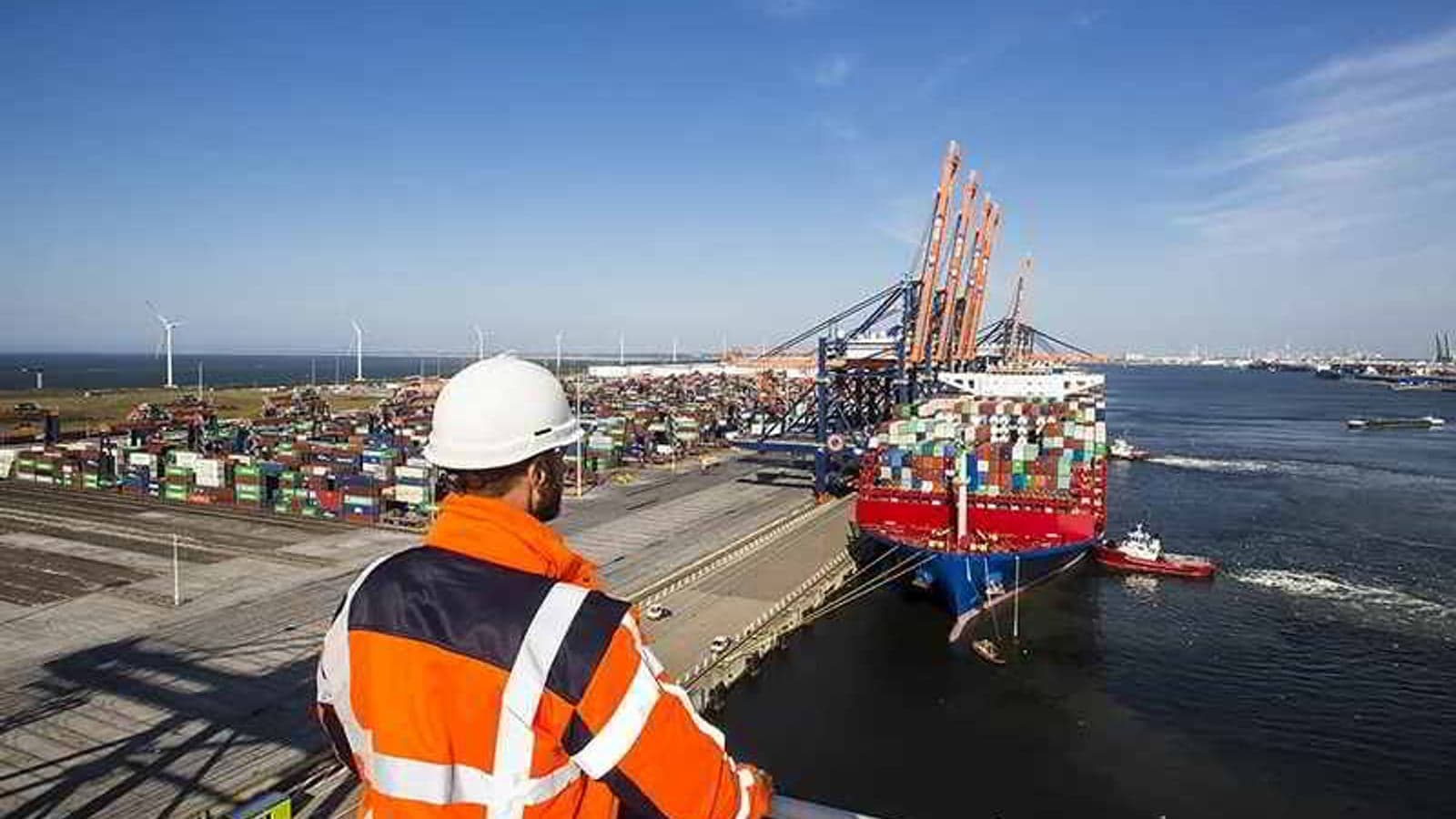
Shipping in Europe and globally accounts for only around 3% of global greenhouse gas emissions, and 10% of those are from the transport sector.
Add in ports as an essential infrastructure, and the decarbonisation of this broader maritime sector is key in the steps towards a net zero world.
“It’s not as fast as it should be – and that’s because it’s very difficult to do,” says Laurens Dourleijn, Sustainability Manager at the Rotterdam-based Samskip, an international container shipping and logistics company.
For example, for shipping there are many different fuel options on the table like biofuels, methanol, ammonia, ethanol and hydrogen.
“That’s slowing down progress, as every fuel needs its own infrastructure and supply chain. This infrastructure, like pipelines and bunkering stations, is widespread for fossil fuels. But for these alternative fuels, it puts ports in a difficult position; what to choose?”
He adds that a few brave companies are moving forward with low carbon fuels in vessels.
“But overall it’s an industry that does not like to take risk and moves slowly. Luckily, there is strong policy in place with the EU ETS putting a price on carbon, and the FuelEU Maritime forcing shipping companies to reduce the carbon intensity of fuels used on board. This policy is clearly driving decarbonisation for maritime shipping in the EU."


Veronika Slakaityte, a Lithuanian energy policy researcher and Marie Skłodowska-Curie PhD Fellow at Chalmers University of Technology, concurs, saying that uncertainty has become one of the defining characteristics of the energy transition.
“This is particularly evident in ports, whose strategic importance has expanded well beyond their traditional role as gateways for trade.”
Highlighting that the recently adopted EU ports strategy recognises ports as critical infrastructure underpinning Europe’s competitiveness, security, resilience and clean energy transition, she continues:
“Ports are expected to prepare simultaneously for electrification, renewable fuels, carbon management, offshore wind and new industrial activity, despite considerable uncertainty over the pace, scale and interaction of these transition pathways.
“Investments in grids, terminals, storage and fuel infrastructure cannot wait for this uncertainty to be resolved. They must be made years – often decades – before markets, technologies and regulatory frameworks have fully matured.
Hydrogen in shipping
Dourleijn’s role at Samskip is multi-faceted, encompassing strategy development to project management to compliance and commercialising the sustainable projects.
“For me, the first step to reducing emissions is not fuel change but it’s looking at the way our network is set up,” he says, citing that a truck driving with one container emits about five times more greenhouse gases than the same container on a ship.
“Just by switching cargo from road-only transport to ‘multimodal’ [making use of different types of transport], we reduce total CO2 emissions by up to 80% without any investments in alternative fuels. Of course, this modal shift is not enough to meet our climate ambitions, but it is the critical first step.”
MORE PORTS CONTENT
Anchoring the EU ports strategy: BilbOPS as a working pilot
Floating hydrogen power hub for shipping validated in UK
Dourleijn says one of his most notable projects currently is the development of the what he calls the “world’s first hydrogen powered container ships”. These ‘Samskip SeaShuttles’ are planned to sail on liquid green hydrogen to create a green corridor between the ports of Rotterdam and Oslo.
“Whichever way we go, hydrogen will play a role in maritime shipping and beyond that in the European energy system. It can be used in liquid form to power ships cleanly, as we are showing at Samskip.
“And other so-called ‘e-fuels’ like green methanol and ammonia are directly derived from hydrogen. Since it can be produced locally from green electricity, and imported from countries with surplus wind and solar, it will form the backbone of a strong and resilient energy system.”
He also notes that these fuels have different use cases. For example liquid hydrogen is best suited for medium distance container transport, while longer distance deep-sea shipping is moving to ammonia and shorter river crossings can go electric.
Electrification is one of the few transition pathways for which the direction of travel is already well established.
Port challenges
In addition to the uncertainty challenge facing ports, Slakaityte cites others as synchronising investment across the emerging value chains that will underpin the maritime energy transition and ensuring that the enabling infrastructure keeps pace with regulatory ambition.
“Electrification is one of the few transition pathways for which the direction of travel is already well established,” she says.
Commenting that the EU has reinforced this trajectory through the Alternative Fuels Infrastructure Regulation – which requires shore-side electricity for container and passenger ships of 5,000GT and above or deployment of a qualifying zero emission technology while at berth at core TEN-T ports by 2030 – she says that implementation remains uneven, with only around 40% of those ports currently providing shore-side electricity.
At the same time, electrification is only as effective as the electricity system that supports it, she says.
“Ports are increasingly expected to accommodate shore-side power, industrial decarbonisation and, in many cases, future hydrogen production, placing them at the centre of growing competition for grid capacity. The challenge is therefore not only deploying new technologies but ensuring that electricity infrastructure and network planning evolve quickly enough to support the strategic functions ports are increasingly expected to fulfil.”
Ultimately, the challenges facing ports are no longer purely technical as they are increasingly expected to deliver on energy, industrial, climate, security and competitiveness objectives simultaneously, she adds.
“Successfully navigating the transition will therefore depend not only on technological innovation or infrastructure investment, but on governance frameworks capable of coordinating infrastructure planning, market development and policy across sectors that have traditionally operated independently. The challenge is no longer simply to decarbonise ports, but to govern their transformation into resilient, competitive and strategically important energy hubs.”
Policy recommendations
Both Dourleijn and Slakaityte offer recommendations for policy makers.
Strong policy is the answer but we don’t have to start from scratch, says Dourleijn, noting that the Emission Trading System is putting a price on CO2 emissions, the FuelEU Maritime is forcing shipping companies to use lower carbon fuels, the Renewable Energy Directive introduces targets to deliver low carbon fuels to the grid and the EU Innovation Fund helps with funding innovative, low carbon projects.
“This should be seen as a complete landscape and every piece helps to bridge the gap between fossil fuels and alternatives. But we are not there yet as policy is not strong enough to significantly bridge the gap and shipping companies cannot take the risk to gamble on an alternative fuel and lose.
“I’m calling for better alignment between all policies, with a stronger focus on the logistics sector in general, e.g. awarding multimodal setups, and introducing risk reduction measures for those first movers that help to build this new economy.”
I’m calling for better alignment between all policies, with a stronger focus on the logistics sector in general.
In a similar vein, Slakaityte says her key recommendation is to treat ports, energy systems and maritime transport as components of a single transition rather than as separate policy domains.
“This requires policy makers to provide long-term regulatory certainty and align energy, industrial and transport planning; it requires shipping companies to continue creating credible demand for low carbon fuels; and it requires ports to strengthen regional cooperation rather than pursuing identical infrastructure strategies.
“At the same time, ports must be recognised as critical energy infrastructure not only in legislation, but also in practice, with this status reflected in resilience investments, grid connection priorities and national infrastructure planning.”
Finally, she adds, while the EU has played an important leadership role, shipping is a global industry and ultimately requires globally coordinated regulation.
“European action can accelerate the transition, but only a robust and predictable international framework under the IMO will provide the market certainty needed to unlock investment at the scale and pace required.”
The European Commission’s ‘Young energy ambassador’ programme involving 30 young people for a one-year mandate is aimed to increase the involvement of young people in the European policy-making process related to sustainable energy, boost their interest and impact in clean energy and recognise and reward their contributions to the energy transition.
Laurens Dourleijn is interested in the interplay between business, strategy and policy for a stronger, more sustainable Europe and as a Young Energy Ambassador, aims to bring his perspective on the energy transition in shipping and logistics to EU policymaking, as well as a wider view on the strategic positioning of Europe through the energy transition.
Veronika Slakaityte’s research examines how EU clean energy ambitions are translated into infrastructure decisions, with a particular focus on ports as sites where emerging energy carriers such as hydrogen and e-fuels are negotiated and implemented. Her work situates such developments within broader debates on how decarbonised energy futures are shaped and constrained by (geo)political pressures and infrastructure realities.
Related tags
Most popular
Join the community for freeAnd get access to all content