Iron could be the answer to Germany's hydrogen requirements shows report
Pamela Largue
Posted on: 1 November 2024
A report released by DNV shows producing hydrogen from iron could be a promising| cost-effective way to meet Germany's green hydrogen needs.
A report released by DNV on behalf of the Climate Neutrality Foundation shows that the production of hydrogen from iron could be a promising, cost-effective way to meet Germany's green hydrogen needs.
According to the report, backup power plants that produce electricity with hydrogen based on imported green iron are likely to be more cost-effective than power plants that use green hydrogen from a German or European pipeline network or plants generating electricity from hydrogen from cracked green ammonia.
DNV's analysis breaks the costs down according to three different scenarios and includes elements of the value chain such as: generation, transportation, storage, and reconversion to electricity:
- Electrolysis in Germany: Domestic generation generates costs of €425/MWh,
- Import of green ammonia: At 581€/MWh, this value chain has the highest costs of the three methods compared, mainly due to the very high costs of ammonia cracking and the higher costs of ammonia storage,
- Import of directly reduced iron (DRI): With electricity generation costs of €402/MWh, this method of H2 provision has the potential to generate the lowest costs of the three value chains examined. In addition, DRI is also suitable for long-term storage and enables the decentralised supply of hydrogen, even at locations without a connection to the H2 backbone.
CNF Director Rainer Baake: "The production of hydrogen from iron is extremely promising. Green iron is an energy storage medium that can be stored relatively easily and cost-effectively and can be used to produce large quantities of climate-neutral hydrogen at the power plant site as required."
Have you read?
RWE secures permits for Eemshaven electrolyser project
UK Chancellor unveils green hydrogen commitment in Budget
Currently, a pilot project called HyIron is being built in Namibia to trial the direct reduction of iron ore using hydrogen produced with very cheap electricity from solar PV. Production is scheduled to start at the end of 2024.
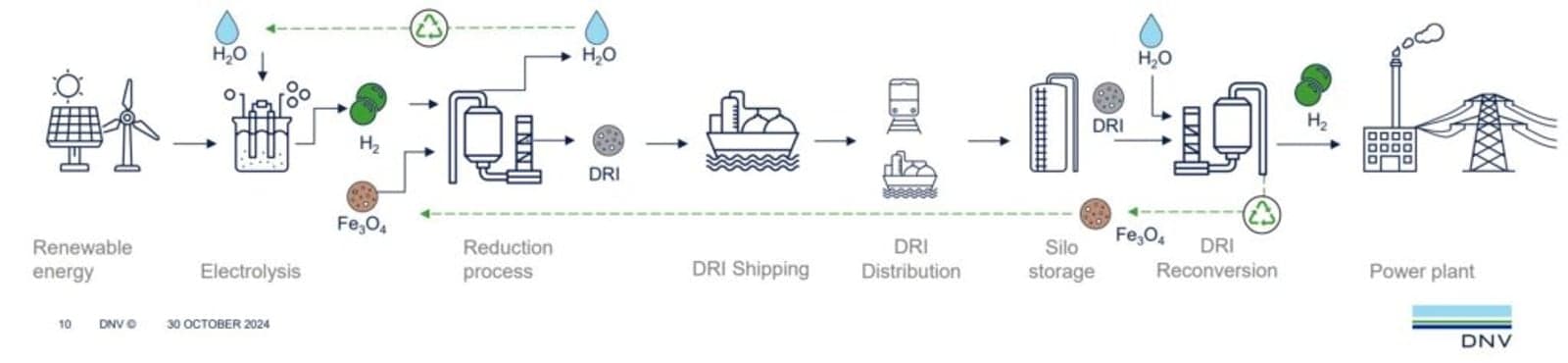
HyIron will pilot the following processes:
- Production of hydrogen from renewable energy
- Reduction of iron oxide using the green hydrogen to produce DRI
- Water, formed in the reduction process, can be recycled and fed back to the electrolyser
- Transport of DRI to Germany by ship (overseas) and distribution by ship or rail (in Germany)
- Local storage of DRI at the power plant in silos
- Reconversion of DRI through oxidation using water. H2 comes from the added water, while the oxygen is combined with the DRI to form iron oxide
- Some storage of hydrogen is likely required as a buffer while the reduction process starts
- Combustion of hydrogen in a hydrogen-fired power plant to support the German electricity grid
- Iron oxide is transported back to Namibia to be re-used in the same process.
Based on the report, CNF suggests iron-to-hydrogen is a versatile option, suitable for decentralised backup power generation, safe and energy efficient.
However, there are potential limitations to the strategy. The availability of pipeline hydrogen and green iron will play a role in ensuring a resilient supply chain and costs might vary depending on the generation, transportation and storage components.