Is nuclear power more risky than renewables?
Pamela Largue
Posted on: 2 May 2024
It's no secret that nuclear has suffered a bad reputation, but do nuclear power projects pose greater risks than their renewable counterparts? Dr Sama Bilbao y Leon weighs in.

It's no secret that nuclear power has suffered from a bad reputation regarding safety, cost and the length of time taken to bring projects to fruition. But do nuclear power projects pose greater risks than their renewable counterparts?
According to Dr Sama Bilbao y Leon, Director-General of the World Nuclear Association, nuclear is no more or less risky than any other clean energy technology. It's all a matter of perspective, and perspectives of countries, media and individuals are changing.
"Luckily for nuclear, the way nuclear is perceived and understood has radically changed in the last three and a half years...There is much more appreciation and recognition of the role of nuclear energy today."
Bilbao y Leon explains that when it comes to nuclear (as with many other sectors), unsuccessful projects make the headlines, while projects that are on time and on budget are considered "boring" and stay out of the news.
"I don't know that it's true that nuclear is more lengthy or more costly than other green energy infrastructure. In fact, if you look at history, the fastest decarbonisation has been achieved with nuclear energy..."
Have you read?
Harnessing AI in renewables, power and nuclear
Small modular reactors: The key to decarbonising the industry sector in the European Union?
Common challenges
Bilbao y Leon referenced some of the challenges experienced in the renewable energy space, such as regulatory framework challenges, permitting problems, financing constraints and workforce limitations.
Nuclear is facing similar struggles, she says, which is why the World Nuclear Association and the Emirates Nuclear Energy Corporation formed the Net Zero Nuclear initiative at COP28.
The goal of the initiative is to unite the industry, government and civil society behind tripling nuclear capacity by 2050, and to illustrate the importance of nuclear in the context of climate change and decarbonisation.
Bilbao y Leon is seeing growing support from governments through energy policies that create a level playing field for nuclear, providing similar opportunities as those provided for other clean technologies.
"We are working with governments to translate energy policies into industrial policies because now we really need to develop the industrial infrastructure, capabilities, supply chain, the workforce that is going to be needed to deliver this clean energy."
As with wind and solar, there are challenges like permitting that hinder projects coming to fruition quickly, which is why optimisation of the regulatory framework for nuclear facilities is critical, emphasises Bilbao y Leon.
The World Nuclear Association is also working with the finance community to ensure nuclear is included in climate finance frameworks, and working with the academic community to attract workers needed, as well as retraining and reskilling those in the fossil fuel sector with relevant skills for nuclear.
Listen to:
Energy Transitions Podcast: Rebranding nuclear power
Nuclear, like other industries, is currently challenged to find the professionals needed to drive scale-up at speed, says Bilbao y Leon.
And in terms of inclusivity, she adds: "Right now...there is much work to be done..."
The nuclear industry is working to inspire young people to get involved in the sector, as well as attract and retain women, evidenced by the recent agreement signed with the International Atomic Energy Agency to incentivise engagement of women in the industry.
Next-gen nuclear alongside renewables
While nuclear faces challenges such as skills shortages and regulatory headwinds, the sector is clearly gearing up to take its place in the future clean energy mix by tackling real and perceived risks.
Bilbao y Leon referred to new technologies and delivery models that will help speed up decarbonisation. For example, the potential for SMRs to decarbonise industry, heating and cooling.
And while nuclear (compared to fossil fuels or renewables) has always been the safest energy source per KWh produced, the sector is doing even more to enhance safety and sustainability throughout the value chain.
The use of AI, digitalisation and advanced manufacturing is making nuclear more cost-effective and faster to deploy, says Bilbao y Leon, adding that these new technologies are also helping to maximise nuclear fuel and promote circular economy.
Also of interest
Poland’s next-gen nuclear programme projected to deliver significant economic benefits
DOE releases coal-to-nuclear information guide
Says Bilbao y Leon, "Used nuclear fuel and nuclear waste...make nuclear energy very good news because what we are doing is from the beginning having this closed circular economy trying to make sure that we make the most of the resources that we have."
The industry is currently working on recycling and reprocessing nuclear fuel and using innovation to minimise raw materials use and waste produced that needs to be disposed of.
Nuclear is one of the few technologies that can produce abundant, 24/7, fully dispatchable, carbon-free energy, says Bilbao y Leon, a fact that makes nuclear power a perfect fit for our future energy mix and complementary to renewables.
“I think that the nuclear industry…[is] trying to make the most of all this innovation and all these new technologies…and trying to incorporate them to continue enhancing safety and security as much as possible but also to make nuclear power plants more cost-effective.”
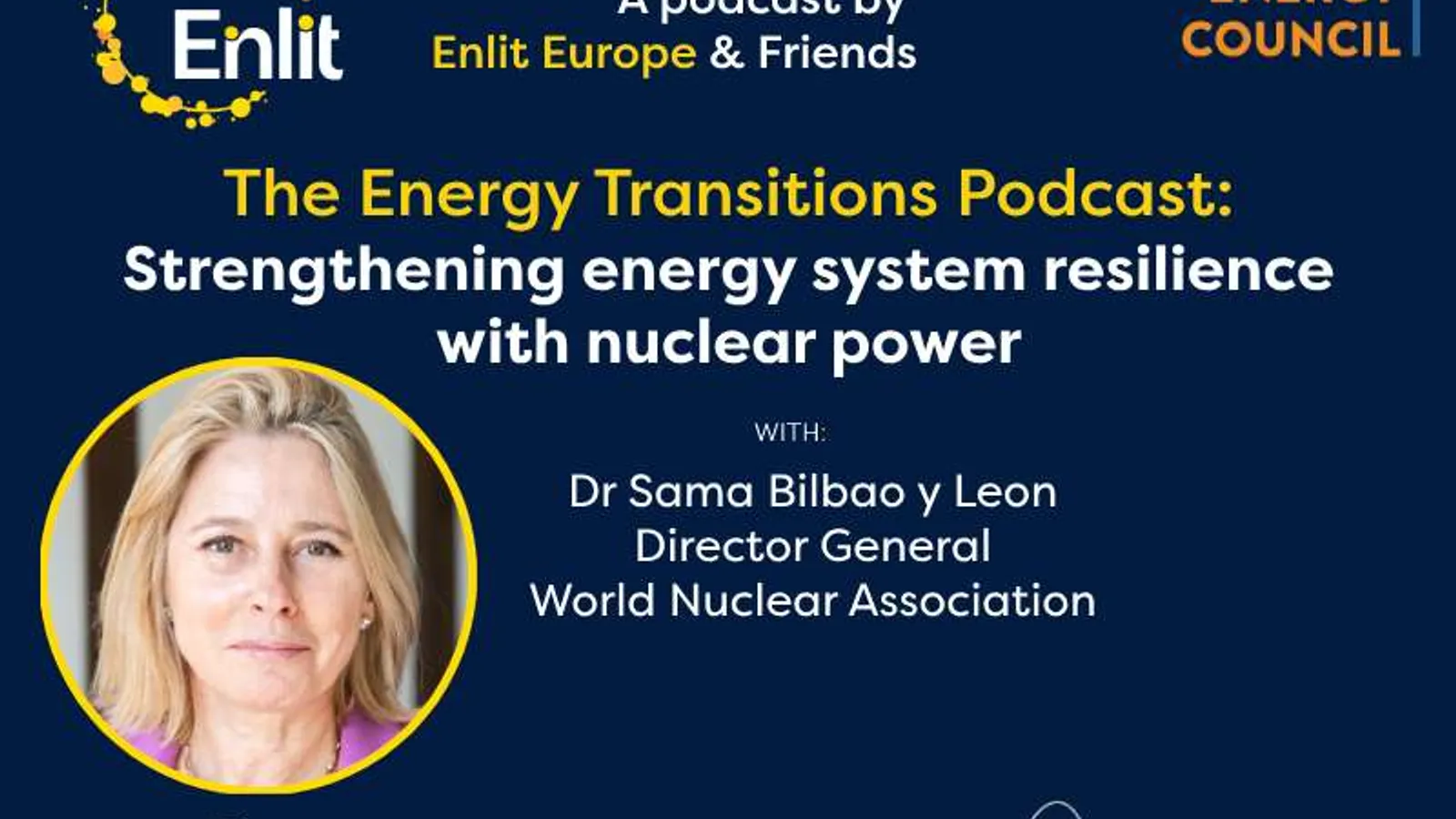
Listen to the full conversation with Dr Sama Bilbao y Leon in this episode of Enlit's Energy Transitions podcast.
Related tags
Latest content
+2
Energy Transitions podcast: Dr Sama Bilbao y Leon - Strengthening energy system resilience through nuclear power
Nuclear power been producing fixed base load around the clock for decades and is now embracing circularity, innovation and sustainability, making it a good fit for our future energy mix.
- Pamela Largue
- 16/04/2024