Why few EU countries generate nuclear energy
Areti Ntaradimou
Posted on: 26 April 2023
EU projects zone in numbers: why only 13 member states generate nuclear energy and why others are considering it.
... and why other member states consider adding nuclear to their energy mix.
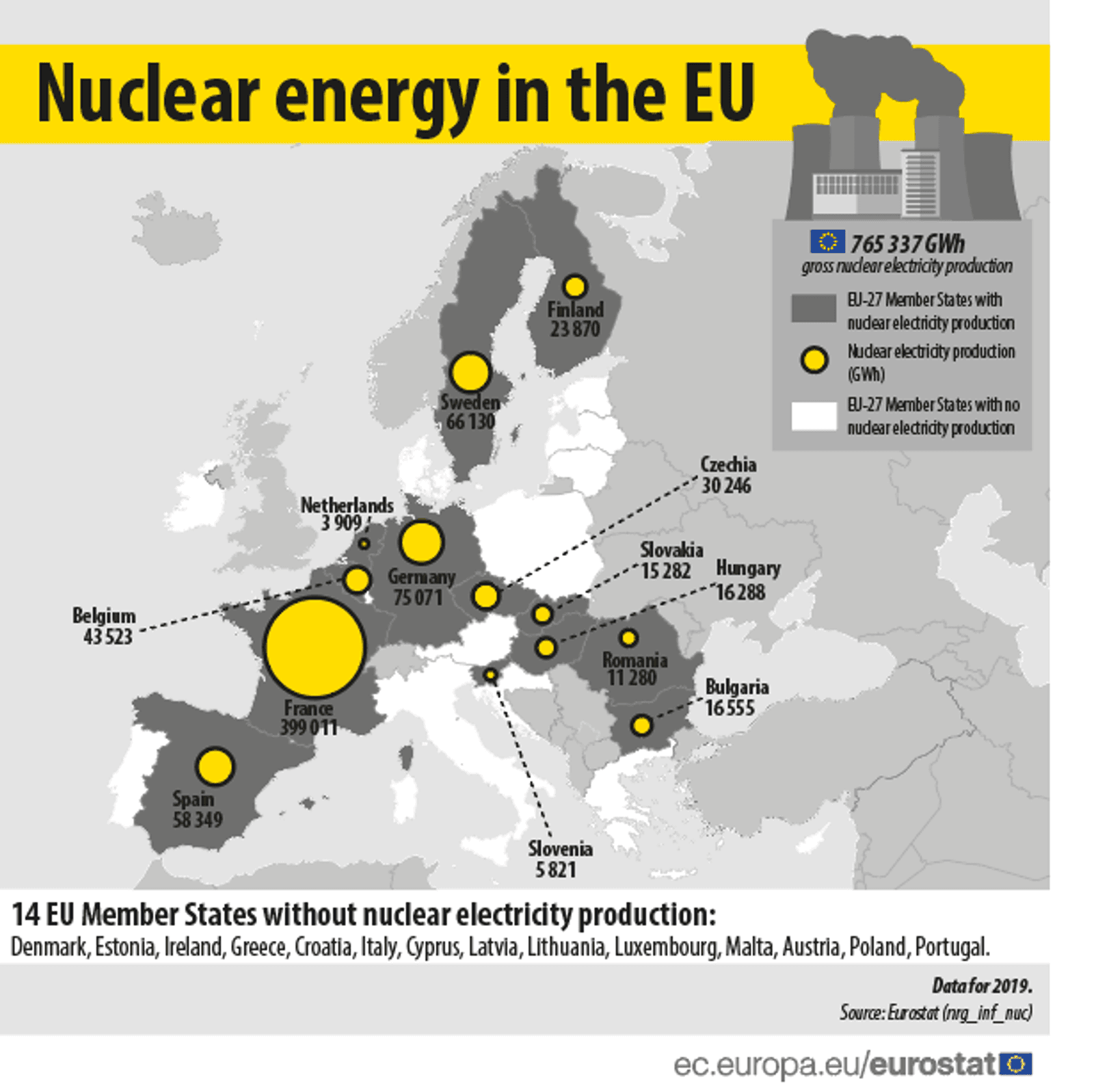
According to Eurostat, the 103 nuclear power reactors (100 GWe) operating in 13 of the 27 EU member states account for about one-quarter of the energy production in the EU.
And specifically, nuclear plants generated around 25.2% of the total electricity produced in the EU in 2021.
In 2019, the largest producer of nuclear power in the EU was France with 399 011 GWh (52.1% of the EU total), followed by Germany (75 071 GWh or 9.8%), Sweden (66 130 GWh or 8.6%) and Spain (58 349 GWh or 7.6%).
These four countries were responsible for more than three-quarters of the total amount of electricity generated in nuclear facilities in the EU.
Since 2006, however, the total gross electricity production from nuclear power plants in the EU decreased by 16.3%, mainly due to the shutdown of nuclear reactors in Germany.
And these numbers are bound to change even more since Germany took the last three nuclear power plants off the grid last April.
That does not change the fact that, according to data from Kaila, there are more than 75 ongoing projects that are EU funded and focus on nuclear energy.
Again, France is at the top of the list of countries participating in nuclear-focused and EU-funded energy projects. Followed by Germany, Italy and Spain.
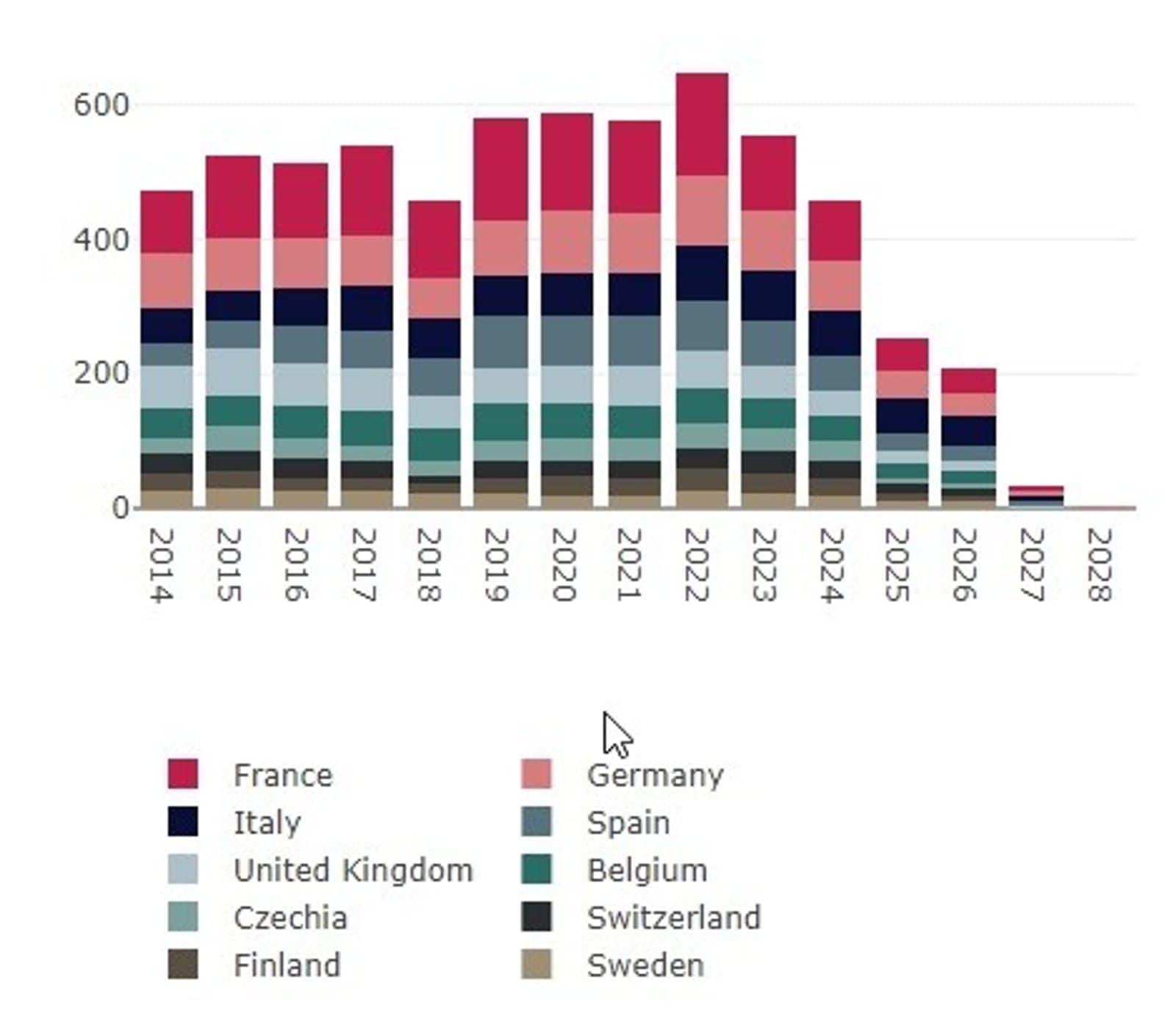
Source: Kaila.com
But, since nuclear seems to be such an "overachiever", why do only 13 EU countries generate nuclear power?
Christophe Schneidesch, EU Projects Zone Impact Circle member and Technical Director / Nuclear Research and Development Manager at TRACTEBEL (ENGIE), believes that "one must keep in mind that exploitation of nuclear technology has always been a national prerogative".
It also depends on "a variety of country-specific factors, including over a 50 years’ time frame, a series of political decisions, public acceptance and reaction to nuclear accidents, techno-economic considerations and regulatory requirements".
"Not all countries had the will and the capacity to create and mobilize all necessary resources to develop and install safe and economic power generation. While some countries made the political decision to invest heavily in nuclear power generation decades ago and to build nuclear reactors to produce electricity, other countries may not have had the same level of interest or resources", he adds.
According to Christophe, the national factors allowing nuclear are multiple.
For example:
- Capacity to develop skills and expertise to build and operate nuclear units;
- Existence of industrial infrastructure to provide a cultural and structural environment favourable to build and maintain a value chain for this technology;
- Availability of financial resources to invest in nuclear, building and operating a nuclear power plant is a huge financial investment which needs an economically viable situation and market;
- Existence of regulatory infrastructure as the construction and operation of nuclear power plants is subject to strict safety regulations, some countries may not have had the necessary resources (educational and/or financial) to put such national infrastructure in place;
- Sovereignty of energy sources, facing scarcity of own energy resources some countries have considered national nuclear power generation as a key asset for energy supply independency while some other countries may have had easy access to less capital-intensive forms of energy.
And of course, public acceptance also played an important role in the evolution of the EU power generation history. According to Christophe, "major concerns for opposition to nuclear energy are related to the potential risks associated with nuclear accidents and the disposal of radioactive waste".
"Because of that, some countries have experienced a strong opposition, which regardless of the preventive and curative actions immediately endeavoured by the nuclear industry and regulators to improve the safety of plant operation, had in some countries a detrimental impact on public opinion. Feeding anti-nuclear movement to obtain politically nuclear phase-out in countries operating NPPs (e.g. Italy after Chernobyl or Germany after Fukushima)".
Should the rest of the EU member countries adopt nuclear too?
"Scaling up renewable power generation in my opinion will not allow alone to match the enormous needs to decarbonize the whole EU power consumption, even considering technological breakthroughs both on production means as well as on consumption efficiency" says Christophe.
Then, "each country should create a comprehensive assessment of its energy needs and available resources (on any type), taking into account the competitiveness and sovereignty of its economy. And then, the decision to adopt or not nuclear power should be in principle motivated on a techno-economic basis from which a social acceptance strategy should be derived if deemed necessary".
The entire interview with Christophe Schneidesch will be published in a future issue of The List.
Related tags
Latest content
+1
How consumers are empowered to support nuclear energy
The European energy transition successfully empowers energy consumers to stimulate the deployment of renewables. In some countries, consumers are also empowered to support an alternative way to decarbonise the energy industry. They take a stand for nuclear energy, writes Patrick Bauduin.
- Smart Energy International
- 09/04/2021