Mission Possible: Tracking Europe's industrial decarbonisation
Pamela Largue
Posted on: 5 December 2024
Catherine McFarlane, Head of Sector Transitions & Insights for Mission Possible Partnership, weighs Europe’s progress in industrial decarbonisation.
Industrial decarbonisation is no doubt gaining pace, however, hard-to-abate sectors require deep decarbonisation and timely investment to ensure a healthy pipeline of commercial scale, clean industrial projects that can reach final investment decision.
Catherine McFarlane knows a thing or two about deep decarbonisation. She is the Head of Sector Transitions & Insights for Mission Possible Partnership.
According to McFarlane, in order to meet our 2050 net zero goals, we will need 700 deep decarbonisation plants up and running by 2030. That’s a mammoth task, but one that excites McFarlane, who believes that the bigger the challenge, the bigger the opportunity for change.

Taking on this challenge is exactly what McFarlane is doing, together with the team at Mission Possible Partnership (MMP), an alliance of climate leaders focused on driving deep decarbonisation of some of the world’s highest-emitting industries.
In McFarlane’s words: “Mission Possible Partnership is focused on turning hard-to-abate sectors on their heads. “MPP’s new Global Project Tracker, released this year, shows that it’s possible to decarbonise, and that technologies are maturing.”
MPP began as a collaboration between four core partners: the Energy Transitions Commission, RMI, the We Mean Business Coalition and the World Economic Forum. In 2023, MPP was established as a fully independent not-for-profit entity. Since its inception, the organisation has focused on developing sector decarbonisation strategies that illustrate the technology, industry actions and investment needed to achieve emissions goals.
According to McFarlane, these strategies are proving critical to supporting companies that are now moving previously announced projects into the action phase. “We have shifted to implementation and supporting the full value chain to support pathways to decarbonisation. “We help facilitate the work of mobilising players on the demand side to accelerate markets, reducing cost.”
To maximise its efforts in supporting decarbonisation, this year MPP launched its inaugural Global Project Tracker. The tool maps the progress of decarbonisation across the globe, showing gaps between the status quo and targets to be reached.
Have you read?
ArcelorMittal delays decarbonisation plans citing EU policy gap
Iberdrola inks solar PPA with Portugal’s Gres Panaria
The MPP Global Project Tracker
MPP’s Global Project Tracker maps announcements, investment decisions and operations of net-zero-aligned industrial projects across critical industrial sectors globally. The tracker focuses on seven hardtoabate sectors – aluminium, cement, chemicals, steel, aviation, shipping and trucking – which together account for 30% of global GHG emissions.
According to the tracker, of the aforementioned 700-plus commercial-scale net-zero-aligned plants which must be up and running by 2030, 68 are currently operational and 42 are at final investment decision (FID). “The good news is that we now have over 100 that have reached FID or are operating.”
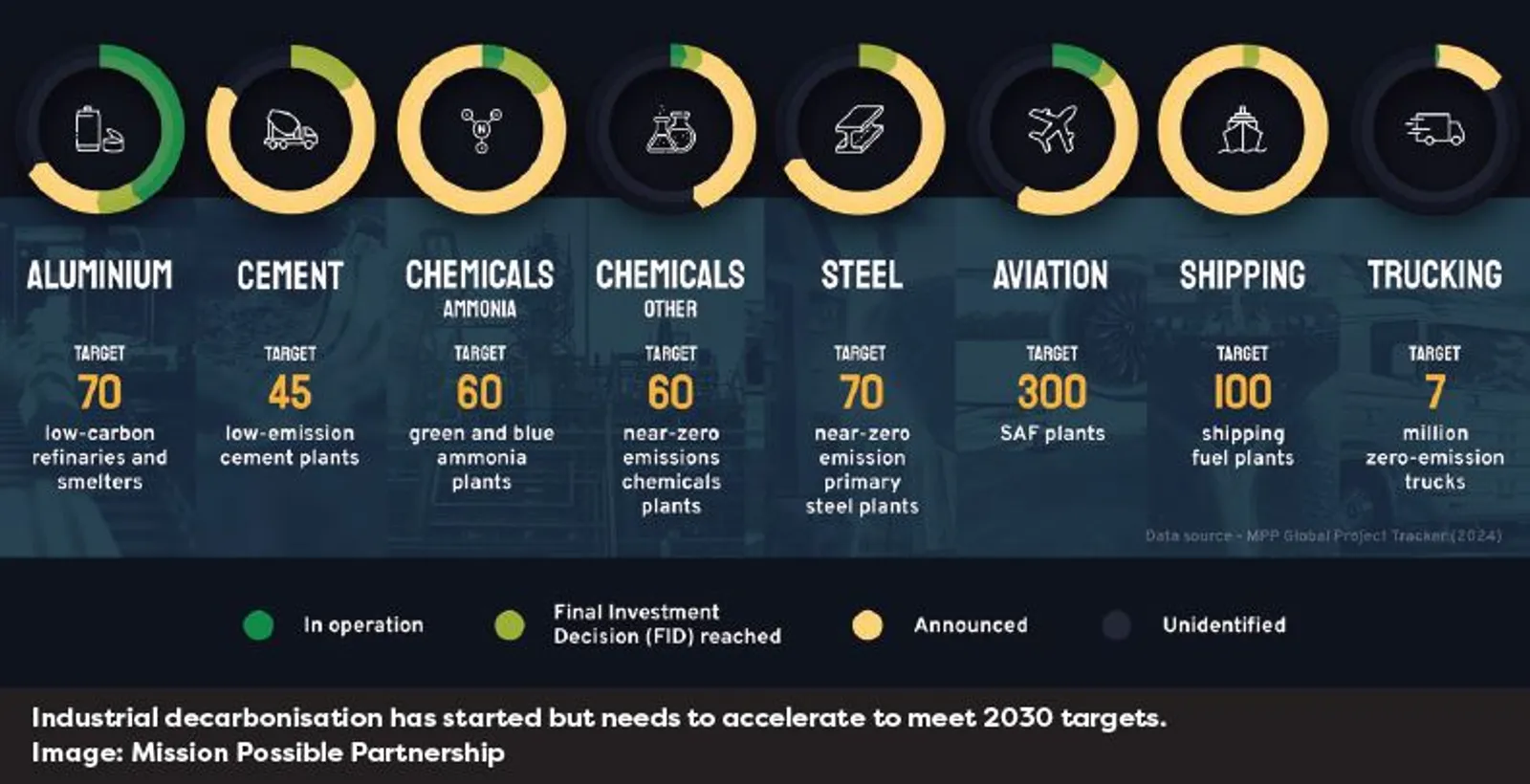
And while 70% of the 700 plants have at least been announced, McFarlane highlights that this shows a gap since we need 600 additional plants to reach FID within the next few years.
While none of the sectors are currently on target to meet industrial decarbonisation goals, the most progress has been seen in aviation, with Sustainable Aviation Fuel (SAF) blending mandates and subsidy schemes driving projects to operation. According to the tracker, 15% of the target has passed FID.
In aluminium, said McFarlane, there is already a strong base of low-carbon refineries thanks to the hydropower smelters and investments in renewable energy. And in the chemicals space, she highlighted what she referred to as “an interesting evolution.”
This is especially the case with ammonia, where there has been a surge in project announcements and a variety of viable offtakers, such as the fertiliser and shipping industries. However, while momentum is building, questions remain about how quickly green ammonia projects can reach commercial scale.
And there is a concern about what is referred to as the green premium, a potential barrier to the energy transition and industrial decarbonisation. The green premium can be understood as the higher price tag associated with greener industrial products, compared to their conventional counterparts produced with carbon-intensive methods.
McFarlane explained: “Fertiliser could be a first mover in building the market for ammonia. When we look at the green premium for ammonia, it can be 50-100% more costly to produce ammonia with green hydrogen as opposed to fossil fuels.”
However, recent research has shown how that additional cost can be cascaded through the value chain. McFarlane explained that this creates opportunities for downstream businesses to “step in and contract those green products and prove the bankability of those production facilities.”
McFarlane believes the green premium will not be a problem in the long term, and emphasises the need to frame the cost in a broader context.
Also of interest
How the Lombardy Energy Cleantech Cluster is tackling the transition through collaboration
Key technologies to drive Europe’s industrial decarbonisation
“We will see a cascade in impact [for example, in] the role ammonia and fertiliser can play in bringing down the overall cost of hydrogen. This will impact other sectors where there is a greater impact on final product cost, such as in shipping.
“Bringing down the cost in one sector can have a knock-on effect on other sectors.”
Industrial hubs
McFarlane used hydrogen to illustrate the role of industrial hubs. Hydrogen will not only be important for the hardest-to-abate sectors, but it can also play a complementary role in steel or shipping.
“There’s this common opportunity – which is why we are looking at the role of clean industrial hubs and the complementary needs of co-located sectors. This presents an opportunity to spread costs across sectors – not just for hydrogen production but also for storage and transportation needs.”
Coordination across industries is critical and, according to McFarlane, “it’s all about understanding the role of tipping points. “It shows what can be done, and the power of the exponential change that will come about in these sectors.” Analysis by MPP indicates that many projects struggle to get from announcement to FID, one of the main factors slowing the current rate of progress.
In order to mitigate these struggles, McFarlane highlighted that a combination of government support, bankability of demand and innovative financing models is needed. And, she stressed, a favourable policy environment is one of the most critical levers for success. This can be seen in policies such as the US Inflation Reduction Act, which has given rise to a surge in available finance and project announcements. In Europe, policy mandates such as ReFuelEU are creating clusters of projects around sustainable aviation fuel, which in turn creates confidence for increased offtake activity.
Project bankability
Besides favourable policy measures, mechanisms must be installed to overcome challenges impacting project bankability. “We see intermediary government-backed subsidy schemes such as the EU Hydrogen Bank. The first auction occurred in 2023 and was oversubscribed, showing a demand and a willingness to pay.”
However, McFarlane added that “we need the mechanisms in place to help match the requirement for long-term contracts with the demand that exists, and solve the problem of price matching.” We also need different private financing mechanisms.
“We are seeing equity co-investment emerging as a model to unlock projects such as H2 Green Steel,” added McFarlane.
A mission of hope
While the task that industry is facing is sizeable, McFarlane is positive that the announced projects show the opportunity to create critical mass and realise new markets for clean industrial products.
“I find there is a huge opportunity for transformation, and that gives me a lot of hope. Seeing the technologies that are maturing, seeing the coordination and the different types of business models and different types of innovative financing that are starting to be noticed in different geographies is really exciting.
“To work in a space with a lot of innovation, and it needs to happen really fast, is very energising.”
The MPP team will continue to monitor progress and its impact on reducing emissions overall. McFarlane and the team have clearly accepted this mission – which is not only possible, but can result in the deep industrial decarbonisation needed to reach our 2050 goals.