Rolls Royce enters hydrogen production market with bold ambitions
Kelvin Ross
Posted on: 14 July 2022
Rolls-Royce Power Systems is entering the hydrogen production market and plans to “launch electrolyzers with several megawatts of power right from the start”.
Acquisition of German stack specialist Hoeller Electrolyzer will allow it to launch multi-megawatt systems within two years
Rolls-Royce Power Systems is entering the hydrogen production market and plans to “launch electrolyzers with several megawatts of power right from the start”.
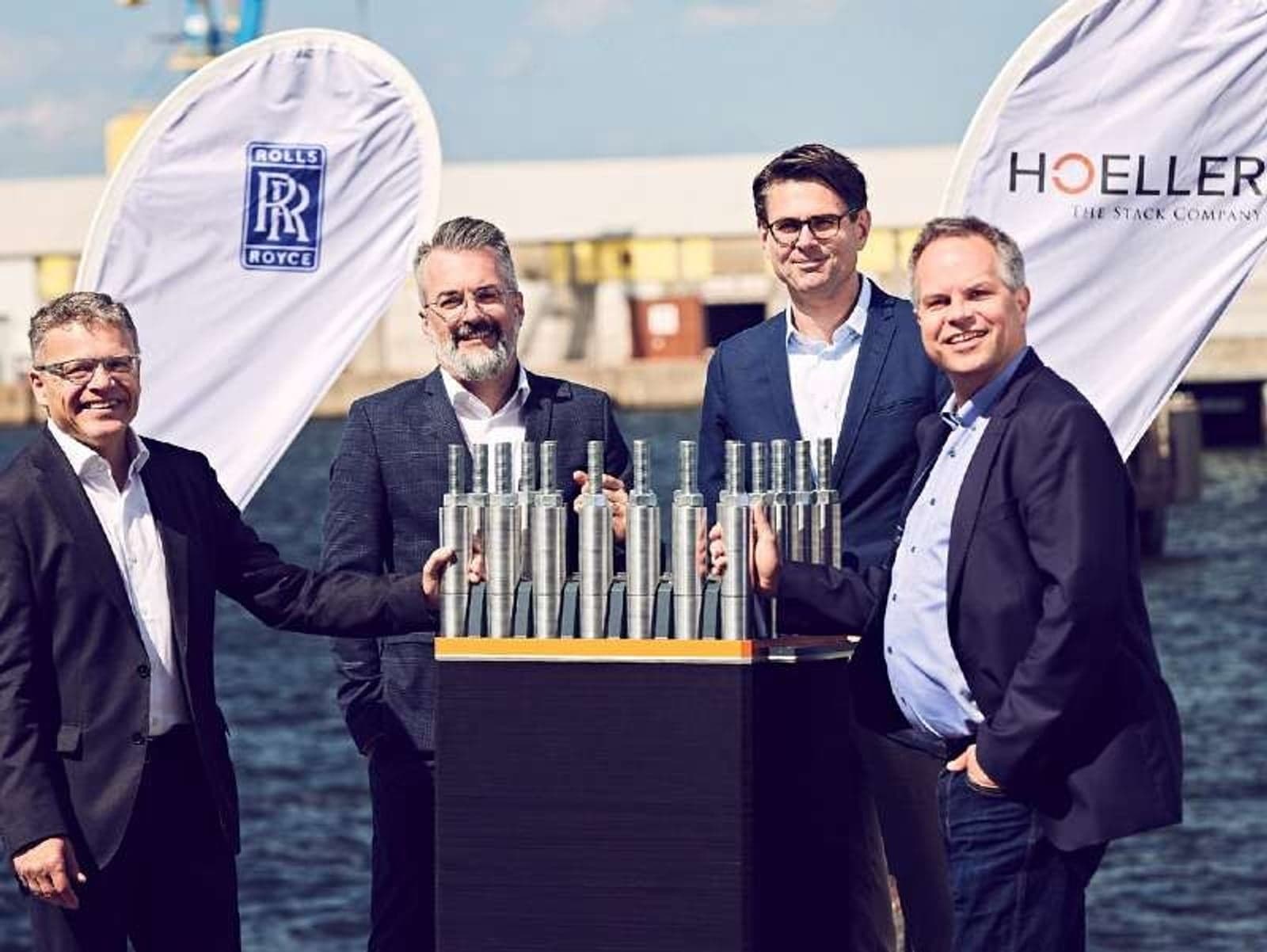
The company has acquired a majority 54% stake in German electrolysis stack specialist Hoeller Electrolyzer.
It will use Hoeller’s technology as the basis of a new range of mtu electrolyzer products from its Power Systems division.
Dr Otto Preiss, chief technology officer at Rolls-Royce Power Systems, said the acquisition “will enable us to supply complete hydrogen solutions and make a significant contribution to protecting the climate”.
And Hoeller Electrolyzer founder and managing director Stefan Höller said: “Our stack is going to produce hydrogen at a price not previously thought possible.”
Hoeller Electrolyzer is based in Wismar, Germany, and is an early-stage technology company developing polymer electrolyte membrane (PEM) stacks, under the brand name Prometheus.
In hydrogen electrolysis, water is subjected to DC electrical current, producing hydrogen at the negative pole and oxygen at the positive pole.
In this way, it is possible to produce carbon-neutral hydrogen by using electricity from renewable sources such as solar or wind.
The electrochemical reaction takes place in a cell between plate-shaped electrodes separated by membranes. Hundreds of cells located one above the other and pressed together form a ‘stack’, the heart of an electrolyzer.
Hydrogen in depth
How do we start the hydrogen domino effect?
Zero Emission Hydrogen Turbine Center: A closed loop of the energy future
How DSOs can play a vital role in Europe’s hydrogen economy
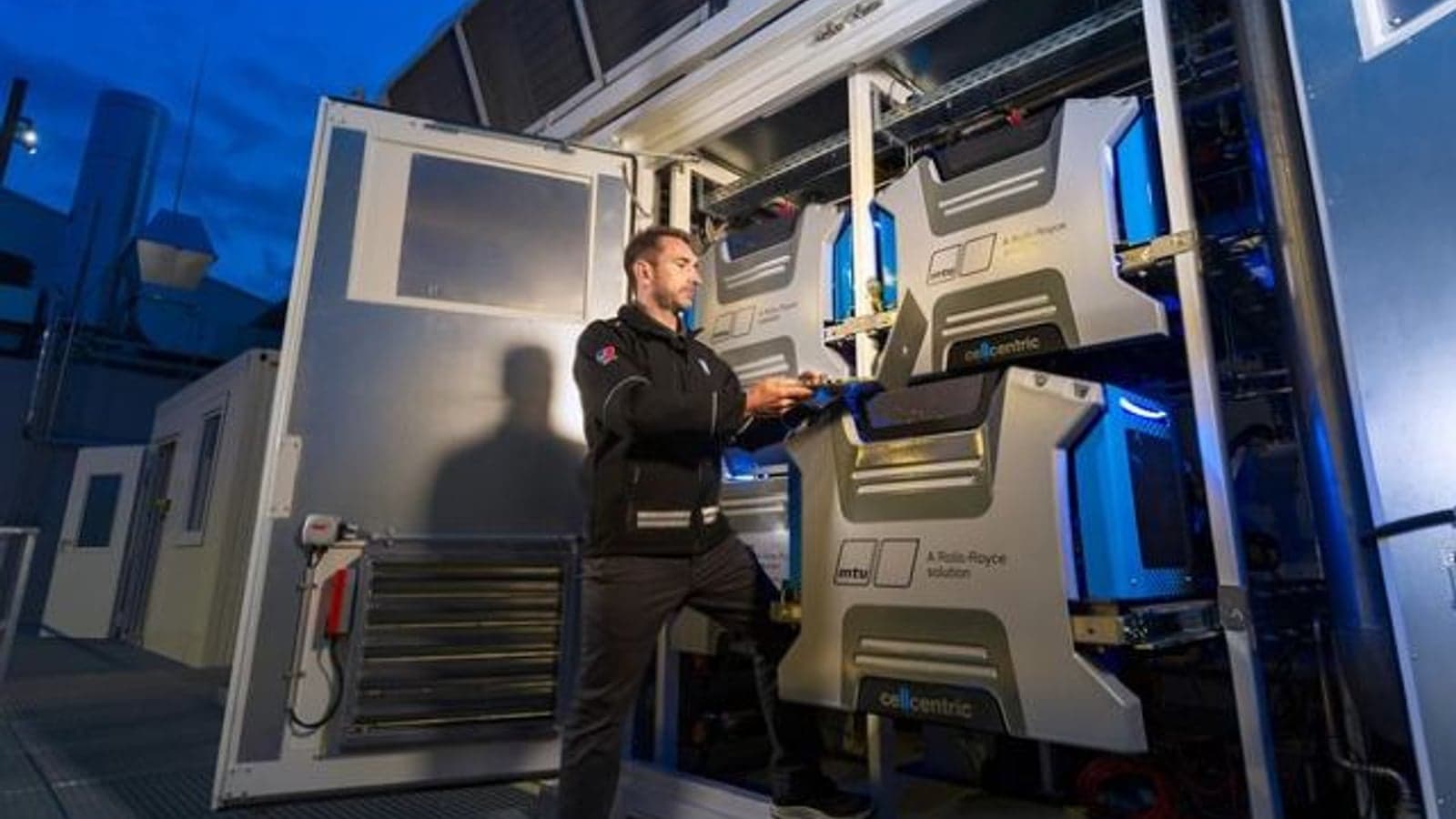
Development work on the first mtu electrolyzer using a stack from Hoeller Electrolyzer is already underway. Next year, it will go into operation at the Rolls Royce Validation Centre in Friedrichshafen, Germany, to demonstrate how an electrolyzer fits into the overall architecture of a microgrid.
An initial customer project is already planned for 2024.
Preiss said that by Rolls Royce developing its own mtu electrolyzers and taking the stake in Hoeller, the company was “methodically growing our hydrogen portfolio and securing access to this fascinating technology, which is not a pipe dream but has great market potential”.
Watch now: Enlit project visit: Residential power-to-gas
“Our complete hydrogen solutions will enable customers to store renewably produced energy in the form of hydrogen for use as and when required, or for further processing or onward sale.”
Matthias Kramer, Joint Managing Director at Hoeller Electrolyzer, said Rolls-Royce was “an ideal partner and supporter who shares our vision of putting stacks into full production”.
Armin Fürderer heads up the Net Zero Solutions business unit of Rolls Royce Power Systems. He said: “We’re going to launch electrolyzers with several megawatts of power right from the start. A total output of over 100MW is conceivable by combining several electrolyzers.”
I spoke to Kramer and Fürderer at the Rolls Royce Power Generation Symposium in Friedrichschafen, Germany, last week.
Fürderer said the stake in Hoeller filled “one piece of the jigsaw puzzle… there are a few more to come, but it’s one very important one”.
“Up to now, we only concentrated on the conversion side: now we are on the lower end of the value chain on the production side. So it’s a major piece of the puzzle.”
He said that to deliver hydrogen solutions “time is ticking and we need to speed up”, adding that the Hoeller partnership shifts things up a gear.
What would make it go faster? “Regulation,” he says. “Having a much clearer roadmap on regulation and permitting, because that is fairly individual at the moment.
“Having a more European-wide approach would speed things up and give the investors certainty that it is coming: that is really important. We need incentive schemes something like we had for solar PV.”
And in the combustion engine vrs fuel cell debate, he predicts no clear winner in the near future?
“There will not be a one-size-fits-all technology – there will be areas where a combustion engine makes more sense, and areas where a fuel cell makes more sense.
“I am not convinced that one is killing the other. There will be room for everyone. We need to diversify our energy portfolio in so many different ways, we need everything.”
Kramer said: “If you look at the hydrogen value chain currently, it only works if you can make connections on all ends. Because otherwise the value chain doesn’t work.
“If you want to implement systems that are running, you need to be able to provide the whole solution. The power supply side is not a given – it comes in various different set-ups.”
Watch on demand: Green is the new Black | Hydrogen, challenges and opportunities
He added that for a hydrogen economy – and indeed the wider energy transition – to truly flourish, a change of industry mind-set was needed.
“One element of this whole energy transition discussion is not only moving away from fossil fuels, but also moving away from a centralised logic: this European understanding that there are big sources of energy and we need a big grid to bring it everywhere in the country.
“I think that needs to change to a more decentralised, organised grids. And then you are back to the question of: what is the right technology? Because it’s not just diesel, or just fuels cells, or electrolyzers.
“If we manage that mind-shift at the same time, we can solve the energy equation. Because otherwise it’s just the same basic structures.”
The equity in Hoeller Electrolyzer now held by Rolls-Royce comes from departing minority shareholders and from an increase in share capital.
Financial details of the transaction have not been disclosed and Höller and Kramer will continue to lead Hoeller Electrolyzer as a standalone company.
Related tags
Most popular
Join the community for freeAnd get access to all content
Related companies
Rolls-Royce Solutions GmbH
Related members
Kelvin Ross
Enlit, Enlit Media
Editor-in-Chief