Australian startup launches ambient hydrogen storage demonstration
Jonathan Spencer Jones
Posted on: 20 August 2025
Australian startup Carbon280 has launched its Hydrilyte pilot plant demonstrating hydrogen storage at ambient temperature and pressure.
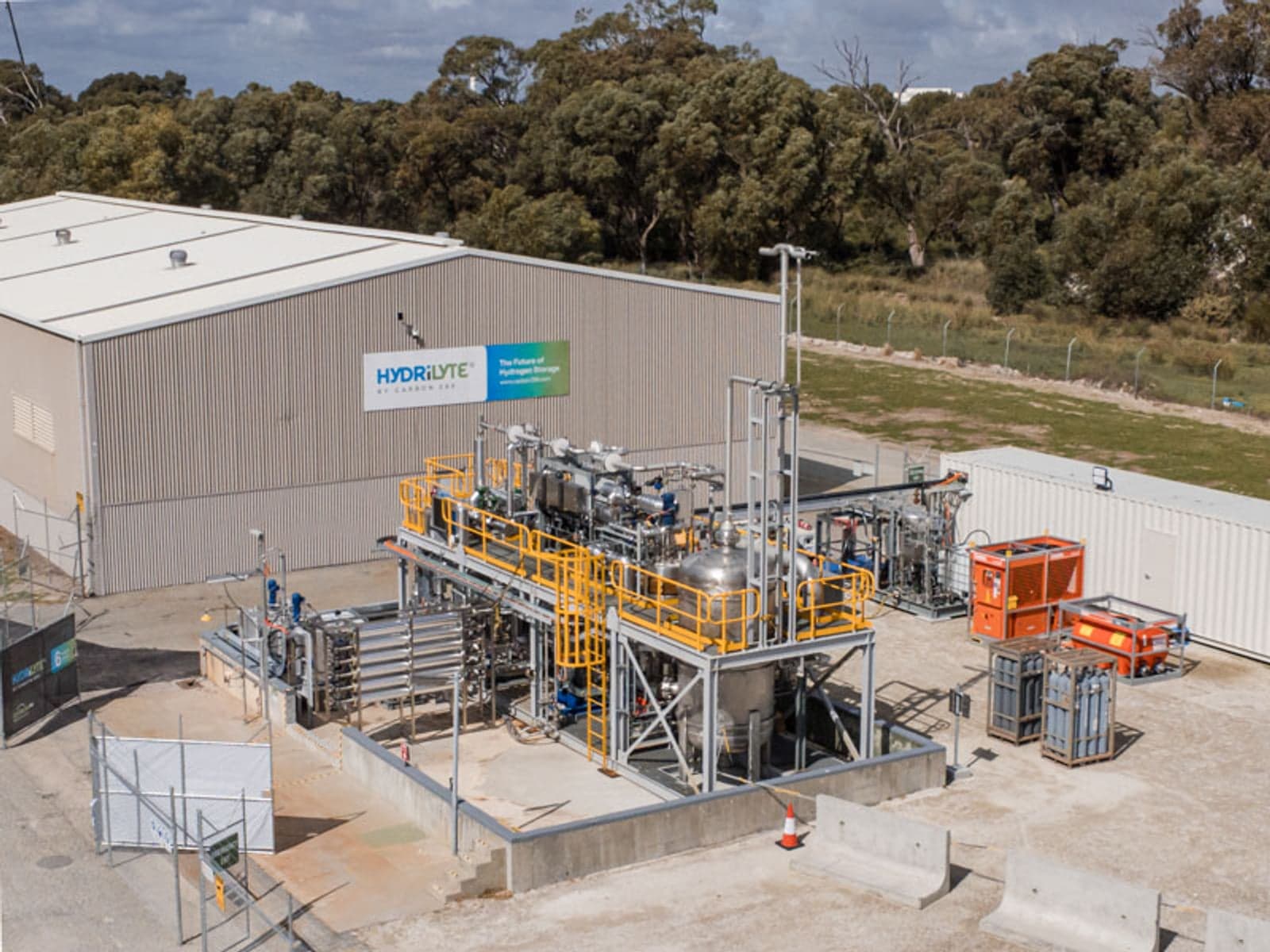
Australian startup Carbon280 has launched its Hydrilyte pilot plant, demonstrating hydrogen storage at ambient temperature and pressure.
The plant, located in Kwinana near Perth in Western Australia, aims to demonstrate at an industrially relevant scale Carbon280’s patented Hydrilyte technology, which separates hydrogen from helium and enables storage of the hydrogen in liquid form, ready for transport.
With this, the storage and transport of hydrogen should be made safer and, most importantly, more cost-effective without the need for specialised pressurised or cryogenic storage facilities. These are important factors, knowing that Australia’s hydrogen ambitions are facing growing headwinds with a number of high-profile projects either stalled or cancelled.
“Rather than transporting a highly flammable gas you are storing and transporting a safe, low-cost liquid that stores hydrogen under ambient conditions,” explains Mark Rheinlander, founder and CEO of Carbon280.
“Low cost and ease of handling will simplify and speed the implementation of hydrogen projects globally, enabling hydrogen use in applications and geographies with less sophisticated infrastructure.”
Have you read?
Novel green hydrogen reactor technology launched in Australia
Green hydrogen shows promise for industrial decarbonisation in Global South
Carbon280 raised over Au$16 million ($10 million) to accelerate its Hydrilyte storage solution, including a $10.6 million seed investment led by Woodside Energy, with support from UK-based renewable energy company Hive Energy and a Singaporean family office, alongside a forecast $5.5 million in R&D rebates from the Australian government.
The Hydrilyte technology pilot plant is a 100kW TRL6 prototype, with a successful outcome validating the technology, which should reduce the costs for existing hydrogen users and improve the economics and speed of implementation of future projects, including the production of green iron, synthetic aviation fuels and methanol.
Carbon280 explains Hydrilyte beginning as a suspension of fine magnesium powder within a light mineral oil.
To store hydrogen, the gas is bubbled through the Hydrilyte suspension, triggering an exothermic reaction as the hydrogen reacts with and bonds to the magnesium to form a stable solid, magnesium hydride (MgH2).
To release the hydrogen, the process is reversed by adding additional heat to the Hydrilyte, which breaks down the MgH2 and releases high purity hydrogen gas, while the original magnesium powder is left suspended in the oil, ready for the next cycle.
As the mineral oil carrier is not involved in the chemical reaction and is not broken down during hydrogen release, the hydrogen is released at very high purity without the need for downstream purification, and the carrier liquid itself does not degrade, minimising make-up requirements during operations.