Eaton and Siemens Energy team up to fast-track data centre deployment
Pamela Largue
Posted on: 3 June 2025
Eaton and Siemens Energy have launched a solution designed to fast-track the approach to building data centres with integrated onsite power.

Power management company Eaton and Siemens Energy have launched a solution designed to get data centres online faster with integrated onsite power, and to allow these power-hungry behemoths to contribute to grid stability.
The partners have been collaborating for over a year to develop and deliver a solution that provides reliable, stable power, which is independent of the grid.
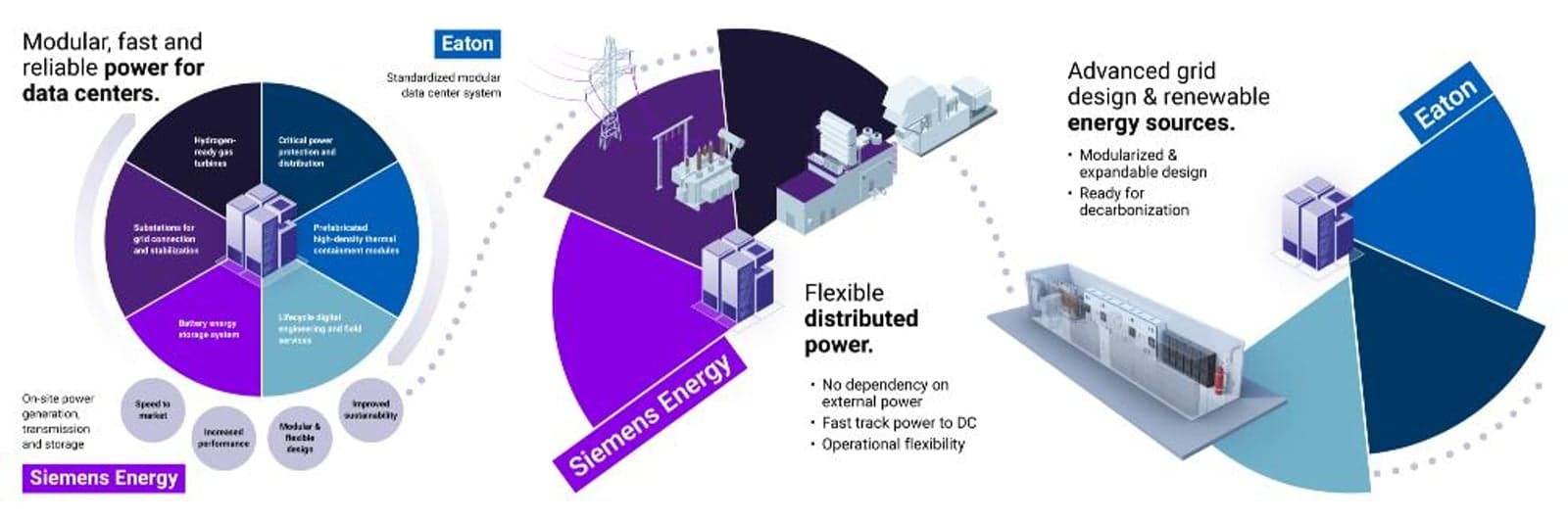
To this end, Eaton and Siemens Energy have developed standardised, modular systems for energy management and on-site power generation that can be built quickly as the data centre is constructed.
The solution is based on Siemens Energy’s modular and scalable power plant concept. It can generate 500MW of electricity from hydrogen-ready GT-800 gas turbines and is coupled with additional battery storage systems.
According to Siemens Energy, the concept includes the option to install an emission-free clean air grid connection during construction or as a retrofit - a unique feature that enables data centres to provide grid services.
Eaton will provide the electrical equipment, engineering services and the software offerings needed for the solution and will help accelerate building and commissioning data centres with skidded and modular designs.
Have you read?
Iberdrola España installs its first microgrid in Spain
Finland’s Steady Energy secures funding for heat-only SMR pilot
Andreas Pistauer, global head of Sales at Siemens Energy’s Gas Services Business Area, commented in a release: “We offer hyperscalers, co-locators and investors a unique package, enabling them to reduce the time to market by up to two years in many places which leads to significant revenue gains. Our power plant design is built with redundancy, eliminating the need for backup diesel generators, and reducing CO2 emissions by about 50 per cent.”
Cyrille Brisson, global segment leader, Data Centres, Eaton, added that their approach provides greater flexibility, swift start-up time and options to reduce emissions in the near and long term.
"Crucially, our approach offers data centre owners and developers the opportunity to build capacity and bring it online fast in any location where they have land available that is close to gas, water and fiber,” Brisson said.
Data centres as part of the solution
In an exclusive interview with Power Engineering International, Brisson and Pistauer explained that the speed of data centre development is faster than the speed at which you can expand the grid. It's this fact that spurred the partners to develop this unique solution.
Said Brisson: "The biggest change we have seen in the last year is the size of the hyperscalers, the size of the campuses and buildings. The grid operators do not have time to plan."
Pistauer added that for the data centre industry, electricity is a lifeline. However, grid connection, or the lack thereof, is a big challenge. Also, the amount of power needed and the reliability of that power needs to be considered in terms of what the grid can realistically offer.
Also of interest
Pennsylvania coal-plant to be turned into gas-powered data centre campus
Hydrogen power generation solution launched for data centres
According to Pistauer we could see demand for electricity reach 945TWh by the end of the decade.
If grid connections take so long, "we thought, there must be a different solution that speeds things up, to cut back on the time to implement and not wait with the business - time is of the essence," added Pistauer.
Both Pistauer and Brisson stressed the importance of this on-site power generation and transmission solution, enabling data centres to provide grid services, which they see as a potential game changer and a way for data centres to be a part of the solution, rather than merely the cause of grid challenges.
"We have been saying this for years... we need to change the behaviour of the data centre to contribute to the grid," explained Brisson.
"[With this solution] we are looking at adding dispatchable power on grid...we will be adding capacity that will help to solve the current bottlenecks and will be bringing capacities which will be needed for grid stabilisation."
The footprint of running on gas
Besides an independent, reliable source of power, data centres also need to take emissions into account, acknowledge Brisson and Pistauer.
In response to comments regarding bringing gas generation onto the grid, they emphasised the need for sufficient resources to run the energy system in a stable manner in the short term.
Read more: Hyperscaler data centres and predictable power – top trends shaping Europe’s data centre landscape
Said Brisson: "We understand there are strict targets concerning emissions reduction. At the end of the day, the higher the proportion of renewables in your system, the more you will need grid coordinated, dispatchable power.
"What we are bringing to the table is the capacity to bring a mix that is sustainable for the grid in the long term".
Referring to the recent power blackouts in Spain, Pistauer concluded: "While the cause of Spain's blackout is still unknown, the need for spinning reserve and dispatchable capacity has been highlighted. This solution will ensure the data centre campus is more than a mere offtaker, it also offers grid stability."