Energy storage bucks US tariff trend thanks to data centre demand
Vic Wyman
Posted on: 21 October 2025
Brussels conference hears 'no other energy technology compares' to storage when it comes to powering data centres.

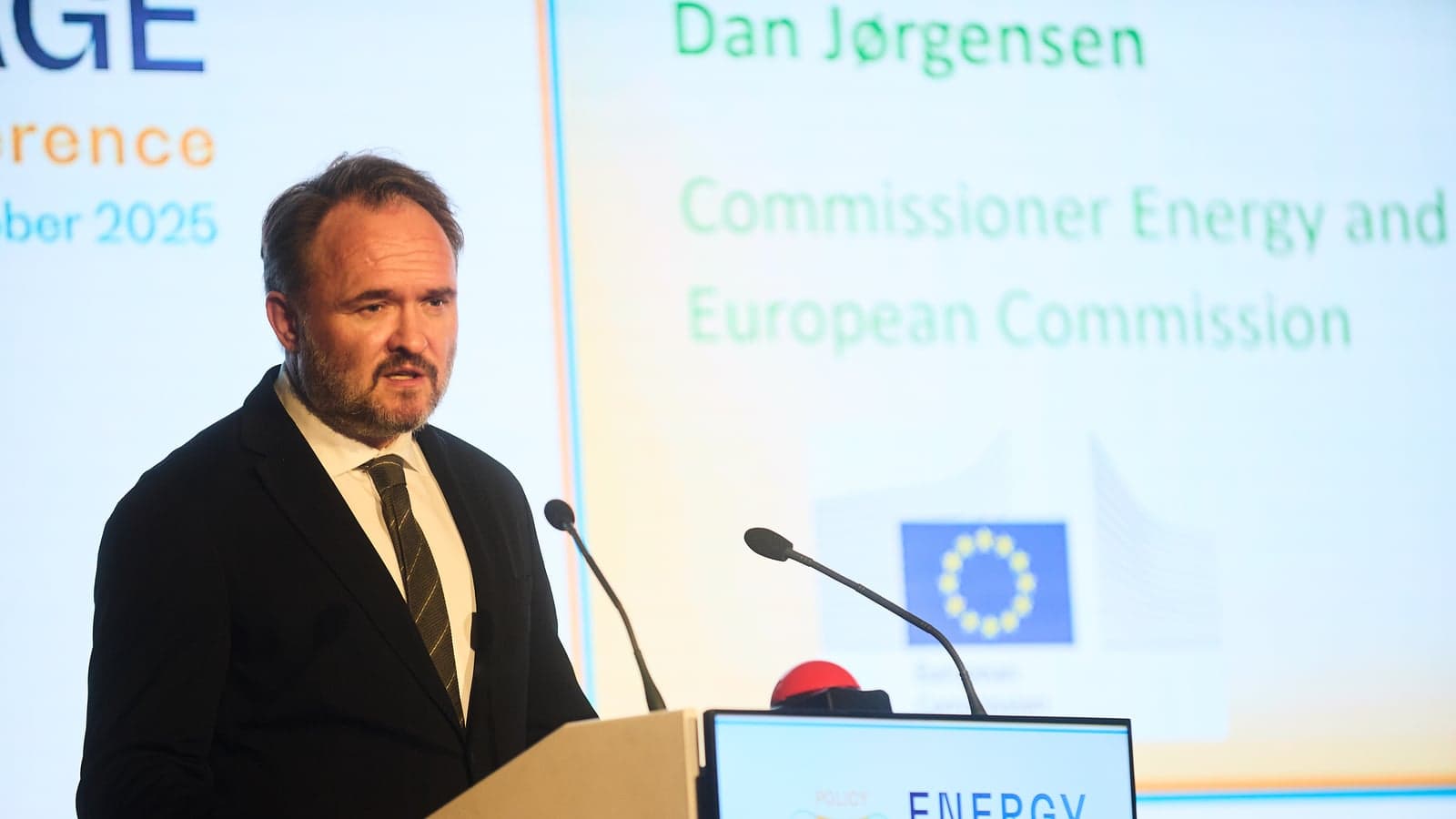
The outlook for energy storage in North America is, despite interventions from President Trump, looking positive, the European Association for Storage of Energy heard at its annual conference in Brussels.
The president's US tariffs and border controls have affected the US solar industry and energy storage, with firms typically limited in what they can import.
Emily Burlinghaus, director of energy storage manufacturing and supply chain in the Solar Energy Industries Association in the US, said that members faced policy uncertainty and that many had switched from Chinese suppliers of parts to, typically, those in Korea and Japan.
Although she expected smaller manufacturers and developers to be most affected by the US tariff war, she was generally surprised by how the industry had adapted, although clarification was still awaited on some measures, including possible taxation related to storage.
Burlinghaus also said that European suppliers of battery manufacturing machinery faced difficulties in getting their employees into the US to train customers on the complicated equipment needed to make batteries.
However, she pointed to the addition of a record-breaking 12GW of US energy storage capacity last year for solar power investments, and record increases in the first two quarters of 2025. Also, in California, for example, a change in net power rules has prompted investment in storage.
The US growth is in part thanks to the building of data centres, the developers of which are keen on the speed of installation of large solar and storage plants, compared with long waits for gas turbines for power plants. "No other energy technology compares," said Burlinghaus.
Canada, which is heavily affected by US policy, will need 40GW of energy storage of all technologies and all durations, forecast the Energy Storage Canada trade organisation. "Right now, we have just under 3GW. So, you can imagine the growth that's about to happen. So, we expect the future to be bright," said Justin Rangooni, president and chief executive of Energy Storage Canada. The future will, however, depend on trade talks between the US and Canada, said Rangooni "We are always watching the geopolitics."
Storage projects around the world are using a variety of funding methods. Post said that they included tolling agreements that pay a fixed income for battery output — as in Italy and in Germany — and power purchase agreements (PPAs) that pay set prices for agreed energy volumes — including a first hybrid PPA for solar cells and battery storage.
Energy storage is 'strategic imperative for Europe' says EU's Jørgensen
UK sees slew of grid-balancing BESS project announcements
Battery storage safety: navigating the path to a secure and sustainable energy transition
Market reforms
Possible good news for storage developers and operators is potential reforms to electricity markets, based on various assessments ,including national flexibility assessment reports expected in July 2026.
The latter will address factors such as the need for renewables and the short-term availability of energy.
All benefits associated with electricity flows, including from day-ahead power trading, intra-day trading and balancing of the grid to match electricity supply and demand need to be assessed, said Georg Thomassen, scientific officer in the EU's Joint Research Centre.
"There are a lot of challenges," he noted. "The system is too complex to handle with back-of-the-envelope calculations." How much investment can be backed up by the wholesale electricity market, for example?
And more state aid could be available for energy storage around the EU, particularly under the Clean Industry Deal State Aid Framework. There is no specific support for energy storage in that, but the technology can support aims such as security of electricity supply, flexibility and more renewables, said Julia Majewska, case handler in the European Commission's competition directorate.
"The European Commission recognises the importance of energy storage in securing affordable and secure supply of clean energy in the EU," said Majewska. Hence the need for regulatory and planning certainty. However, she said that the hope was that firms could get the revenue from the market, rather than from state aid.
Lukasz Kolinski, director for green transition and energy system integration in the Commission's energy directorate, said that the Commission has asked EU countries to facilitate flexibility and that signals and benefits needed to be clear: "Network charges could be specific for storage and flexibility."
Long considered
One concern for some in the sector is the future for long-duration energy storage (LDES), which could take various forms including chemical, thermal, mechanical and electrochemical. Units could supply energy or heat for long periods, from perhaps eight hours up to months.
LDES could avoid 35-88% of the curtailment of renewable energy possible by 2030 because of poor operation of the market, said Paula Rey Garcia, head of unit in the European Commission's energy directorate; "We need to have a clear basis for long-duration energy storage."
Mike Vasconcelos Tocchetti, head of European business development at the Italian company Energy Dome, which uses carbon dioxide as the basis for LDES, said that permitting for projects favoured lithium-based batteries over other storage technologies.
He also said that today's markets valued short-term flexibility over duration but suggested that PPAs could help bridge the gap by pricing the firmness of energy delivered.
Marcel Eijgelaar, principal researcher in the certification organisation DNV, said that more volatility in grids favoured more short-duration storage and efficient battery storage, which meant more competition for LDES.
He expected two-hour and four-hour batteries to dominate the storage market, perhaps reaching 20% of peak demand in north-west Europe and up to 80% in solar-dominated south Europe by 2035. And the storage would act partly as LDES, with batteries responding to competition by not fully discharging to avoid negative prices for electricity.
Eijgelaar suggested that to gain a 5% market share (in MW) in 24-hour storage, the cost/MWh would have to be a fifth of the cost of lithium/sodium-ion batteries: "It is a very competitive environment."
Making things better
EU state aid could also be available for storage equipment manufacturing — separately from state aid for installations.
Luca Taranto, case handler in the Commission's competition directorate, pointed to three relevant sets of rules: the Climate, Energy and Environmental Aid Guidelines of 2022; the General Block Exemption Regulation; and the recently-adopted Clean Industrial Deal State Aid Framework (Cisaf).
All three are part of the EU's clean industrial deal. Cisaf allows a fast-track procedure for clean energy roll-out, decarbonisation and clean-tech manufacturing and covers storage technologies among others. "We only care about companies starting new investments," said Taranto.
However, Joan Gonzalez Fabra, research and innovation officer at the Batteries European Partnership, called for support for the ramping up of battery production: "Support has to be given on operating expenses or [factories] will fail on ramp-up."