Energy storage is 'strategic imperative for Europe' says EU's Jørgensen
Vic Wyman
Posted on: 20 October 2025
EU Energy Commissioner tells Brussels conference that energy storage can tackle climate change and boost competitiveness
Some technical advances can take many decades to be accepted, but energy storage has quickly become a big growth area and a key factor in the energy and economic planning of the EU.
Regulations are being tweaked to ease the deployment of energy storage installations, the EU is putting storage at the heart of its climate change and growth policies, and financiers such as private equity firms are sniffing around for lucrative deals.
Energy storage was a fringe interest when the industry group the European Association for Storage of Energy (EASE) — now renamed Energy Storage Europe (ESE) — was set up 15 years ago, but factors such as Russia's full-scale invasion of Ukraine and the growth in renewable energy capacity have persuaded many that it is vital.
Europe woke up to the need for large-scale energy storage four or five years ago, said ESE Secretary General Patrick Clerens. For years before that "nobody knew what energy storage was". However, then the Ukraine war showed the folly of the EU's dependence on Russia for fossil fuels and the boom in renewables meant that storage was increasingly needed to provide flexibility to help match energy demand and supply and to stabilise electricity grids.
"We are underpinning the energy system," said Clerens, pointing to the European Commission's inclusion of a legal definition of energy storage in the EU's clean energy package in 2019.
David Post, the ESE President, told the recent annual conference of ESE in Brussels, Belgium that energy storage also had a social function: "A responsibility to ensure that the energy would be stable and at the same time competitive and cheap for the future."
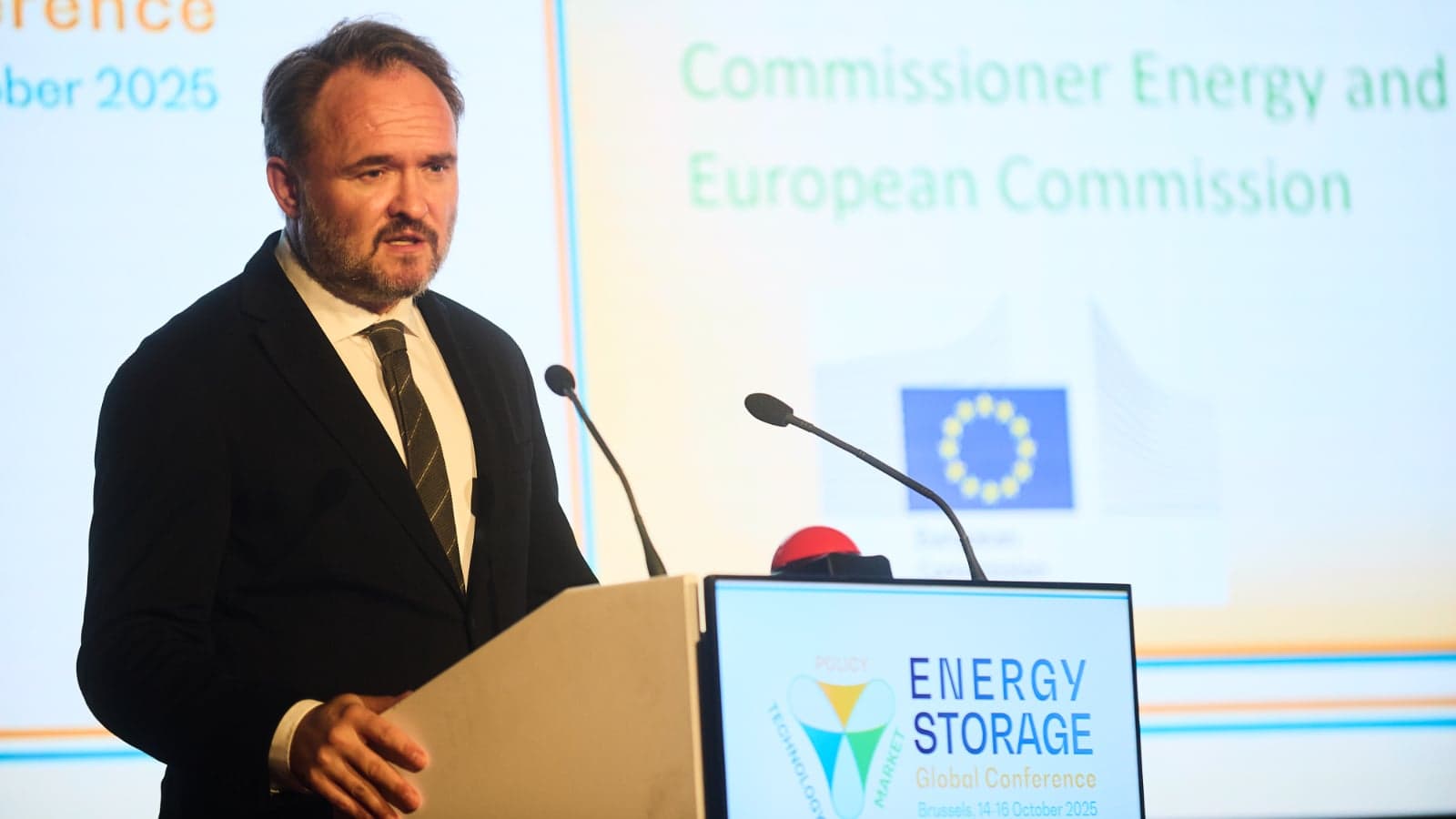
"Energy storage is a strategic imperative for Europe," the EU Energy and Housing Commissioner Dan Jørgensen told the conference.
2024 marked a record year for installations, with 12GW of capacity added. However, we are not moving fast enough.
Energy storage would help Europe to deal with three big challenges, he said: the need to become independent of imports of Russian fuel (the EU imports more than €400 billion ($466 billion) of fossil fuel a year from around the world); climate change: "It's here and we need to act fast"; and low competitiveness, including energy, being two to three times dearer than in the US and in China.
"Energy storage is a big part of the solution," said Jørgensen. "We need to make sure that the energy from our wind and solar is not wasted. Energy storage can be our safe guarantee for that purpose." Also, as renewables grew, we needed to ensure that the electricity system was flexible enough to meet fluctuations in supply and demand. Compared with 2021 — the EU flexibility requirement would more than double by 2030 and grow by seven times by 2050.
But Jørgensen had good news for the delegates, including coming changes to allow more state aid by EU countries for energy storage projects and easier permitting.
Rapid development
Energy storage mainly takes the form of batteries and pumped hydro schemes, which push water uphill when electricity is cheap and plentiful and let it run downhill through turbine generators when power is needed. But other technologies are possible, with ESE recognising five categories — chemical, electrochemical (typically batteries), electrical, mechanical and thermal. "The biggest one in [terms of] growth is electrochemical," said Clerens.
Post said that in 2025 the industry installed 15 times more capacity than five years before: "Energy storage has become a fundamental part of the energy system."
Lars Stephan, Marketing, Policy and Public Affairs Director for EMEA in German company Fluence Energy, pointed to the maturity of the technology, compared with a typical 5MW battery in a container installed 10 years ago. "Today, 5MW in a 20-foot container is old technology," he said. "Two years ago, a 50MW project would have been big. Now a 50MW project is too small. A 250MW project is more like the new norm."
Two-thirds of storage installations are stand-alone, said Silvestros Vlachopoulos, Energy Storage Research Manager at the UK consultancy LCP Delta. And projects co-located with solar and wind plants may not have the same metering point or be connected to the same inverter, while 35—45% of co-located projects each year are next to conventional power plants, said Vlachopoulos.
Reto Kaspar, Head of Project Development Batteries at Axpo Energy, said that in some countries the difficulty of getting grid connections makes hybrids the best option for fast deployment of battery storage.
Have you read?
Bottleneck battling storage project to be built in ‘relief area’ in Germany
Battery tech roundup: Five developments in key BESS markets
Funding flows
Post pointed to trends which underpinned optimism in the future for storage in Europe, including: plans for large battery factories — gigafactories — in Europe; the increased variety and sophistication of energy tender mechanisms, including demand response or flexibility; new investors; the growing importance of software to optimise economics and manage risk; emergence of technologies other than batteries; and grid congestion and the need for more grid stability.
Investments in gigafactories in Europe, for example, included a €4.1 billion ($4.8 billion) plant in Spain and a €2 billion ($2.3 billion) factory in France. They were mainly for electric vehicle batteries, said Post: "But we see more production lines for stationary storage."
Energy Transitions podcast: Spain's battery manufacturing advantage on the road to net zero
There has been a wide range of approaches to paying for storage, he said: "All signals that the market is evolving in the right direction."
Approaches include tolling, in which an electricity company pays a battery owner a guaranteed revenue for electricity. Italy, for example, has a tolling agreement for 2GWh of storage and there are many tolling deals in Germany, said Post.
Power purchase agreements (PPAs) trade agreed volumes of energy at set prices over long periods, reducing risk for seller and supplier and easing financing and supply planning. Post pointed to a first hybrid PPA for solar cells and battery storage.
"This show clearly how the industry is evolving and how it is attracting money," said Post. Money was coming from sources such as private equity and infrastructure funds which were "comfortable with the concept of energy storage".
More support
Post said that, ignoring whether hydro plants were included: "The industry is expected to grow between now and 2030 by four and a half times."
He cited a forecast that the 36GW of installed capacity in 2024 would rise to 163GW in 2030. "In 2030 the expectation is that every single country will have energy storage as a key component of the energy system." This year, for first time, more MW of utility-scale storage would be installed than residential MW of storage, he added.
Jørgensen said that the about 89GW of energy storage in the EU included 53GW of pumped hydro and 35GW of batteries. "And we are moving in the right direction," he said. "2024 marked a record year for installations, with 12GW of capacity added. However, we are not moving fast enough."
The European Commission has estimated that the EU would need more than 200GW by 2030 and 600GW by 2050 — or the addition of at least 18.5GW of storage capacity each year.
"And it's not just about delivering more storage; it's about delivering the right type of storage," said Jørgensen, who pointed to the need to cope with longer periods of solar or wind generation. "Long-duration technologies will become more important."
The EU has introduced a state aid reform framework to make it easier for member states to back storage. "And the implementation of our action plan for affordable energy will further support the roll-out of storage in a number of ways," said Jørgensen.
That would include a new grids package within months, which would "simplify and accelerate permitting for storage projects, with a particular focus on stand-alone energy storage, which has not been covered yet by EU legislation".
The EU has also proposed investing about €30 billion ($35 billion) in energy infrastructure spending in its 2028—34 budget.
"Investing in a smarter grid with greater storage solutions is a strategic way to deliver value," said Jørgensen. But he said that public money would not be enough — hence the EU will launch a clean investment strategy and a grids investment package with the European Investment Bank.
In September 2025 the European Commission also began work on a tripartite contract for storage, including electric vehicles.
"We are giving [storage] the place that it deserves," said Jørgensen. The contract, to be signed within months, will bring together the public and private sectors and financial institutions "By providing scale and producing shared voluntary commitments we can increase certainty and deliver more investments."
Latest content
+4
What Spain’s blackout means for the US grid and its energy storage future
EU grids tend to be centrally managed whereas the US runs a patchwork of regional systems. Barrett Bilotta of Agilitas Energy examines what can one learn from the other to counter the threat of cascading blackouts.
- Guest/partner contributor
- 31/10/2025
+4
Why Europe needs collaboration, not just ambition
Jaroslav Macek from Elevion Group shares why Europe’s energy transition needs orchestration, not just ambition and how collaboration, digitalisation, and investment in skills can drive a resilient, cost-effective energy future.
- Enlit Editorial Team
- 17/11/2025