EnerKíte to test airborne wind turbine at German energy lab
Pamela Largue
Posted on: 30 August 2024
EnerKíte| together with a consortium of partners| plans to test its wind turbine prototype at E.DIS Group's energy laboratory in Kezin.
German airborne wind turbine developer EnerKíte, together with a consortium of partners, plans to test its wind turbine prototype at E.DIS Group's energy laboratory in Kezin.
The airborne wind turbine will join a solar park, several biogas plants, a combined heat and power plant and a small wind turbine, which are already in operation at the planned location.
According to EnerKite, it's the first time an airborne wind turbine will be tested in a system network with other renewable energies and consumers.
The test operation will last until mid-2027, and will provide insights into how a prototype of the 100kW product class will function in an overall grid-connected system.
In addition, the partners will investigate whether and to what extent airborne wind turbines at high altitudes affect the social acceptance of wind energy.
Have you read?
Sustainable decommissioning planned for ageing Scottish wind farm
Equinor and Polenergia secure permits for Bałtyk 2 and 3 offshore wind farms
In addition to EnerKíte as project manager and developer of the airborne wind turbine and E.DIS subsidiary e.disnatur, consortium partners include the German Aerospace Center (DLR), the Department of Experimental Fluid Mechanics at TU Berlin, the Institute for Climate Protection, Energy and Mobility (IKEM), Bachmann electronic GmbH and INVENT GmbH.
EnerKíte's novel solution
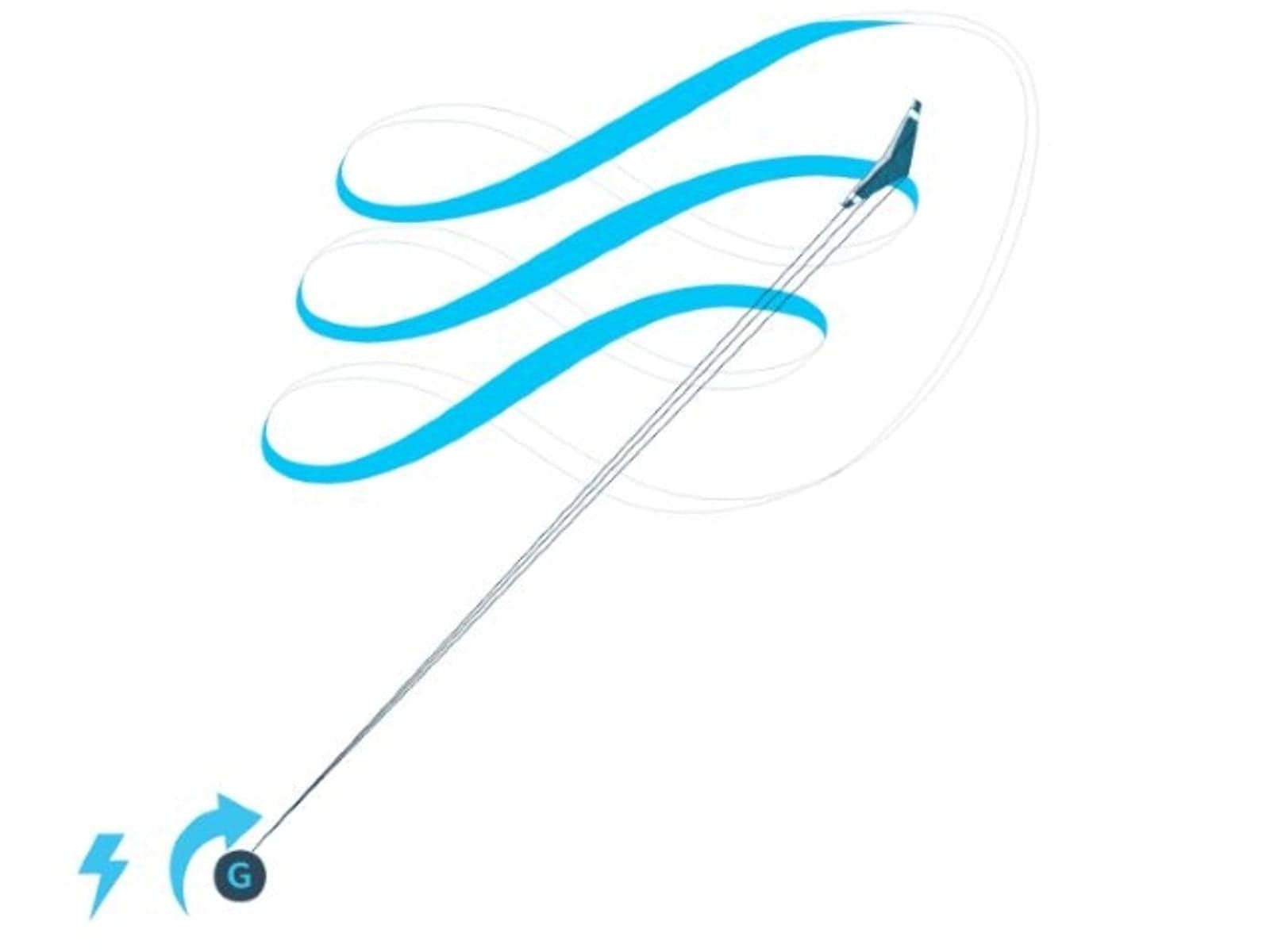
EnerKíte's airborne wind turbine works by following a figure-eight path in the wind, which produces large forces that pull cables attached to drums in the base station.
A generator converts the rotation of the drums into electricity. As soon as the wing reaches the cable's end, it glides back to the initial height. The cables are rewound with minimal energy input, and the cycle repeats again.
According to Nicole Allgaier, project manager of EnerKíte: "The advantage of these systems is that they produce many times the annual yield of a conventional small wind turbine with the same output, while operating at high altitudes in steady winds and with a smaller wing area - they do not require towers."
EnerKíte envisions a future decentralised energy system where airborne wind turbines will be used in combination with photovoltaic systems to supply a renewable baseload with a stable production profile.
The consortium partners aim to provide the public with information about the project and the potential role airborne turbines can play in the future energy system. To this end, a dialogue market in Ketzin is being planned on 13 September 2024, where interested citizens can learn about various aspects of the project and exchange ideas with the project sponsors.
The project is being funded by the 7th Energy Research Program of the Federal Ministry for Economic Affairs and Climate (BMWK).