First Solar plans fifth US manufacturing plant to meet increasing demand
Pamela Largue
Posted on: 28 July 2023
First Solar has announced plans for a fifth manufacturing facility in the United States to increase production of the Series 7 solar module.
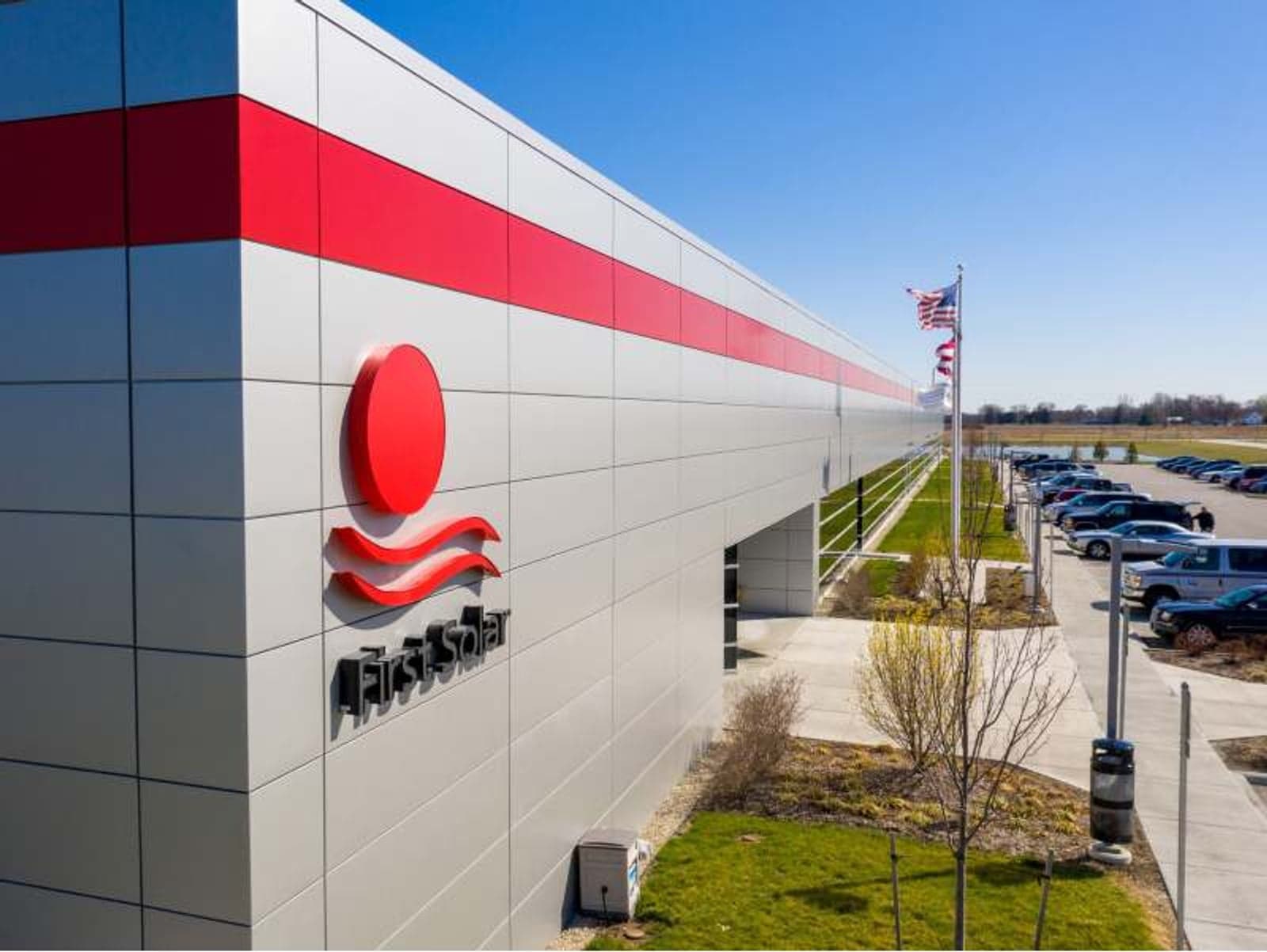
US solar technology firm First Solar has announced plans to build a fifth manufacturing facility in the United States to increase production of the Series 7 solar module.
First Solar will invest up to $1.1 billion in the expansion project, increasing manufacturing capacity by 3.5GW to reach 14GW in the US by 2026.
The facility will produce First Solar’s Series 7 modules, manufactured with 100% US-made components identified in the current domestic content guidance issued by the US Department of Treasury.
The Inflation Reduction Act provides tax credits for projects that use equipment made in the United States, in an effort to reduce the nation's reliance on Chinese-made products and boost home-grown manufacturing opportunities.
According to First Solar, its uniquely American technology is exclusively designed for the US utility-scale solar market.
First Solar utilises thin film Cadmium Telluride (CadTel) photovoltaic (PV) technology, which provides greater energy yield and offers superior recyclability compared to, for example, crystalline silicon.
The Series 7 includes a larger form factor, a new back rail mounting system and enhanced lifetime energy performance for PV projects.
Have you read?
US policymakers under pressure to get green hydrogen right
Amazon reaches 30 solar and wind projects in southeastern US
The location of the facility is yet to be decided however First Solar expects it to be complete in the first half of 2026, creating 700 new manufacturing jobs.
“This decision is underpinned by robust fundamentals, including an order backlog of approximately 78 gigawatts, the industry’s strongest balance sheet, a repeatable vertically integrated manufacturing template, and a proven technology platform,” said Mark Widmar, chief executive officer of First Solar.
First Solar had previously announced an approximately $1.3 billion investment in a new 3.5GW manufacturing facility in Alabama, a 0.9 GW expansion of its existing manufacturing footprint in Ohio, and a dedicated R&D innovation centre in Perrysburg, Ohio, which is expected to be completed in 2024.
A global manufacturing race
In the US, favorable policies and incentive schemes at the state and federal levels are expected to boost the industry’s growth in the US. According to the Department of Energy, the US PV manufacturing industry has the capacity to produce PV modules to meet nearly a third of today’s domestic demand.
The industry is focusing on technological advancements and innovation to minimize the cost of solar PV with industry players looking to expand their foothold in the renewable energy market over the coming years.
Europe has ambitious solar power targets. As part of its EU solar energy strategy, the region is aiming for 750GW of installed solar-PV capacity by 2030. However, according to McKinsey, this goal faces a potential supply resilience risk in that Europe currently relies almost entirely on imports from one country for the solar PV panels it needs - China.
While European companies initially led the industry, Chinese solar-PV companies now dominate both manufacturing at scale and deploying new technologies.
McKinsey notes that almost 95% of the world’s wafer production occurs in China, which is also home to the top five companies across each step of the value chain (barring Wacker in Germany).
European companies are starting to respond by expanding manufacturing capacity, such as Turkeys Kalyon PV boosting its 1.2 GW integrated ingot-to-module facility and Enel’s 3Sun building a 3GW facility to produce heterojunction (HJT) cell technology modules.