How AI can help make the most out of energy system flexibility
Yusuf Latief
Posted on: 12 March 2026
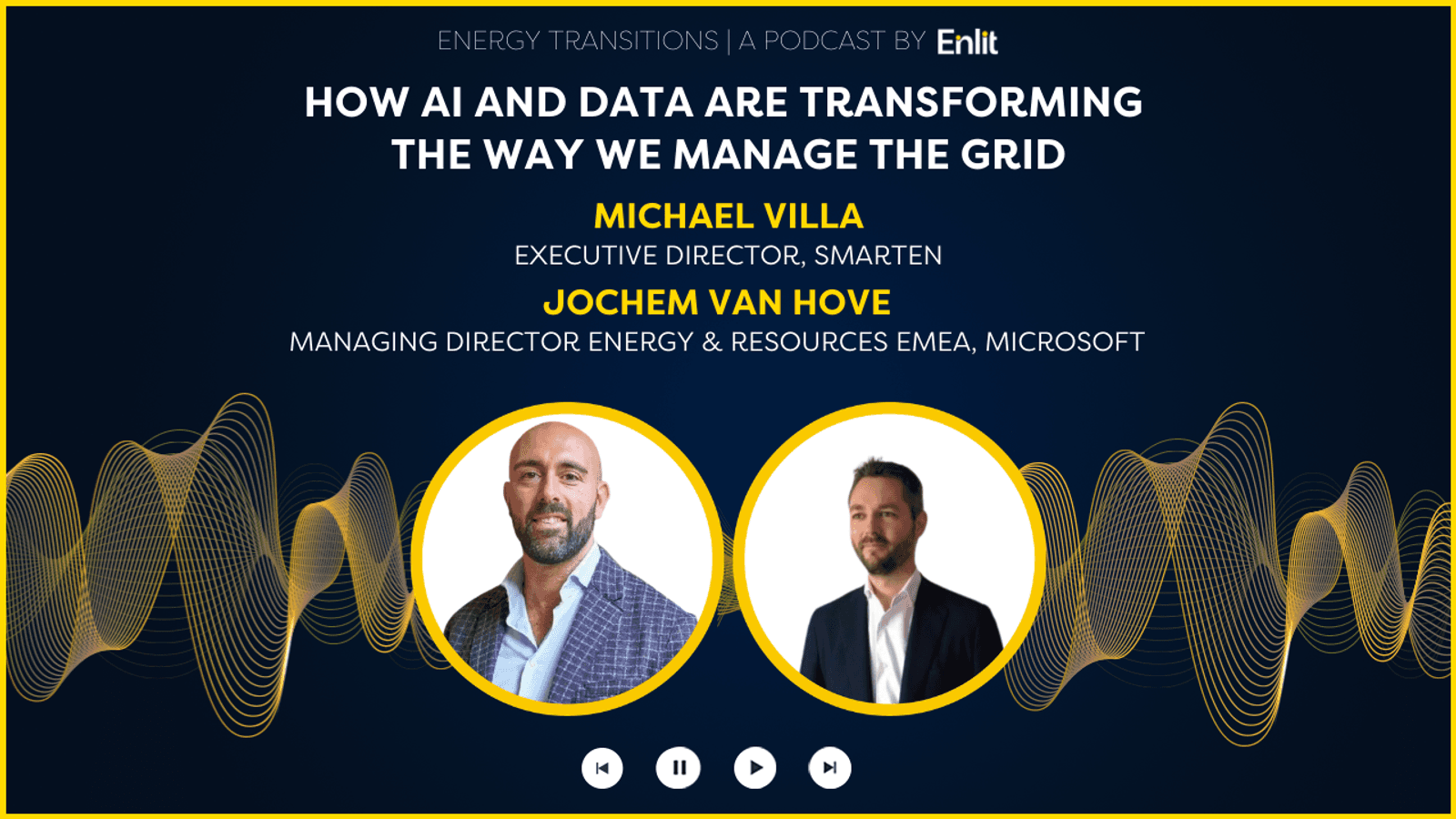
SmartEn's Michael Villa and Microsoft's Jochem van Hove discuss energy system flexibility and how it can be enhanced with artificial intelligence.

As Europe’s electricity system becomes more decentralised and renewable-heavy, flexibility is increasingly seen as the mechanism that will keep the grid stable.
But the question facing policymakers and industry alike is not whether flexibility exists. It’s about how to make the most of it.
That was the focus of a recent discussion with Michael Villa and Jochem van Hove, who joined the Energy Transitions podcast to examine how digitalisation and artificial intelligence are reshaping how flexibility is activated.
Their conclusion is straightforward: much of the flexibility Europe needs is already deployed in homes, vehicles and industrial sites. The challenge is turning that latent capability into something the grid can use.
From power plants to distributed flexibility
For most of the last century, flexibility in electricity systems meant adjusting large power stations.
Grid operators could call a plant and ask it to ramp generation up or down to balance supply and demand. In a system dominated by centralised generation, that model worked.
But the operating environment has changed.
Variable renewables, electrified heating, electric vehicles and digital technologies have turned the grid into a far more distributed system. Flexibility is now increasingly expected to come from the demand side.
Villa, the Executive Director of SmartEn, argues that this shift is already well underway.
“We need to think about new forms of flexibility, notably demand-side flexibility,” he says.
That flexibility exists across a wide range of assets: households adjusting consumption, electric vehicles shifting charging times, or energy-intensive industries temporarily reducing demand.
Ultimate flexibility comes with real-time insights. That requires everything to be connected in a way that allows data to flow and be accessible to those who need to make choices.
Yet much of that potential remains untapped.
The issue, Villa argues, comes down to an absence of incentives: “To activate flexibility from consumers, they need to be exposed to price signals or incentives.
“We are not there yet to exploit the full potential, not because we don’t have flexible resources deployed…but because we are missing these signals.”
Flexibility as a data problem
From a technology perspective, flexibility is increasingly becoming a data challenge. Said Microsoft’s van Hove, Managing Director Energy & Resources EMEA: “Ultimate flexibility comes with real-time insights.
“That requires everything to be connected in a way that allows data to flow and be accessible to those who need to make choices.”
Cloud platforms, data infrastructure and AI are therefore becoming core components of modern grid operation.
In practical terms, that means gathering data from multiple sources — consumers, system operators, weather forecasts and electricity markets — and translating it into signals that can trigger load adjustments in seconds or less.
And according to van Hove, Microsoft’s own operations illustrate the concept.
“AI and Gen AI are capabilities we, as Microsoft, are also fully embracing. Every new data centre that we bring online is also a moment where we add to that flexibility.”
AI in flexibility markets
Of course, AI is already widely used by companies operating in demand response and aggregation markets.
According to Villa, firms working with distributed flexibility are deploying machine learning tools for forecasting, optimisation and automated response.
“Flexibility is by definition time-dependent, and to have this time dependence adjustment, you need to have a lot of data from consumers, from system operators, and from world electricity markets.”
Sometimes, it’s a question of milliseconds in reaction to a request from a system operator to keep the system in balance.
These sources have to be combined and translated into a signal that allows for seamless activation, he says, “through data-enabled solutions, so that the activation of consumer flexibility is done very rapidly.”
The timeframes involved can be extremely short. In some cases, distributed resources must respond within milliseconds to maintain system balance.
“Sometimes, it’s a question of milliseconds in reaction to a request from a system operator to keep the system in balance,” added Villa. “So we really are talking about the use of AI to really support crucial systemic needs with the support of distributed resources.”
This is a far cry from the traditional model in which operators manually contacted power plants.
Instead, the modern system relies on secure digital infrastructure linking thousands of decentralised assets, each responding automatically to system signals.
Villa describes the shift as a fundamental change in how electricity systems operate.
“In the past, we were very much used to system operators calling the big power plant and asking them to turn on or off. Now we need to rely on a decentralised system connected through reliable and secure digital tools.”
The emerging role of generative AI
While machine learning is already widely used, the industry has also begun to explore what generative AI could add.
One application is forecasting.
Accurate predictions are critical for both renewable generation and electricity demand. Even small improvements can significantly improve grid stability and reduce balancing costs.
Van Hove says generative AI is helping improve those forecasts.
“Accuracy can go up, and that means something in terms of how you’re able to predict outages in the system,” he explains. “That is a huge part of how flexibility ultimately can or cannot work.
Listen to the full podcast to hear more from Villa and van Hove on cybersecurity, what conditions are needed to make a decentralised energy resource market thrive, and why we need to lean into the opportunities offered by digital, intelligent technologies.