Life cycle insights in MOF-based hydrogen storage within MOST-H2
Guest/partner contributor
Posted on: 11 December 2025
MOST-H2 aims to advance sustainable hydrogen storage by developing high-performance, monolithic metal-organic framework (MOF) adsorbents.
Widespread use of hydrogen as an energy carrier is a key priority for the EU, in order to achieve its climate and energy transition goals. However, developing sustainable, efficient and safe hydrogen storage technologies has yet proven to be challenging. Here is where MOST-H2 comes into play. The project combines advanced synthetic strategies and sophisticated computational techniques, including molecular simulation and machine learning, with a cyclic materials development approach, to deliver new high performance, sustainable monolithic metal-organic framework (MOF) adsorbents for hydrogen storage.
This integrated multiscale lab-to-tank approach develops, validates and demonstrates innovative, low cost cryo-adsorptive MOF-based hydrogen storage with an optimal combination of volumetric and gravimetric capacity, but also a low environmental footprint while operating at low pressures.
To identify differences between the choice of the main precursors and the main solvents involved and to guide improvements in the synthesis of a potential industrial-scale production for lowering the environmental impacts, an analysis of the whole life cycle from cradle-to-grave is applied within the project. This LCA approach will also include the tank system and the hydrogen supply chain in the final assessment.
MOST-H2 methodology
Two different approaches need to be considered when analysing the environmental impact of a product and its surrounding system. A cradle-to-gate LCA assesses a product's environmental impact from raw material extraction ('cradle') up to the moment, when it leaves manufacturing ('gate'). Transport is not considered.
A cradle-to-grave LCA is more comprehensive and covers the entire product life cycle, including its use phase and disposal. Within MOST-H2, both approaches are investigated.
Initially, for the full cradle-to-grave studies the functional unit and for cradle-to-gate studies the declared unit must be defined. For MOST-H2, the functional unit for the cradle-to-grave of the MOF storage system is selected as: Storing 1kg of hydrogen, which will be released and refilled daily over the whole reference service life (e.g. 20 years or different) with a pressure-temperature swing adsorption process between 100bar/77K and 5bar/160K. For the cradle-to-gate study of the MOF production, the declared unit is defined as: Storage of 1kg of hydrogen inside the MOF taking into account the gravimetric density for a pressure-temperature swing between 100bar/77K and 5bar/160K.
The declared unit for cradle-to-gate differs here from other studies where often only the production of 1kg of MOF, without including the performance of the MOF as a key indicator, is assessed. For this reason, cradle-to-gate results are given per 1kg H2 stored, as well as 1kg MOF produced.
After defining the functional unit, the system boundaries need to be set. For MOST-H2, the system boundaries cover the chemical reactions and heating steps needed to synthesise different MOFs as well as the synthesis of the metal precursor and organic linker starting from the raw materials. These system boundaries for cradle-to-gate are depicted in Figure 1. The final cradle-to-grave studies will also include the use phase with compression, cooling and hydrogen supply over the reference service life, as well as end-of-life scenarios.
![Figure 1 - System boundaries for the cradle-to-gate for different MOFs with background data in grey and foreground data within the dotted box (experimental). The different colour codes depend on the modelling approach as described in Parvatker et al [1].](/_next/image?url=https%3A%2F%2Fenlit.stream.prepr.io%2F2funjkd6onjo%2Fw_1600%2Ffigure-1-system-boundaries.png&w=3840&q=75)
For calculation of the environmental impacts, different background data, as well as experimental foreground data, i.e. laboratory data for the synthesis of different MOFs, such as amounts for linkers, metal salts, solvents, modulators, additives and cleaning solvents (if applicable), as well as the heating temperatures, heating duration and the mixing duration and are used together with details from the synthesis setup.
To simplify the model and to harmonise the foreground modelling with the background database, recycling at the end of life follows a so-called cut-off approach, also known as the 100:0 approach or recycled content approach. The critical hotspot of solvent use and solvent recycling is not cut from the product system, since the solvent recovery is assumed to be closed-loop recycling and therefore part of the same life cycle under study. The closed-loop recycling is expected to take place, for example, in the same chemical plant that is producing the MOF and the recycled solvent is directly fed back into the inputs and leads to environmental burdens from recycling.
In green metric approaches, figures of merit like the process mass efficiency or reaction mass efficiency are used [2], whereas the reaction mass efficiency is the ratio of the mass of all products over the mass of the reactants. The intensity is usually the inverse of the efficiency. Two main parameters that are used within MOST-H2 are the reaction mass intensity and an additionally defined solvent mass intensity, which is given by the ratio of the volume of solvents over the mass of the products.
Results and discussion
To show in a compact way the impact results for different scenarios of the solvent mass intensity and the reaction mass intensity, a colour coded matrix was developed and calculated for each MOF structure (Figure 2).
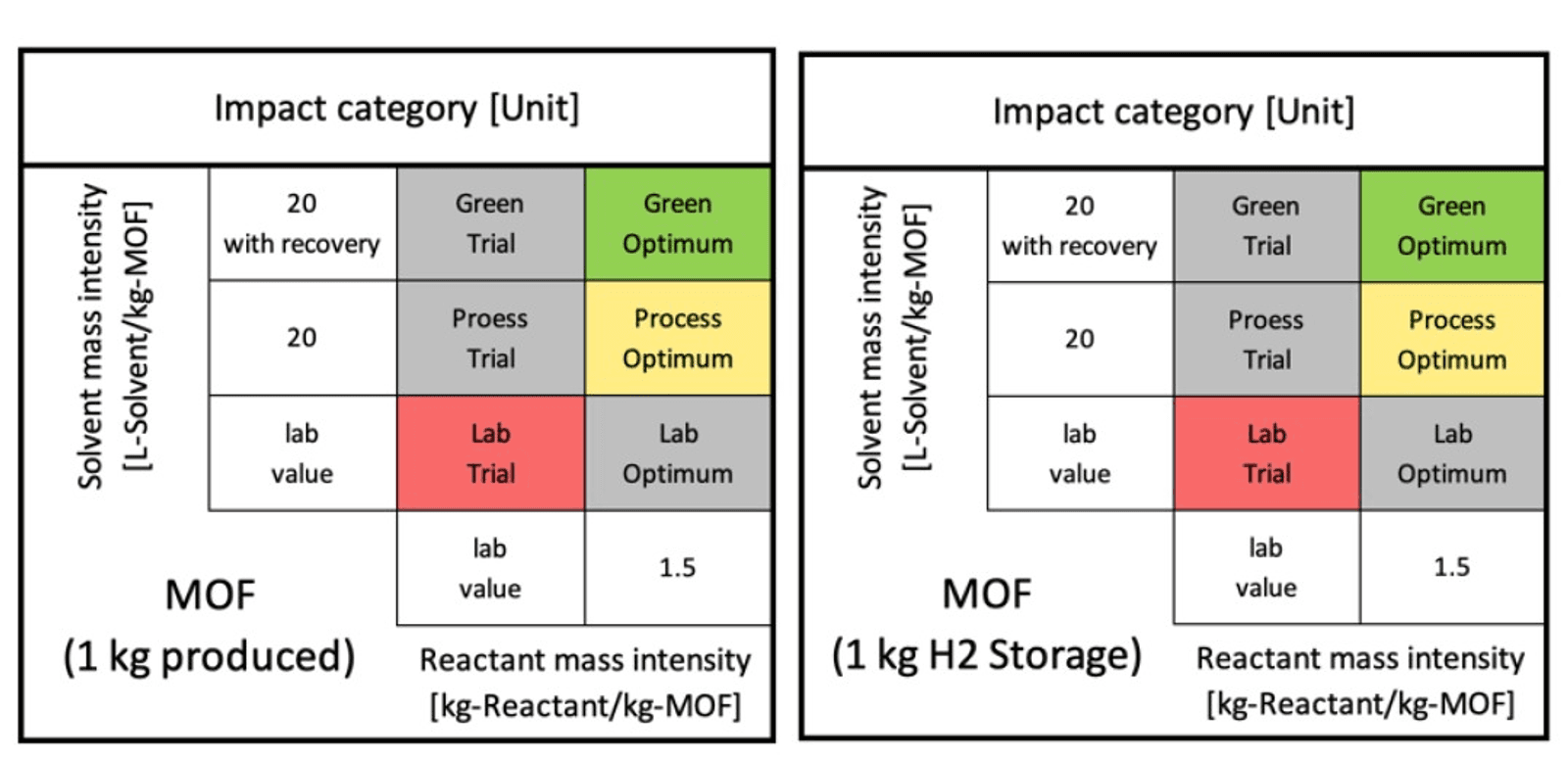
Figure 2 depicts two matrices for the cradle-to-gate production of 1kg MOF on the left and the declared unit of 1kg H2 stored inside the MOF structure with the standard pressure-temperature-swing on the right. Both matrices have the same structure. The result values in the right box are scaled from the values on the left by the best measured or estimated gravimetric uptake of the MOF in mass fractions (wt%).
In total, all result matrices for six different scenarios, three literature MOF structures, six MOF structures developed within the project and 10 different synthesis recipes are calculated for single score, climate change and resource use impacts by using the environmental footprint method 3.1. This results in 60 matrices and 360 environmental impact result values, which can be seen in detail in the latest public deliverable [3].
Conclusion
When laboratory recipes are harmonised for a potential industrial upscaling by assuming equal solvent mass intensities and reactant mass intensities, different MOFs from the solvothermal synthesis exhibit similar climate change impacts in the order of 30 to 70kg CO2e for the declared unit of 1kg MOF produced and in the order of 300 to 700kg CO2e for the declared unit of 1kg H2 stored in the MOF.
These results are due to the fact that the actual impacts mostly depend on the amount of solvent use and the potential recovery rate of the solvent in a subsequent distillation (recycling) process and less from the precursor or the synthesis step itself. In a scenario where a reasonable recovery rate of 90% for the solvent is set, the climate change impacts can be as low as 30kg CO2e for 1kg MOF produced in an upscaled and optimised synthesis route.
System boundaries will be extended by including the use phase and the end-of-life, where potential scenarios for landfilling, burning or recycling of some parts of the tank system, for example the steel, will be assessed with secondary data. For the use phase, parameter variations of the reference service life and the refilling rate will be studied further. An initial hotspot analysis of the use phase has already shown that the energy for compression and cooling are additional significant parameters that influence the overall environmental impacts of the whole MOF tank system but remain equal or lower than in conventional hydrogen storage systems that use higher pressures.
Together with a risk assessment and key metrics like the H2 storage capacity, the MOST-H2 tank will be compared against benchmarks of other technologies like compressed or cryo-compressed hydrogen at 350 and 700bar.
Finally, the full life cycle model will be completed with cost data for the inputs in the tank system, which allows to assess all environmental impact categories and the life cycle costing for all material and energy demands at once.
References
1. Parvatker, A. G. and Eckelman, M. J. (2019). Comparative Evaluation of Chemical Life Cycle Inventory Generation Methods and Implications for Life Cycle Assessment Results. ACS Sustainable Chem. Eng. 2019, 7 (1), 350–367.
2.Blömer, J., Maga, D., Röttgen, J., Wu, Z., Hiebel, M., Eilebrecht, S., Jentsch, S. and Eggers, N. (2024). Assessment of Chemical Products and Processes: Green Metrics and Life Cycle Assessment – A Comparison. Chemie Ingenieur Technik, 96: 561-574.
3. Deliverable D5.3 Cradle-to-gate LCA and LCC of MOST-H2 MOFs: version 3.
About the authors
Dr Conrad Spindler is a Senior Researcher and Consultant at GreenDelta in Berlin with 8 years of experience in fundamental and applied research for materials sciences. In his current position, he has worked on life cycle sustainability assessment and database developments for private customers and public research projects, including MOST-H2.
Loay Radwan is a Senior Sustainability Consultant and Researcher at GreenDelta with over five years of experience in sustainability research, data analytics and project management. He works on EU Horizon projects, such as MOST H2, integrating and advancing environmental, social and economic dimensions in sustainability assessments.
Most popular
Join the community for freeAnd get access to all content
Related projects
MOST-H2
+1
1 June 2022 - 31 May 2026
View projectLatest content
+4
Accelerating sustainable hydrogen storage: MOST-H2 and the MOFSynth tool’s breakthrough in MOF design
The MOST-H2 project advances hydrogen storage by computationally designing sustainable metal organic frameworks (MOFs) using the MOFSynth tool, which evaluates synthesisability based on energy and geometry differences.
- Guest/partner contributor
- 15/09/2025