MOST-H2 hydrogen storage innovation for clean regional rail applications
Guest/partner contributor
Posted on: 22 January 2026
A key objective of MOST-H2 is to assess the technical feasibility of hydrogen storage systems based on metal-organic frameworks for heavy duty mobility.

Across Europe, regional railways play a crucial role in daily mobility, yet many still rely on diesel traction. Electrification is not always feasible, particularly for long or mountainous routes. Hydrogen fuel cell electric trains offer a zero emission alternative that combines electric traction with fast refuelling and long range.
The MOST-H2 project works on an integrated multiscale lab-to-tank approach to develop, validate and demonstrate innovative, low cost, cryo-adsorptive hydrogen storage. It aims at developing monolithic metal-organic framework (MOF) adsorbents with an optimal combination of volumetric and gravimetric capacity. The targeted materials can store hydrogen efficiently, will be easy and safe to transport and have a small environmental footprint.
Two partners from the project consortium investigating the holistic feasibility study of the MOF storage system in the railway sector as well as the further deployment scenarios in the road transport sector are FEN Research GmbH, representing the Green Energy Centre Europe, located in Innsbruck, Austria, and Italferr SpA (Ferrovie dello Stato Italiane Group, ITFR) in Rome, Italy.
In this article, the focus is on the selected use cases and possible integration of compressed hydrogen as a basis for follow-up studies on the application of the MOST-H2 MOF-H2 storage in heavy duty mobility.
MOST-H2 methodology
Since the implementation of a H2 electric train is associated with a significant technology and procurement risk due to the status of prototypes and first series, an accompanying project entitled HyTrain was developed by FEN Sustain Systems GmbH at the early stages of the commercial project development in the region of Tyrol, Austria for the project operator Zillertaler Verkehrsbetriebe AG (ZVB), together with the hydrogen research centre HyWest at the Green Energy Centre Europe.
This was followed by an R&D project, which was later submitted via WIVA P&G to a national research funding call. After positive evaluation by an international jury, the project entitled 'WIVA P&G HyTrain' was awarded funding in 2020 from the Austrian Climate and Energy Fund via the Austrian Research Promotion Agency.
The exploitable results from this R&D project are used as a basis for the technical feasibility evaluation of the low pressure MOST-H2 MOF-based H2 storage tank (operating at 100 bar) in the railway sector.
Project results
Case study 1: Zillertalbahn, Austria
Diesel-hydraulic locomotive two-fold train sets currently in operation by ZVB drive about 0.6 million km per year and consume about 0.8Ml of diesel. This corresponds to an average of 1.3l/km of diesel and CO2 emissions of 2.2 million kg per year.
In general, some of the advantages of the H2 electric train in comparison to the diesel-hydraulic locomotive trains are:
- Reduction of travel time from the current 55 minutes to 45 minutes for the 32km route with the same number of 18 stops (Figure 1);
- High acceleration capacity of the trains (S-Bahn characteristics);
- Increased operating speed from 70 km/h to 80 km/h (100 km/h);
- Increase in container size from the current 220 to 450 passengers/train;
- Increase in train kilometres from the current 602,615 to 770,880 per year.

In the initial phases of the commercial project development, technical requirements for the operation of an H2 electric train by ZVB was communicated to Stadler Rail AG, a hydrogen train supplier, based on which the following technical requirements were established:
- Four storage unit modules with aluminium frame;
- Connection via high pressure line;
- Pressurised hydrogen cylinder (type IV) with 8kgH2 at 350 bar;
- Service life of 5,000 cycles or refuelling in accordance with EC 79/2009;
- One refuelling process per day outside operating hours;
- TK16 high flow couplings.
Further technical data from this hydrogen storage system unit were collected from technical data sheets to calculate the required input parameters based on the mass of the storage system. The mass of the storage system can be expressed by the sum of the total mass of five pressurised H2 cylinders including the total mass of the H2 stored inside plus 10% of the total sum for the mass of the storage system in cubic form.
Case study 2: Southern Italy regional line
In order to find a comparable system to the Austrian case study, the focus was placed on a railway line in southern Italy with similarities such as travelling from point A to point B and regional services. After several evaluations, a track line in south of Italy was selected (Figure 2).
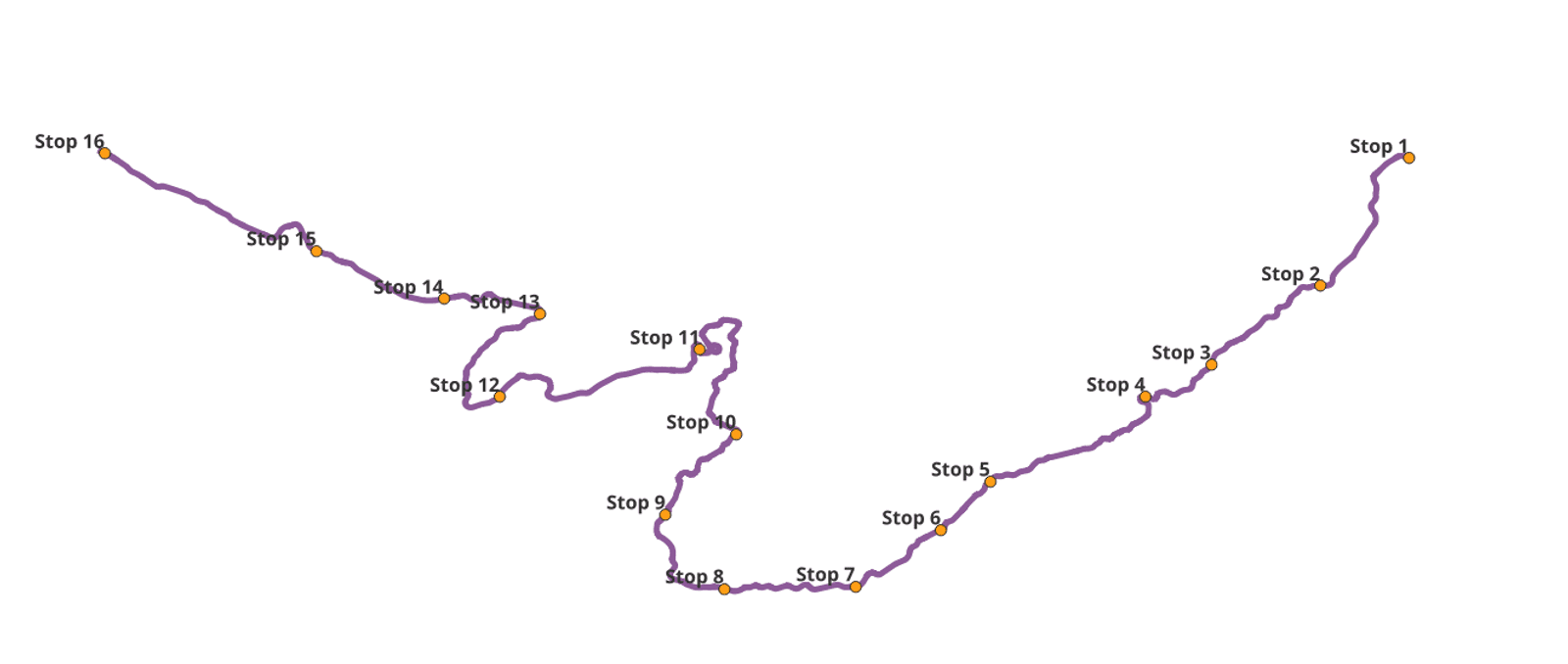
This line extends for approximately 180km and, similar to the Austrian example, is currently operated with regional passenger services. It includes 16 intermediate stations along its route.
Both case studies share the common feature of relying on diesel traction and exhibit suitable conditions for the implementation of a hydrogen-based propulsion system. Moreover, the adoption of hydrogen traction, combined with the improved performance of next generation rolling stock, results in the order of 20 minutes in travel time along the line. The diesel train in operation is the ALn 668 model powered by two diesel engines with a power rating of 115kW each, allowing a maximum speed of 110km/h and a range of about 600km. With 600l of diesel fuel, this diesel train can travel approximately 690km.
With a similar number of stops, the energy consumption for both Austrian and Italian case studies can be estimated. With a journey duration of about 3 hours 20 minutes, the total energy consumption is about 300kWh.
Conclusion
Using data from Austria’s 32km Zillertalbahn and a comparable 180km Italian line, the study combines modelling with real duty cycle data to determine the size of tanks and refuelling costs for possible applications of low pressure (approximately 100 bar) MOF-H2 storage as a viable option for clean regional rail transport.
Early results suggest feasible energy densities and daily depot refuelling using well established high flow interfaces. The economics depend on the cost of MOF per kilogram and the extent of the rollout.
Current models are being further developed for comparison with the MOST-H2 MOF-H2 storage tank under development. One interesting aspect would be to consider the infrastructure beyond the vehicle storage system, with specific references to the refuelling stations, and accordingly to expand the costs analysis and planned modelling, supporting the study with a multicriteria analysis.
For more on MOST-H2, visit the project website.
About the authors
Niusha Shakibi Nia is a Senior Researcher and Project Manager for technology, innovation and R&D projects with a focus on power on demand and power-to-hydrogen processes. Her role within MOST-H2 is to coordinate the research activities and tasks associated to the techno-economic analysis of MOST-H2 storage systems.
Juan Carlos Rodas Correa is a senior civil engineer working at Italferr SpA and contributing to national and international infrastructure projects through advanced analyses in railway operations, service planning and system performance assessment. As part of MOST-H2 he has led the development of travel time simulation models.
Nikolaus Fleischhacker is CEO of FEN Research GmbH and co-founder of the Green Energy Centre Europe. With a doctorate in civil and environmental engineering, he leads national and EU hydrogen initiatives including MOST-H2, advancing technologies and strategies that enable Europe’s transition towards energy autonomy and climate neutrality.