Power demand destruction intensifies in Europe shows report
Power Engineering International
Posted on: 17 April 2024
A post-COVID slump in electricity demand continued in the first quarter of this year in a period characterised by record renewables generation| falling fossil fuel output and declining gas prices.
A post-COVID slump in power demand continued in the first quarter of this year in a period characterised by record renewables generation, falling fossil fuel output and declining gas prices.
These were key highlights of a new report on the European electricity market from energy data analyst Montel EnAppSys.
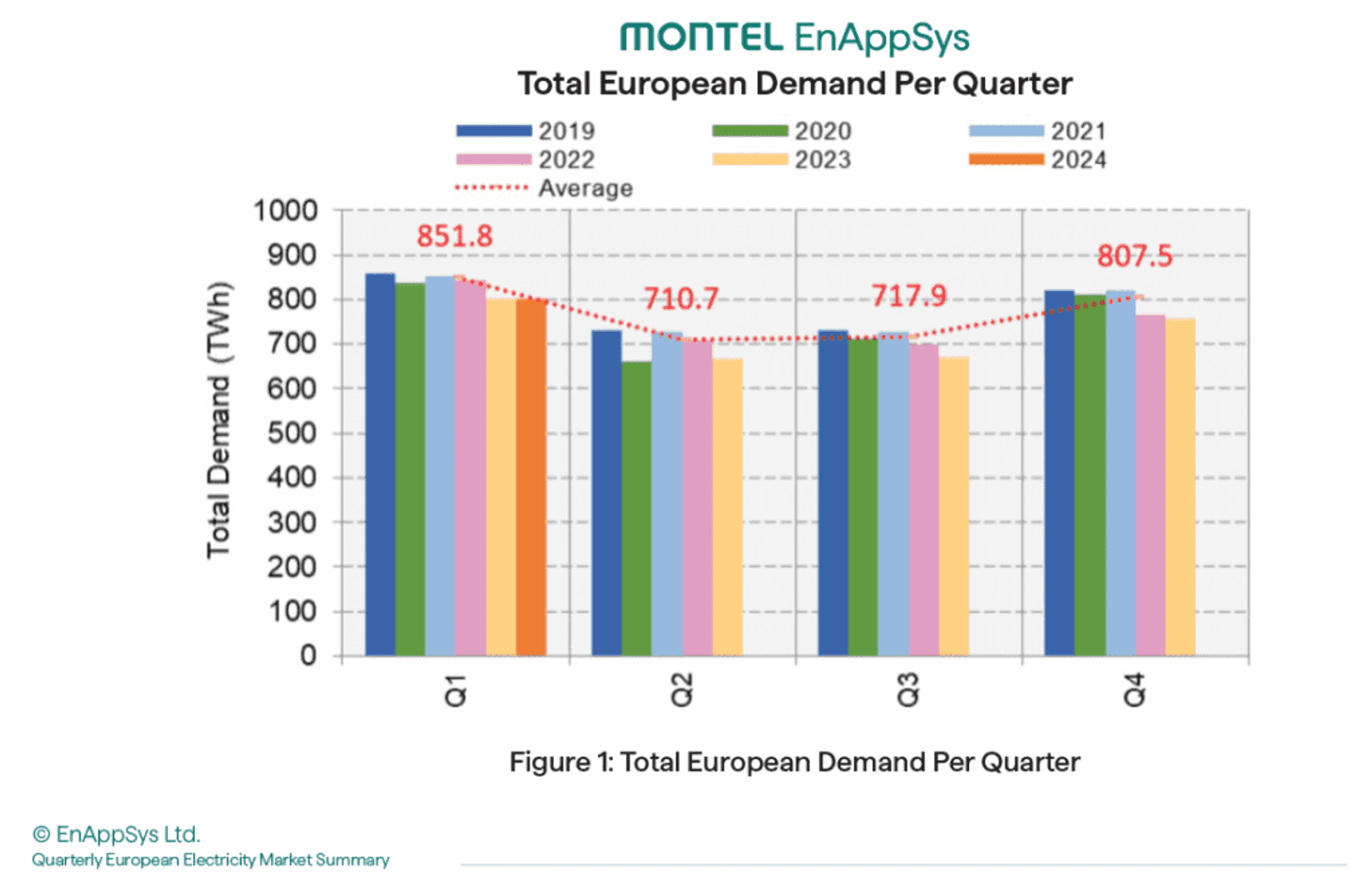
The report showed that demand totalled 800.1TWh in the first three months of this year, 5.2% lower than in the same period in 2022 and 6.3% lower than in Q1 2021. This highlighted a longer-term trend of demand destruction which started when the COVID-19 pandemic hit in early 2020 and continued as the global energy crisis unfolded.
Despite this underlying trend, however, there were signs of a possible recovery in the Nordics, with Denmark, Finland, Norway and Sweden seeing a 9%, 11%, 7%, and 8% rise in demand versus Q1 2023 respectively. This rise was attributed to the ongoing electrification of heating and transport, as well as this region experiencing a particularly cold winter.
Renewables generation across Europe
Renewables generation hit a record high of 375.9TWh, exceeding the previous record of 358.4TWh the previous quarter, due mainly to a rise in hydro generation from 126.4TWh in Q4 2023 to 136.6TWh in Q1 2024. The biggest increase came from France and Norway, with hydro increasing by 3.5TWh and 2.1TWh respectively.
Wind out-turn in Europe totalled 175.6TWh in the first three months of this year, slightly below the previous quarter (177.4TWh) but still the second highest figure for wind generation on record.
Have you read?
Has Europe lost its first-mover advantage in renewable energy?
Accelerating offshore wind development through advanced modelling
Low demand and high renewables output led to a fall in fossil fuel generation. The biggest decline came from coal/lignite, which fell to 84.8TWh from 94.1TWh the previous quarter. Germany saw the most substantial decline, with falls of 2.4TWh and 1.5TWh for coal and lignite respectively compared to the previous quarter. Poland also saw a fall in coal usage, a 1.9TWh decrease versus the previous quarter.
Gas prices declined steadily across Q1 2024, with the average price falling as low as €23/MWh in January and February, although prices recovered slightly to an average of €27/MWh in March.
Jean-Paul Harreman, director of Montel EnAppSys, said: “Despite electricity and gas prices falling from the peaks of Q3 2022, demand remains down compared to the pre-COVID and pre-energy crisis periods. With the weather especially warm by historical standards in some parts of Europe, reduced heating load and low industrial demand have contributed to the continuation of this trend. A further reason for the historically low demand is the increase in embedded solar capacity, which is ‘behind the meter’ and hence generation is registered as negative demand.
“The surge in renewables generation in Q1 was primarily due to an increase in hydro generation. One possible reason for the high levels of hydro generation was the historically warm temperatures in France, which are likely to have caused melting of snow, allowing more water to flow into reservoirs.
“Given the time of year, solar output made up a relatively small part of the renewables total (36.5TWh). However, although this figure was low compared to hydro and wind, it was still the highest solar output on record for any Q1 period, suggesting that records for solar generation are likely to be broken in Q2 and Q3 when the weather is more favourable.
“The ongoing fall in gas prices since 2022 caused the coal-to-gas switching phenomena to continue into the first quarter of this year, with the short-run marginal cost of gas generators dropping beneath that of coal units. This resulted in gas-fired assets being dispatched more often ahead of coal-fired ones. This trend was seen most strongly in Germany; compared with Q1 2023, there was a 1.8TWh increase in gas generation against a 7.4TWh decrease in coal and lignite generation.”
The report shows that renewables (biomass, hydro, wind, solar and waste) accounted for more than one half (50.1%) of overall European power generation in the first quarter of 2024. Nuclear (23.4%), gas (14.7%), coal/lignite (11.3%), oil (0.4%) and peat (0.1%) made up the rest.