Project DECODIT: Bringing the energy transition home
Areti Ntaradimou
Posted on: 22 November 2024
The EU Horizon Programme-funded DECODIT project which aims to simplify the energy transition for homeowners.
Areti Ntaradimou talks to Stratis Kanarachos and Vassilis Antonopoulos to learn more about the aim of project DECODIT to simplify the energy transition for homeowners.
Funded by the EU Horizon programme through the Climate, Infrastructure and Environment Executive Agency (CINEA), project DECODIT equips citizens with the tools and knowledge needed to make informed decisions about energy efficiency.
Notably, this project also marks the first time that Enlit is participating in a consortium as the communication and dissemination partner, playing a role in conveying the project’s value to a broader audience and ensuring widespread awareness of its outcomes.
What is DECODIT?
DECODIT is an Innovation Action project with a focus on demystifying the complex process of home energy transition.
At its core, the project focuses on gathering and processing data from various service providers to create user-friendly digital tools. These tools are designed to help homeowners navigate the most effective energy-saving options, from evaluating renewable energy solutions to exploring renovation scenarios and assessing electrification opportunities.
According to Stratis Kanarachos, a Senior Consultant at European Dynamics and the project’s Coordinator, “DECODIT is not just about technology; it’s about empowering individuals at all levels of energy literacy to actively participate in the energy transition.
"We are building tools that are accessible and beneficial to everyone.”
Also of interest:
EU Energy Projects Podcast: Empowering homeowners for energy efficiency with DECODIT
Project WeForming: Revolutionising intelligent grid-forming buildings
EU Energy Projects Podcast: Coordinated infrastructure planning with Mark van Stiphout
Addressing key energy sector needs
Buildings account for approximately 40% of the EU’s energy consumption and 36% of its greenhouse gas emissions, Eurostat data suggests, making them a crucial target for energy efficiency improvements.
DECODIT tackles this challenge by developing digital services that enable citizens to modernise their homes. By involving citizens directly in the service design process, the project ensures that the developed solutions meet their actual needs.
“Our approach is citizen-centric,” Kanarachos explains. “By engaging homeowners in the design process, we ensure that the tools we create are truly effective and user-friendly.”
Furthermore, DECODIT will recommend changes to policies, regulations, market structures, and business models to encourage widespread adoption of these energy-saving services.
A collaborative effort
The success of DECODIT is fuelled by a diverse consortium of 18 partners from 11 European countries, each bringing unique expertise to the table.
Academic institutions like FRC, AAU, and INESC provide the scientific foundation through cutting-edge research and development. Technology providers such as European Dynamics, QUE Technologies, and INNEN translate this research into practical, market-ready digital solutions. End users, including MIW and RENESCO, ensure that the developed tools are tailored to meet specific needs and promote widespread adoption.
Kanarachos emphasises the collaborative nature of the project: “This is a truly European effort.
"Each partner contributes a critical piece of the puzzle, ensuring that DECODIT’s solutions are robust, scalable, and ready for the market.”
QUE Technologies, in particular, plays a crucial role in achieving DECODIT’s objectives. “Our advanced technology ensures seamless integration and processing of diverse data sources from demonstration sites,” says QUE’s Vassilis Antonopoulos.
“This is essential for delivering accurate, personalised decision support, which will facilitate active citizen participation in the energy transition.”
Target audience
DECODIT’s influence extends beyond just homeowners. The project targets a broad spectrum of stakeholders including policymakers, regulatory bodies, complementary Horizon Europe initiatives, industry players, and the research community.
Kanarachos notes, “We are not just building tools for individual homeowners; we are creating a framework that can drive systemic change across the entire energy sector. By engaging a wide range of stakeholders, we ensure that the impact of DECODIT is both broad and deep.”
Innovative digital services
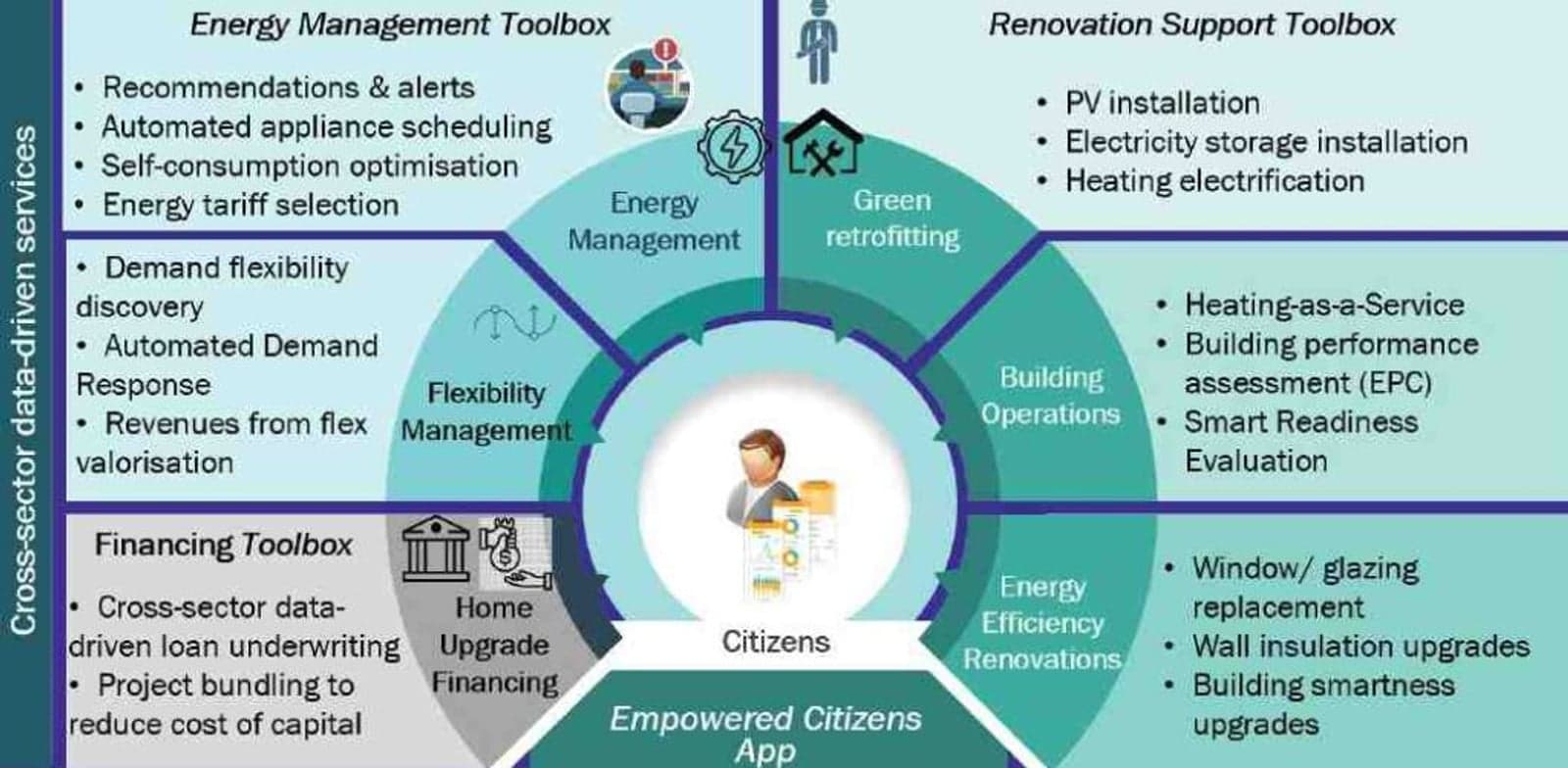
A key objective of DECODIT is to develop digital services that assist citizens in making informed decisions about their energy use.
These services include a personal data platform where homeowners can securely manage information about their properties, and an AI-driven assistant that offers personalised guidance on energy efficiency.
For industry experts, DECODIT provides a toolbox for analysing building energy performance and planning renovations.
Additionally, a financial decision support system helps assess loan eligibility for home upgrades, reducing financial barriers and encouraging investment in energy-efficient solutions.
“The tools we are developing,” Kanarachos explains, “are designed to make the energy transition as seamless and accessible as possible. Whether you’re a homeowner looking to improve your energy efficiency or a financial institution assessing loan risks, DECODIT has something to offer.”
QUE Technologies emphasises the importance of their development of the Consumer Digital Twin (CDT), a data management framework that will advance into a cloud-based, semantically enabled consumer-owned data integration system.
“The CDT represents a significant advancement,” says Antonopoulos. “It allows for managing cross-sector data and supports domestic energy asset configurations, making it easier for citizens to participate actively in the energy transition.”
Have you read:
We need an energy transition that works for everyone says Anna Bazley
It’s time for utilities to evolve for the new energy customer says AGL’s Jo Egan
Diverse pilot projects across Europe
DECODIT is being tested in four European countries, each with unique conditions that reflect the continent’s varied climate, cultural norms, and regulatory environments.
For instance, the Imanta Garden Complex in Riga, Latvia focuses on energy management services and balancing energy loads in a modern residential complex. In contrast, the Murcia demo site in Spain explores renewable energy adoption in a cooperative community. Each pilot is designed to test the adaptability of DECODIT’s solutions across different regions.
“Our pilot sites are crucial,” says Kanarachos. “They allow us to fine-tune our tools in real-world conditions, ensuring that they are effective across a wide range of scenarios.”
QUE Technologies is also deeply involved in the digitalisation of these demonstration sites, leading efforts to establish federated data sources and ensure interoperability with DECODIT’s core components.
“We are responsible for surveying each pilot infrastructure’s readiness and supporting its upgrade,” explains Antonopoulos. “This ensures that the digital tools we develop can be effectively implemented and scaled across different regions.”
Overcoming regulatory challenges
DECODIT recognises the challenge posed by varying local rules and regulations across Europe. To address this, the project is developing flexible digital tools that can adapt to specific regional and community needs while maintaining a standardised foundation. This approach ensures that the solutions offered are cost-effective and compliant with local regulations.
“Regulatory flexibility is key,” Kanarachos points out. “By designing tools that can be tailored to local needs, we can overcome barriers that would otherwise hinder the adoption of energyefficient solutions.”
Support: EU Commission and local authorities
The success of DECODIT depends heavily on collaboration with the European Commission and local authorities.
The Commission can help by fostering partnerships with similar Horizon Europe initiatives and promoting standardisation efforts, which will amplify the project’s impact. Local authorities, with their indepth regional knowledge, are instrumental in tailoring DECODIT’s approach to local conditions.
“Support from both the EU Commission and local authorities is critical,” Kanarachos concludes. “Their involvement ensures that our project not only meets its objectives but also delivers lasting benefits to communities across Europe.”
Driving the energy transition
Ultimately, project DECODIT is one of many EU-funded projects that drive innovation and energy efficiency.
What differentiates this project is that its citizen-centric approach, which actively involves end users in the design process, ensures that the solutions are not only effective but also tailored to real-world needs.
Project DECODIT is not just about advancing technology. It’s about creating a sustainable future by enabling citizens to play an active role in the energy transition.
Related tags
Most popular
Join the community for freeAnd get access to all content
Related projects
DECODIT
+4
1 June 2024 - 31 December 2027
View project