South Africa's grid funding gap hampers energy transition
Yunus Kemp
Posted on: 26 May 2026
Delays in resolving grid connection uncertainty, budget quotes and self-build frameworks are already stalling some renewable energy projects.
Mounting challenges around financing, bankability and delivery of South Africa’s rapidly expanding transmission grid infrastructure risks slowing down the country’s energy transition.
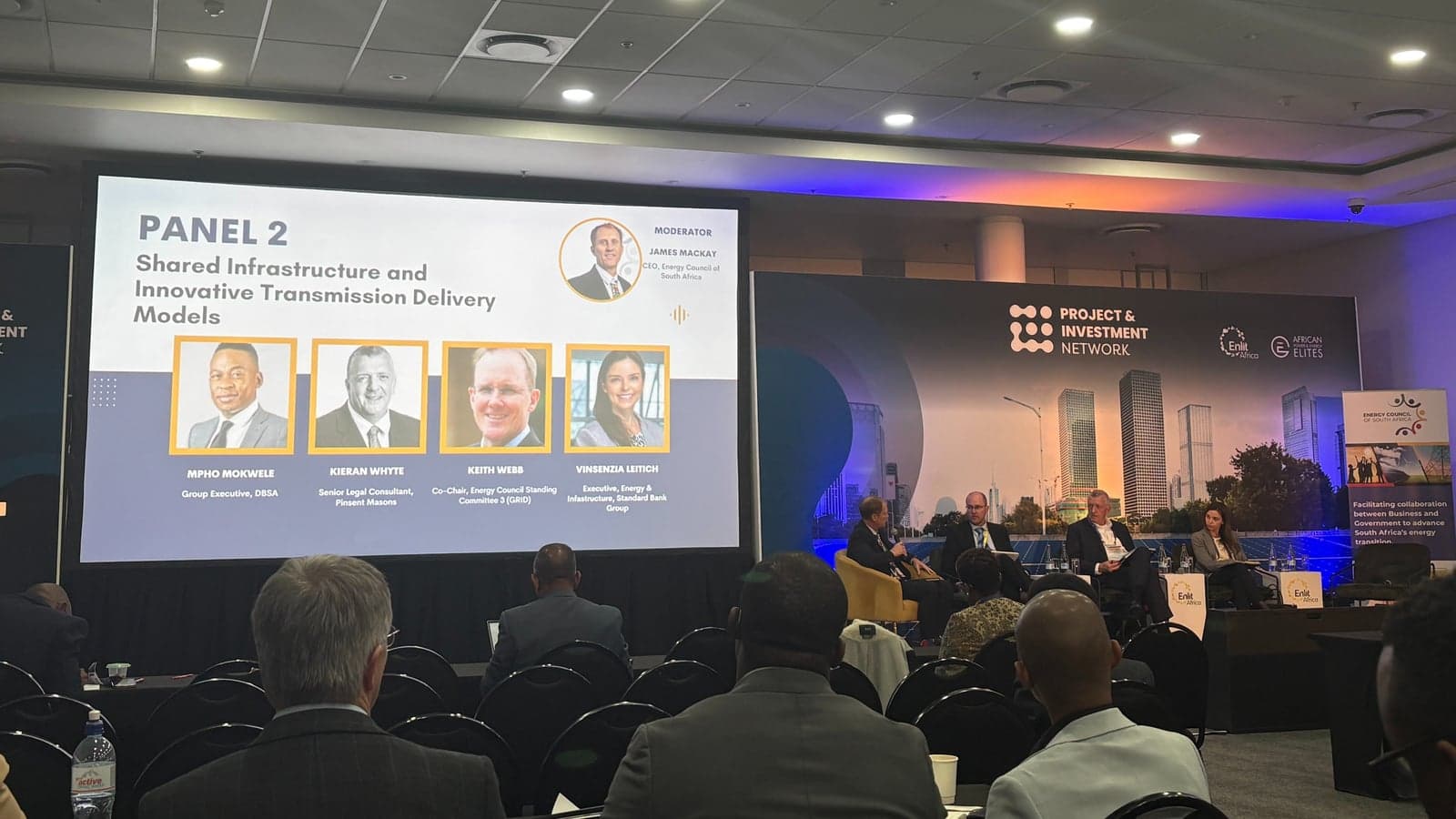
That was the warning from energy executives, financiers and legal experts speaking during a panel discussion on shared infrastructure and innovative transmission delivery models at Enlit Africa 2026 in Cape Town.
Panellists said South Africa’s combined Transmission Expansion Plan (TEP) and Independent Transmission Projects (ITP) pipeline already represented a roughly R440 billion capital programme, with near-term collector grid requirements expected to add another R30 billion.
The large-scale investment requirement comes as government and industry pursue plans to unlock up to 5GW of additional grid capacity in the near term to support renewable energy deployment and wheeling arrangements.
James Mackay, CEO of the Energy Council of South Africa, said improved integration planning could unlock further transmission capacity through to 2035.
“We think that through integration optimisation and better planning that’s possible,” Mackay said.
However, he cautioned that South Africa was attempting to deliver a massive integrated transmission programme while operating in a rapidly evolving legal and regulatory environment.
“The challenge in the room is that we’ve got to deliver this large integrated capital programme in a changing legal and regulatory environment,” he said.
Despite strong market demand, available capital and technical expertise, growing pressure on the national fiscus and affordability constraints meant the sector would need innovative financial models and enhanced security structures to crowd in investment.
Among the financing mechanisms under discussion were public-private partnerships (PPPs), concession structures, self-build transmission models and greater involvement by development finance institutions (DFIs).
Self-build transmission under pressure
Keith Webb, co-chair of the Energy Council GRID working group, said the industry had been focusing heavily on self-build transmission frameworks and grid access reforms.
“We’ve got a fairly good sense for what are the key issues there, what needs to be fixed to make it more bankable,” said Webb.
While self-build infrastructure models were already functioning, developers were increasingly being required to finance much deeper and larger transmission infrastructure investments than in earlier renewable energy procurement rounds.
Historically, independent power producers (IPPs) largely financed collector networks directly linked to their generation projects.
However, worsening grid congestion now meant developers were being pushed into large-scale transmission infrastructure investments extending to major substations and high-voltage transmission levels.
He said some projects now required developers to finance infrastructure equivalent in scale to the renewable generation projects themselves, often without certainty that future users would share the costs.
The industry was increasingly grappling with how to structure “shared works” infrastructure investments where developers build oversized transmission assets in anticipation of future projects connecting later.
Have you read?
Download: Enlit industry report 2026 on energy system resilience solutions
CI3 invests $4m in South African wastewater-to-green-methanol plant
Regulatory certainty critical
Kieren Whyte, senior legal consultant at Pinsent Masons, said South Africa’s electricity market was undergoing structural transformation at multiple levels simultaneously.
The country was transitioning away from Eskom’s historic vertically integrated monopoly model while introducing new market structures, wheeling arrangements, wholesale trading systems and transmission reforms.
“There are a lot of things changing in this environment while we’re trying to achieve something,” Whyte said.
He pointed to the establishment of the National Transmission Company South Africa (NTCSA), the ongoing restructuring of Eskom and the anticipated evolution of distribution market reforms as major factors reshaping the financing landscape.
Whyte said investors and lenders required clearer policy sequencing, tariff frameworks and institutional certainty before large-scale transmission financing could accelerate.
“There is a commitment to finalise the electricity pricing policy,” he noted, adding that government was also working to strengthen the institutional capacity of the Department of Electricity and Energy and regulator Nersa.
Despite the complexity, Whyte is optimistic.
“There is this South African attitude of let’s get on with it and do it. It’s not going to be perfect the first time. We can build on what has worked.”
Revenue security emerges as key bankability issue
Vincenzia Leitich, executive for energy and infrastructure at Standard Bank Group, said transmission projects presented fundamentally different financing risks compared to renewable generation assets.
“As a commercial lender, we can take construction risk… we can take technology risk,” Leitich said.
“But the one thing that we can’t take is revenue risk.”
Unlike renewable generation projects, transmission assets offer limited fallback value in the event of non-payment or project termination because the infrastructure cannot easily be repurposed or sold.
“If there’s non-payment and there’s a termination event, there’s no non-payment security,” she said.
Leitich said lenders would require robust long-term tariff frameworks, cost recovery mechanisms and potentially escrow arrangements to ensure payment security throughout concession periods.
She added that regional markets were also exploring models involving private off-takers and utility-backed structures to improve revenue certainty.
Debate over role of DFIs
Panellists also debated the role of development finance institutions in supporting South Africa’s transmission buildout.
Webb argued that South Africa’s domestic capital markets were already capable of providing long-term rand-denominated financing, cautioning against assumptions that DFIs would automatically solve the sector’s funding challenges.
He suggested DFIs could play a more effective role through credit guarantee vehicles, policy reform support and technical expertise rather than simply acting as direct lenders.
Leitich added that DFIs could help absorb specific risks through guarantee mechanisms and long-term risk-sharing arrangements alongside commercial lenders.
Industry participants agreed that while financing solutions were emerging, significant work remained around procurement structures, concession agreements, security frameworks and operational coordination.
The speakers warned that delays in resolving grid connection uncertainty, budget quotes and self-build frameworks were already stalling some renewable energy projects.