Alfion-Infra and a DSO-driven business model for onshore power supply
Guest/partner contributor
Posted on: 7 April 2026
The Alfion-Infra project supports the deployment of onshore power supply infrastructure at the Port of Igoumenitsa in northwestern Greece.
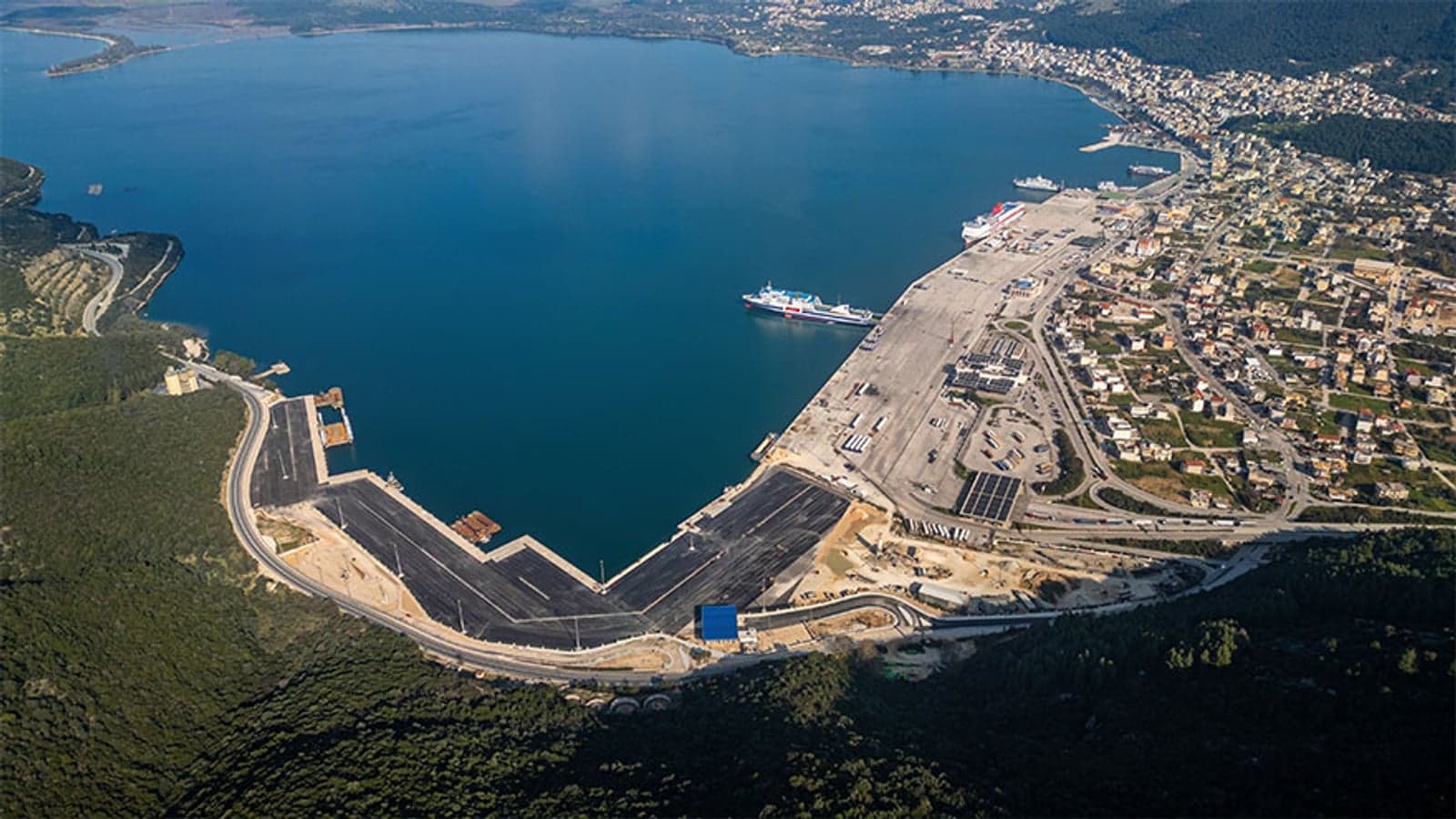
Maritime transport is a cornerstone of European trade and connectivity, yet ports remain important sources of local air pollution and greenhouse gas emissions.
As Europe accelerates its energy transition, electrifying ships at berth through onshore power supply (OPS) is emerging as a key solution for reducing emissions in port cities while supporting the decarbonisation of maritime transport.
Ships typically rely on auxiliary diesel engines while at berth to power onboard systems such as lighting, heating and cargo operations. These engines emit pollutants including nitrogen oxides, sulphur oxides and particulate matter, which negatively affect air quality in coastal regions.
To address these impacts, the European Union has introduced a comprehensive regulatory framework aimed at decarbonising maritime transport. Within the Fit-for-55 policy package, two key regulations – the FuelEU Maritime Regulation (EU 2023/1805) and the Alternative Fuels Infrastructure Regulation (AFIR, EU 2023/1804) – require ports and vessels to deploy and utilise OPS systems over the coming decade.
Onshore power supply, also known as cold ironing, shore side electricity or alternative maritime power, enables ships to shut down their auxiliary engines and connect directly to electricity provided from shore. This technology significantly reduces emissions, noise and fuel consumption while they are docked.
The Alfion-Infra (Alternative Fuel Implementation in Igoumenitsa Port) project [1] contributes to this transition by deploying OPS infrastructure at the Port of Igoumenitsa, a strategic gateway connecting Greece with Italy and the broader European transport network. Each year approximately 2.5 million passengers and about 250,000 trucks transit through the port.
Beyond infrastructure deployment, and in parallel to this project, new governance and business models that can facilitate the large-scale rollout of port electrification across Europe are being explored.
Alfion-Infra methodology
The Alfion-Infra project focuses on the design and implementation of OPS infrastructure capable of supplying passenger and Ro-Pax vessels operating at the Port of Igoumenitsa. The system includes three onshore connection points (2 × 3MVA and 1 × 0.5MVA) designed to supply significant electrical loads to ships during berthing. The project also includes technical and environmental studies for a future OPS installation at a cruise ship berth.
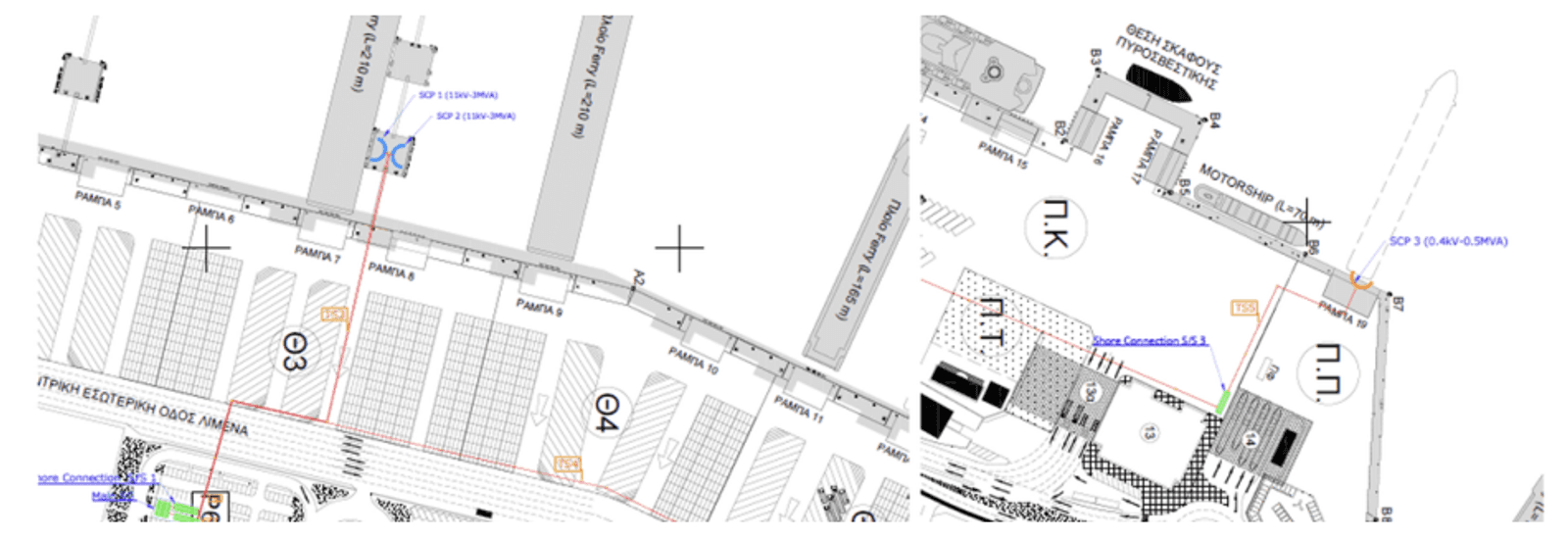
The project encompasses the engineering design, procurement, installation and commissioning of OPS equipment, as well as its integration with the national electricity distribution network. Implementation is carried out through collaboration between the Igoumenitsa Port Authority, the Hellenic Electricity Distribution Network Operator (HEDNO), the National Technical University of Athens and specialised companies including WMG, Protasis and Hydrus.
Technically, the installation complies with international interoperability standards such as the IEC/ISO/IEEE 80005 series, ensuring compatibility between ships and shore-side infrastructure.
Results and discussion
Technological readiness of onshore power supply
OPS technology is mature and widely standardised. A typical OPS system includes HV grid connections, transformers and frequency converters, cable management systems and the ship-to-shore electrical interface.
These technologies are commercially available and already implemented in several European ports. Consequently, the main barriers to OPS deployment are not technological but institutional and economic. Projects often face challenges related to high upfront capital costs, unclear cost-recovery mechanisms, and the need for coordination between ports, shipping companies and electricity network operators [2].
The business model challenge
Across Europe, OPS projects typically follow port-led models, in which the port authority builds and operates the OPS infrastructure and acts as an intermediary between electricity suppliers and ships. In intermediary models, the port manages electricity distribution and may apply mark-ups or connection fees. In facilitator models, ships purchase electricity directly from suppliers while the port provides infrastructure access (for a detailed analysis see [2]).
Although these models allow OPS deployment, they often create coordination challenges with the electricity grid and may generate uncertainties regarding pricing, investment incentives and operational responsibilities. The latest technology radar from E.DSO acknowledges these challenges affecting the future of the European grids [3].
The 'extension-to-grid' model
To address these challenges, an 'extension-to-grid' business model has been proposed. In this configuration, the DSO plays a central role in the development and operation of OPS infrastructure.
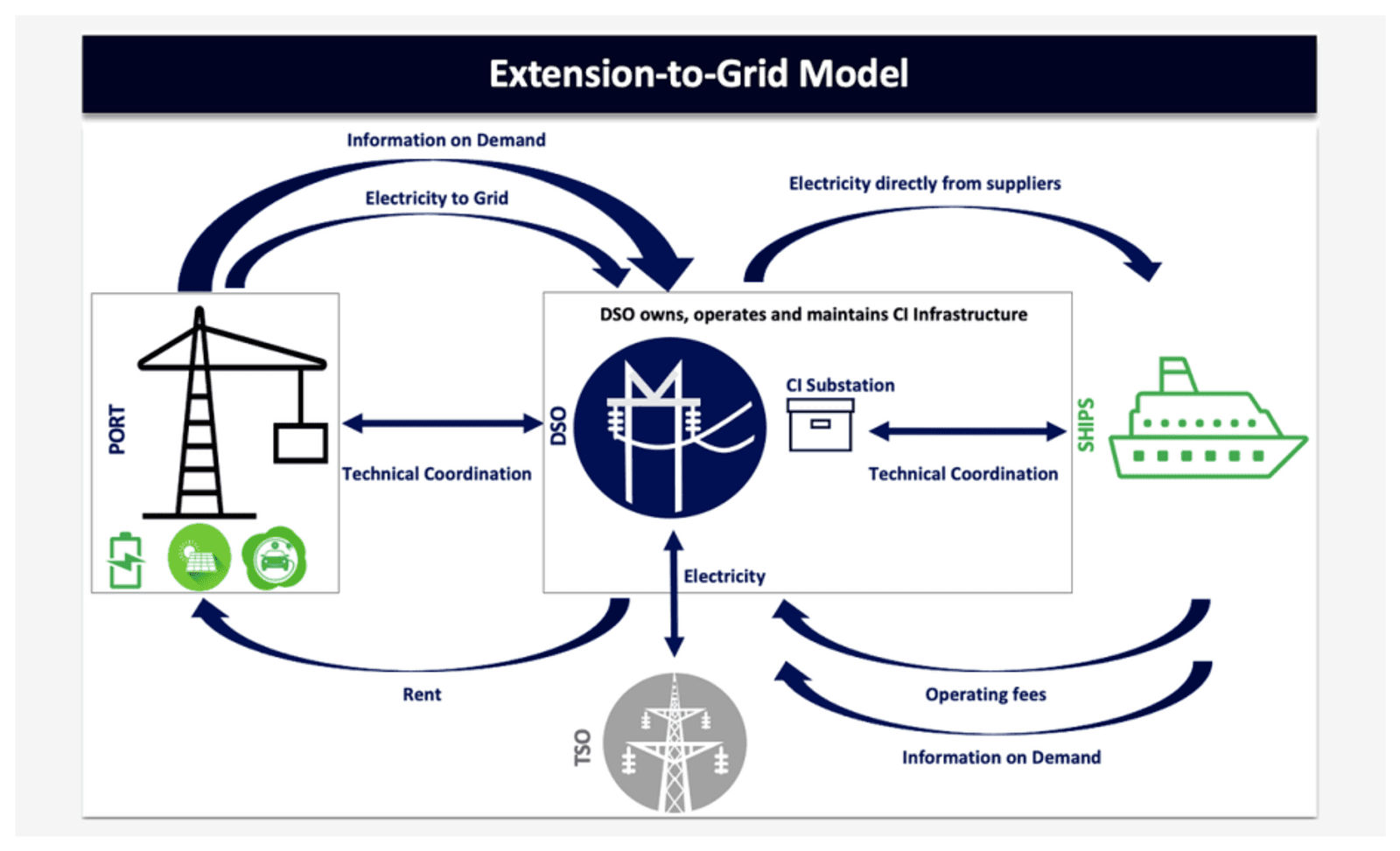
Under this model, OPS systems are integrated directly into the electricity distribution network, and the DSO manages grid connections, system balancing and network capacity planning. Ships can access electricity through the competitive energy market, while ports focus on operational coordination rather than acting as energy suppliers.
This approach offers several advantages. First, it strengthens technical coordination between port demand and grid capacity, which is crucial given that a single passenger vessel may require electricity comparable to that of a small town. Second, it reduces information asymmetries between stakeholders and facilitates more efficient infrastructure planning. Third, the model reduces risks of monopolistic pricing by ports, since electricity provision remains within the regulated electricity market. Finally, it can enable faster deployment of OPS infrastructure, particularly in smaller ports that may lack the financial or technical capacity to develop such systems independently.
Beyond the specific case of Igoumenitsa, the DSO-oriented model highlights a broader shift in how port electrification may be governed across Europe. As ports increasingly become large electricity consumers – sometimes requiring loads comparable to small urban districts – the integration of maritime demand into the electricity distribution system becomes a systemic issue rather than a purely local port investment decision.
DSOs already possess the technical expertise, regulatory oversight and system planning responsibilities required to manage such complex energy flows. Positioning DSOs at the centre of OPS deployment therefore allows port electrification to evolve from isolated infrastructure projects into coordinated components of the wider energy transition.
Conclusion
Port electrification is an essential component of Europe’s strategy to decarbonise maritime transport. While OPS technologies are already well established, their widespread deployment depends on effective coordination between ports, electricity networks and shipping companies.
The Alfion-Infra project demonstrates how OPS infrastructure can be implemented in a TEN-T European port while also exploring innovative governance approaches. By proposing a DSO-oriented business model, the project highlights how DSOs can play a key role in accelerating the deployment of shore-side power infrastructure.
Looking ahead, integrating port electrification within electricity distribution planning may become a critical enabler of Europe’s broader energy transition, supporting both cleaner maritime transport and more resilient electricity networks.
References
- European Commission, 2025. ALFION-INFRA project details.
- Ennis, S. F., Mammassis, C. S., Markellos, R. N., Prousalidis, J. M., Manos, A., Loukos, G., & Tracey, N., 2026. Regulatory and Business Innovation in Uncharted Waters: Mandatory Cold-Ironing.
- E.DSO, 2025. E.DSO Technology Radar v7.
About the authors
Constantinos S. Mammassis is Senior Innovation Advisor at the Hellenic Electricity Distribution Network Operator (HEDNO). His work focuses on innovation, strategy and emerging business models in high transition industries. He holds a PhD from the University of Patras, Greece, and an MSc from Bayes (formerly Cass) Business School, University of London.
Theofanis Kontopoulos is an Electrical Engineer in the Research & Innovation Department of HEDNO, contributing to shore-side electricity CEF projects and Horizon research initiatives. He holds a Diploma in Electrical and Computer Engineering and an MSc in Naval Architecture and Marine Engineering both from the National Technical University of Athens
George Loukos is Research & Innovation Director at HEDNO, where he leads initiatives to accelerate innovation and the adoption of emerging technologies supporting the network of the future. He previously held senior roles in telecoms, ICT and gas. He holds degrees from Aristotle University, Manchester, and a PhD from Loughborough University.