The role of membranes in carbon capture
Guest/partner contributor
Posted on: 23 August 2023
Carbon Capture is a part of every industrial decarbonization roadmap. This is a separation challenge| which brings about the question of whether membranes can be used.

Carbon Capture, Usage and Storage (CCUS) is a central part of every industrial decarbonisation roadmap, writes Dr Richard Collins, research director at IDTechEx.
At its heart, this is a separation challenge, which therefore brings about the question of whether membranes can be used.
Membranes are a very attractive solution. They can offer an energy efficient route to gas separation, which is a large advantage in any technoeconomic analysis, but that is not the complete picture.
Membranes have several limitations; most significantly, polymeric membranes have a pay-off between permeability and selectivity.
In post-combustion carbon capture, the main separation is CO2/N2. There are multiple challenging considerations, including that the flue gas is usually at atmospheric pressure, with relatively low CO2 concentration, and often a wide range of contaminants.
Membranes are pressure driven systems; if a large amount of compression is required prior to the membrane module, then you can immediately say goodbye to that energy efficient advantage.
Have you read?
Study shows carbon capture and storage potential for North Sea ‘super basin’
US commits $1.2bn to advance direct air capture projects
Some players are looking to deploy existing membranes for post combustion carbon capture, but most have accepted that this is unfeasible.
Instead, many are looking to advanced membranes as an enabling solution; with a key focus in dramatically increasing the permeability. This has been an active area of R&D for a long time but is now reaching the stage of early-stage commercial trials from MTR, Compact Membrane Systems, Aqualung (NTNU research), Cool Planet Technologies (Helmholtz-Zentrum Hereon research) and more.
These early deployments have both material and design considerations, and the results will be very telling as to the potential for membranes.
Of course, the competitive landscape is far from stationary.
Amine scrubbing is the most typically employed and what many benchmark against, but there are many others at various levels of commercial maturity. Solid sorbents are stepping into the limelight; in particular, metal-organic frameworks (MOFs) are gaining significant momentum in the industry.
By the time those advanced membranes are ready to deploy at scale, the incumbent landscape may look very different.
Why it’s time to fast-track carbon capture to future-proof power plants
There are other routes and opportunities for carbon capture including pre-combustion approaches. Again, membranes have been considered in these applications, but there are different considerations here.
Firstly the main separation challenge is H2/CO2, and the conditions, for example, to integrate into an IGCC facility are very different. Different membranes may have a higher degree of selectivity for CO2 or H2, and although there have been some interesting studies, this will likely remain at an early stage.
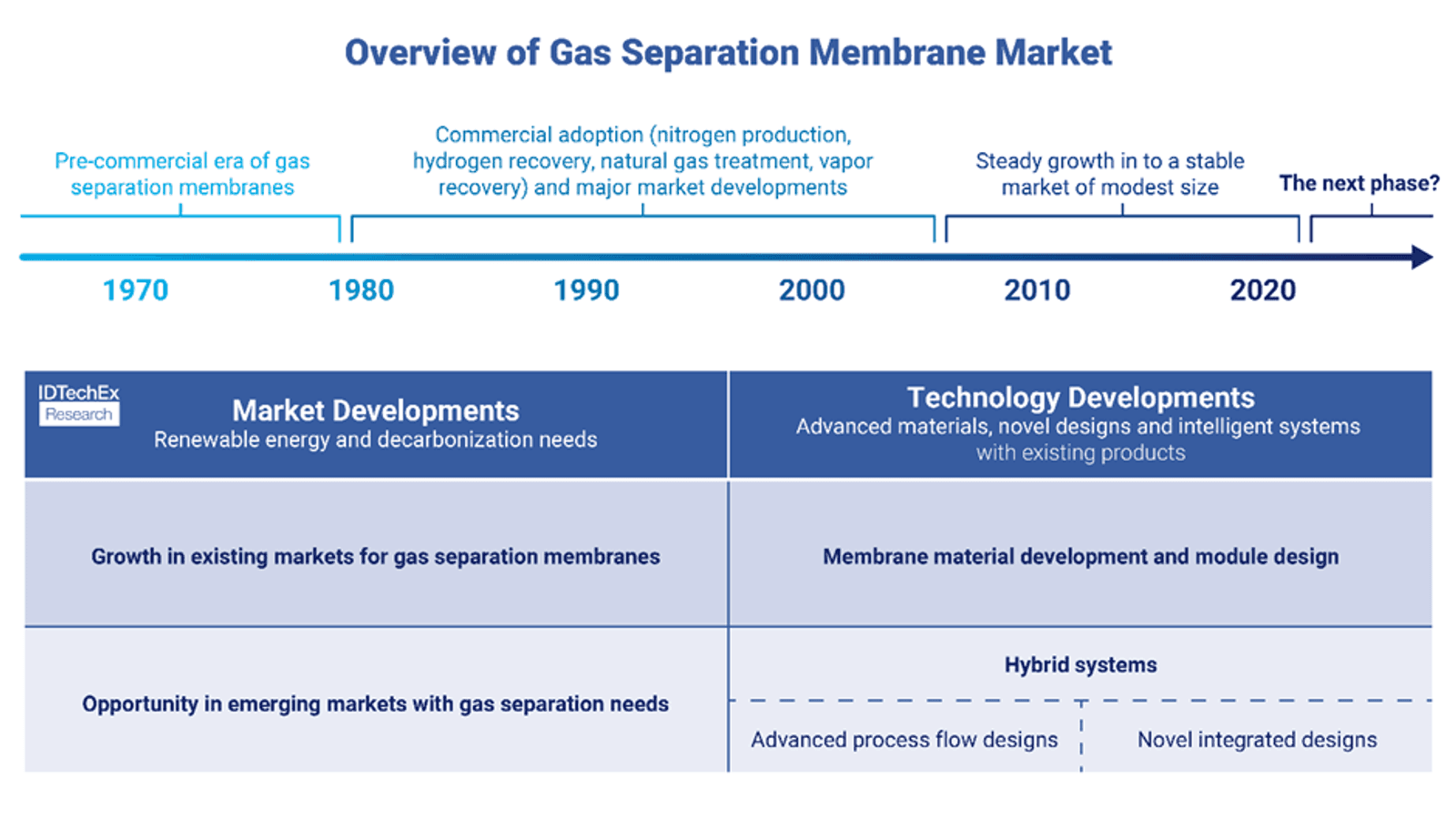
Finally, the question is whether membranes must be used either in isolation or as a primary separation technique.
One emerging space of combining membranes with absorbents, such as liquid amines, as shown by the likes of the start-up Ionada amongst others. Equally, Air Liquide is a major player and has made use of its existing membrane know-how and technology in its CryoCap H2 process alongside a cryogenic separation unit.
As discussed, the central question of carbon capture is that of efficient gas separation. Incumbent membranes may not be suitable as the primary approach, but material and engineering developments are progressing out of the lab and into promising commercial trials.