Vehicle to grid: Driving towards the perfect intersection in energy
Yusuf Latief
Posted on: 12 December 2023
There is little doubt that Vehicle to Grid is booming as a way to coordinate grid congestion. But what has led to its uptake?

There is little doubt that Vehicle to Grid (V2G) has been a booming concept in energy as a way to coordinate grid congestion. But what has led to its boom? And how does it fit into the energy sector? I spoke to Driivz chief Doron Frenkel and AVERE’s Raphaël Héliot to find out.
Describing his experience of driving the F-150 Lightning truck – an “absolute monster” of an electric vehicle - Frenkel says how he slips into the sleek cockpit and one feeling permeates his experience: “Everything fits.”
Whether the specific space to place the laptop, or simply the feeling of comfort and power after pushing the pedal, “and it flies” - the experience is exhilarating, says Frenkel, who is the CEO of smart EV charging company, Driivz.
But Frenkel’s remarks aren’t reserved for the experience of driving the EV. It is also his allusion to how the EV, when capable of bidirectional charging, fits into the energy sector.
Bidirectional charging – the ability of the electric vehicle to charge up its battery from the power grid and later discharge excess power, either back to the grid or to the home, or even to another EV – has over the last year seen rapid interest.
Bidirectional charging fits into a system called vehicle to grid (V2G), which has been seeing a lot of pilot projects steer its development as an asset for consumption management.
And according to Frenkel, V2G is one of the latest components that fits perfectly in place within the energy transition puzzle.
Have you read:
We don’t know what the future of the grid looks like… yet
Partnership to create investment landscape for EV battery recycling in Central Europe
Early adoption in the rear-view
When asked about the rapid pace at which V2G has come onto the scene, Frenkel referenced the case study of the Netherlands, which has seen EV uptake happening “in several hockey sticks (…) And now we’ve passed the (EV) early adopters phase.
“There’s more public infrastructure and even charging at home is more convenient.” But add up all these new EVs and their power consumption from charging, he says, and grid management becomes an issue.
“Each EV in the Netherlands consumes the same amount of power that the entire home consumes in a year. If you have two vehicles, it's actually triple the amount (…) It’s really hard for infrastructure to cope with that.”
And these numbers are on the residential side. Take them and consider commercial and industrial-scale charging, where parking lots of vehicles are charging – “suddenly the entire area has major issues from power consumption.”
Not to mention the energy coming from renewables. Referencing the graph, Netherland's grid is pushed to its limit, “The blue is consumption per day for non-EV consumers. Green is the EV and what EV adds and the yellow and red are the boundaries of the grid; at some times of the day, EV charging exceeds the grid’s capacity.
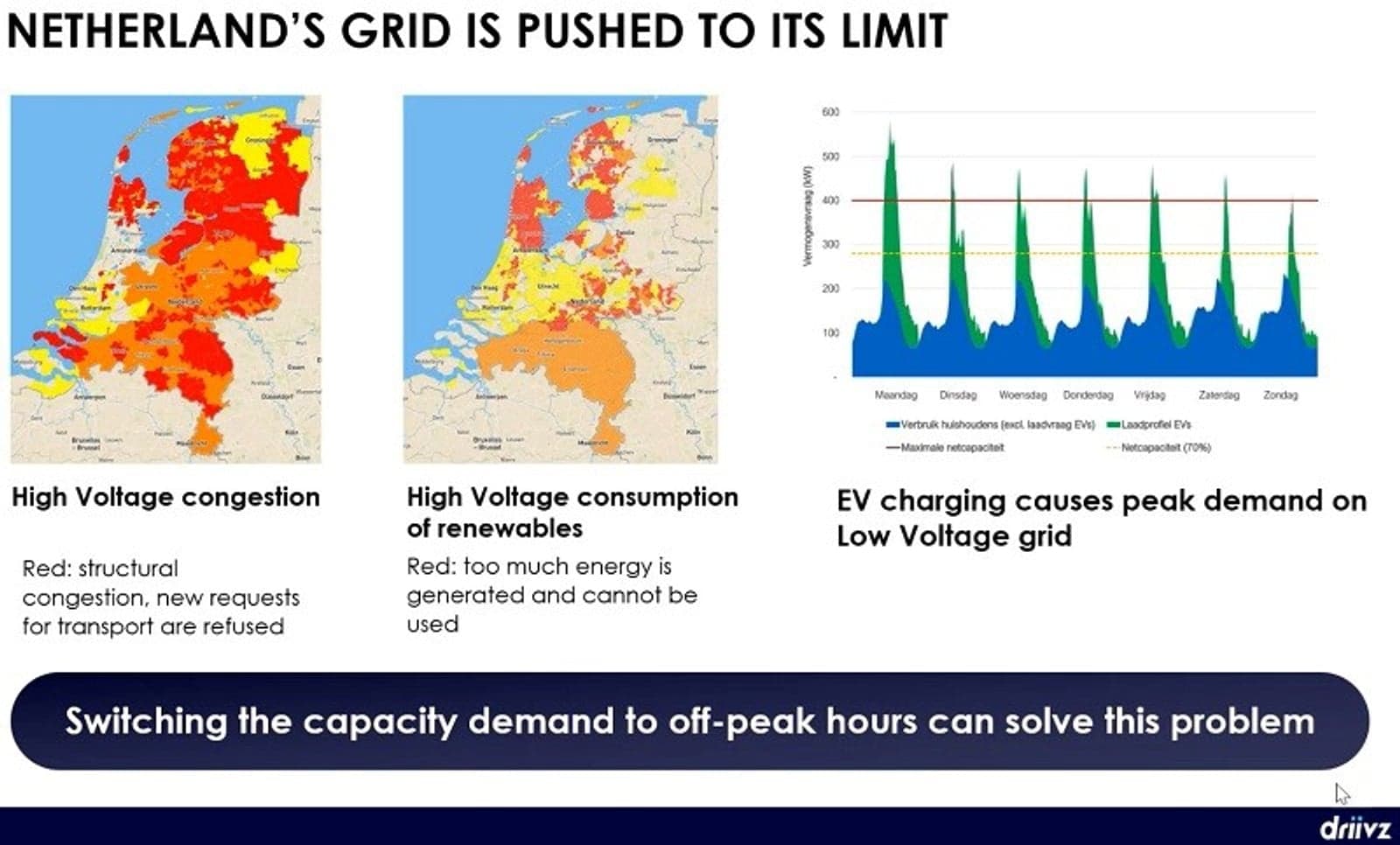
“Generation is also increasing with renewables (going) overcapacity.
“If (grid operators) want to fix that, it will have to be in the next two years, maximum, or else the frequency will deviate.
“The challenge is that we don't have batteries to store this (excess) energy.” And what is an EV if not a battery on wheels.
“That's where we get into V2G. Once you're looking at EVs as batteries on wheels and you can charge and discharge the batteries whenever you want, you can start to look at EVs as part of the solution to the energy revolution as opposed to the problem.”
A perfect intersection
This idea of the technology being a perfect puzzle piece is not, however, a revelation solely felt by Frenkel. It is shared across industry, and expressed by Raphaël Héliot, a policy manager at AVERE, the European Association for Electromobility.
In fact, according to Héliot, the role of V2G can be seen as the perfect intersection between transport and energy.
Asked about what sparked V2G’s boom, Héliot says “There's several things. Firstly, we have a commitment in Europe to become greener and to switch to renewable electricity. Switching to renewable electricity raises a lot of questions when it comes to the grid.
“And so V2G is seen as an enabler to actually welcome this renewable electricity into the grid and provide flexibility to the grid.
“It’s like the intersection, the crossroads between transport and energy. It’s the best of both worlds in a sense that it's helping provide flexibility to the grid, but it's also helping users switch to e-mobility and potentially gain some financial incentives to do so.”
Also of interest:
Transforming a factory for the e-mobility future
How to Scale V2X: Findings from INFLEXION
However, adds Héliot, although the tech continues to prove itself a valuable tool in energy, challenges lie in scaling it up.
“The technology is ready, more or less - we have almost all the standards as an industry in place, we have the hardware - we can do it. That's not the issue.
“The issue is making sure that it integrates throughout Europe into our grid so that it isn’t only treated as an energy community-scale aspect.”
And although this is a significant challenge to overcome, movement is already being made.
Héliot says that through some legislations, such as the Renewable Energy Directive and the Energy Performance of Buildings Directive, tech such as bidirectional charging and V2G systems are being acknowledged and even incentivised.
“Of course, more needs to be done, although I will say that politicians have understood and acknowledged in some legislation (…) that bidirectional charging and V2G should be incentivised.
Héliot also references different European-funded projects, which “do have a role to play in research and innovation and help feed the debate.
“There’s several of them, including SCALE and FLOW (…) which are actually giving knowledge to the policymakers and helping them understand that Vehicle to Grid is a possibility and that we should actually make sure that all legislations are compatible so that we can ramp up renewable energy and decarbonise road transport.”
Related tags
Latest content
Partner content
+6
DriVe2X: paving the way for bidirectional charging and green electrification
The DriVe2X project is poised to accelerate the adoption of electromobility through innovative smart charging techniques and advancements in bidirectional charging technology.
- Guest/partner contributor
- 11/11/2024