Wanda Buk reveals the surprises of Poland's energy transition
Kelvin Ross
Posted on: 15 December 2023
The Vice President of Regulatory Affairs of Polish energy company PGE reveals some surprises behind Poland's energy transition.
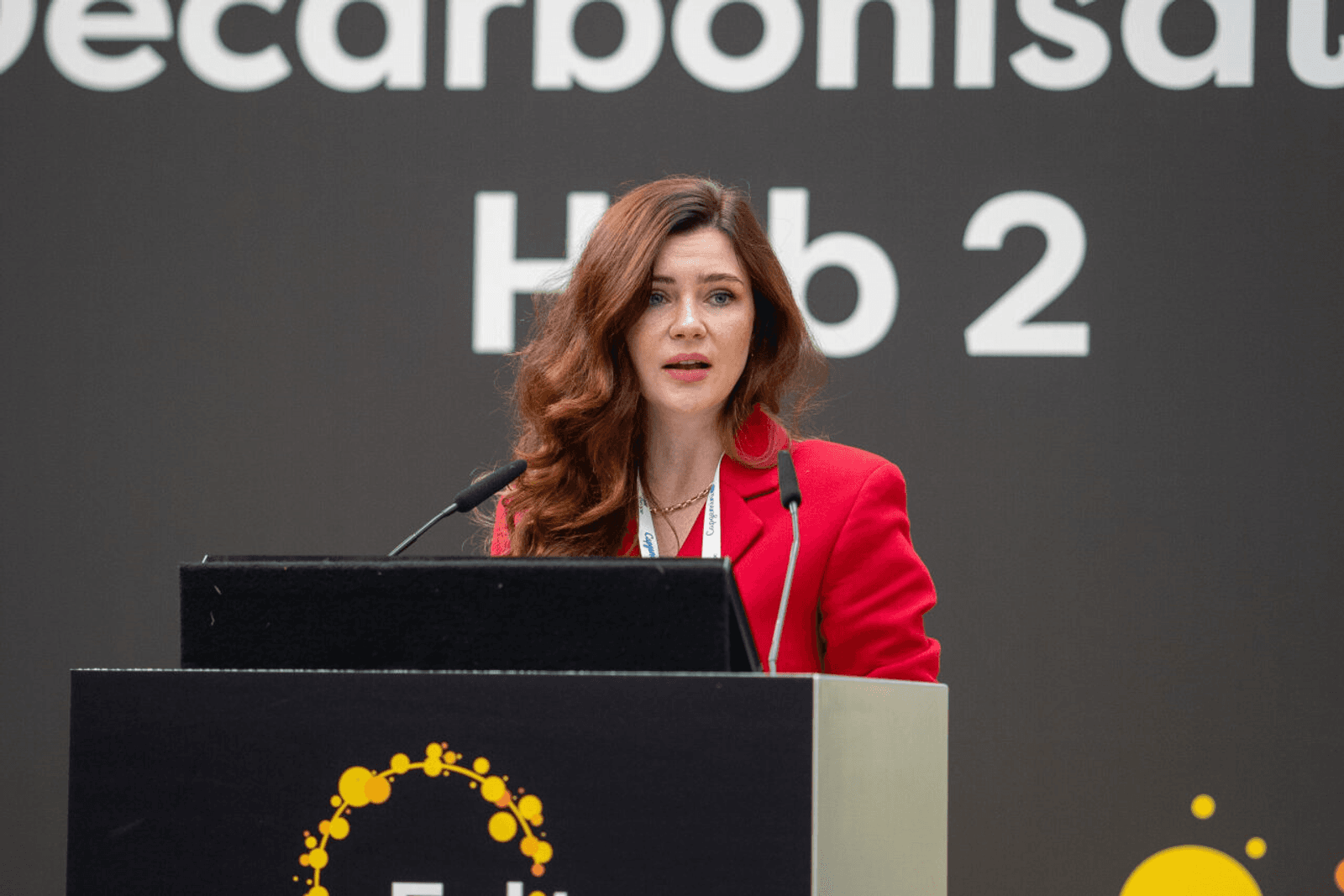
The Vice President of Regulatory Affairs of PGE highlights Poland's energy transition success stories
It is sometimes said that certain people perform tasks with military precision, even though they have no background in the armed forces.
Wanda Buk is an exception. She was born and raised in a military family and studied international military relations at the War Studies University, Poland’s most prestigious military academy.
“My father was a soldier,” she says, “and there is a saying in the army: generals tend to prepare themselves for a war in the past, for threats and situations that have already happened. But we should think wider — we should anticipate different potential threats.”
Buk has taken this adage and used it to shape her strategies as vice president of Polish energy company PGE Polska Grupa Energetyczna.
She believes that climate policy must be part of a trilemma alongside military security and economic strength.
She says that the knock-on effects of Russia’s invasion of Ukraine have shown “how easily you can squander long-term efforts to provide climate targets” if countries do not operate with such a three-pronged strategy.
Energy security
And in terms of anticipating potential threats, Poland proved itself to be ready for the energy crisis caused by the invasion of Ukraine.
“We are only as strong as our weakest link,” says Buk.
“This is crucial to energy security in Europe: each member state must first build its own national resilience.
Want more Poland articles?
Masdar acquires 1GW renewable portfolio in Poland
Poland’s energy transition: Two steps forward, one step back
Tier one contracts finalised for Baltica 2 wind farm
“When Germany and other European Union countries were putting a lot of faith into the free market and strengthening relations with Russia, we were investing into LNG terminals.
“And our society was bearing the cost of that investment because we knew we needed to be independent and self-reliant.
“The reality that we are now in has confirmed that we were justified to be very reserved towards Russia. I think this is something that other countries could learn from us.
“Every member state needs to take care of its own energy needs. Only if you are secure at the national level are secure at the European level.”
‘Independent and self-reliant’ would be a fair description too of Buk’s career: she’s achieved a lot in a relatively short space of time.
A lawyer by profession, as well as her military relations credentials, she graduated from the Faculty of Law and Administration at the University of Łódź, plus the Faculty of French Business Law at the Université de Poitiers in France.
She’s worked for the Polish government, firstly managing an organisation responsible for the implementation of the European Union funding, and then as the Deputy Minister of Digital Affairs, overseeing the telecommunications sector.
She’s been in her current post with PGE since 2020 and sits on the board of the Polish Electricity Association in Brussels.
There are several moments in our interview that Buk mentions a collective mindset among the Polish people, and it crops up again when we talk about the phase-out of coal plants.
Embracing Poland's energy transition
There’s a perception outside of Poland that scrapping coal and lignite production and generation would be opposed by the many communities that have built up and thrived around these industries.
However, Buk says: “You’d be surprised. People in Poland never like to be left behind. We understand that we need to build our national resilience — we always knew that our strength is in us being independent. But at the same time, we don’t ever want to be left behind. We like being around the European table and having a place at that table.”
Therefore, adapting to the changes brought about by a gradual shift the clean energy is broadly welcomed, she says, and PGE is playing its part in accelerating this green transition.
Poland’s low-carbon ambitions offer clear investment and business opportunities
“Two years ago, we launched a centre of competencies to reskill our employees to build the competencies in renewables, because there was a need for this among society.”
However, she stresses that PGE and Poland were careful to manage this clean energy transition at a pace it believes is best for its workers and the wider country.
“The European Commission expected us to deliver it faster and it took us a lot of time to explain why we cannot deliver it faster: because society needs to adjust for a new reality.
“But we successfully concluded our negotiations,” she says with a smile.
Solar success story
Which is not to say Poland’s adoption of renewables is moving at a slow pace: far from it.
“Solar has a very good story in Poland,” says Buk. “In 2020, we had 1.7GW of installed capacity in solar. And do you know how much we have today? It’s 13GW. We’ve already reached an impressive pace in the green transition.”
However, the connection problems that plague so many other European countries are also present in Poland.
“Where we are facing bottlenecks is the grid. In 2017, we had around 200-to-300 refusals from DSO operators to connect to the grid: in 2022 it was 3000.”
This is frustrating, she says, because “there is a huge willingness in the Polish market and in Polish society” for the switch to renewables, “but our grids are not adjusted to this potential”.
“So we are losing out… but I’m sure we will catch up in the future. This is the situation… and we are not alone.” Meanwhile, on wind power, she says there is “huge potential on the Baltic Sea”.
Buk says PGE will deliver 3GW of offshore windfarms in the Baltic Sea by 2030 via projects it is working on with Ørsted, yet she adds that “the potential of Baltic Sea remains much, much bigger”.
Support for women in energy transition
When I meet Buk in Brussels for our interview, it’s a few days before International Women in Engineering Day, so I ask her if it is important to her to promote roles for women in the energy sector.
There’s a long pause. Then: “I didn’t expect this kind of question.”
Then another long pause. And then she says: “I have an issue when people say, ‘women are like this’ or ‘men are like that’, and that the different genders bring different things to the table. I don’t agree with this.”
However, she adds: “Women need support in their career because we have a different social role. There is this moment in our professional life when we must focus on the personal because there will be a time when we may decide to have children.
“I think it’s super-important to help women during this phase. To help them keep up with trends in the workforce and to keep our skills on the same level after maternity leave.”
But she stresses: “I don’t think that women need any other support because we are doing well. If we want to go through the ranks, we can do this.”