Water electrolysis – contributor to net zero goals
Jonathan Spencer Jones
Posted on: 13 June 2022
Green hydrogen production as a product of water electrolysis is opening the way for this otherwise energy intensive technology to support the net zero drive.
Green hydrogen production as a product of water electrolysis is opening the way for this otherwise energy intensive technology to support the net zero drive.
Water electrolysis, long known for the production of hydrogen, is growing in popularity across the world for its potential to deliver large volumes of green hydrogen.
As such water electrolysis is a key technology for the decarbonisation of industry and more as, so far at least, it is the only technology that can be scaled for large scale green hydrogen production and thereby improve its economic potential.
Have you read?
Green hydrogen megaprojects on three continents
Hydrogen hype dissected by cleantech experts during Belgium-UK trade mission
Clean hydrogen: What you need to know
With the further challenges that come with electrolysis of seawater rather than freshwater, such as in Saudi Arabia and expected to become more widespread as freshwater resources become more scarce, research is ongoing to advance the technology to improve both the input energy and output hydrogen efficiencies.
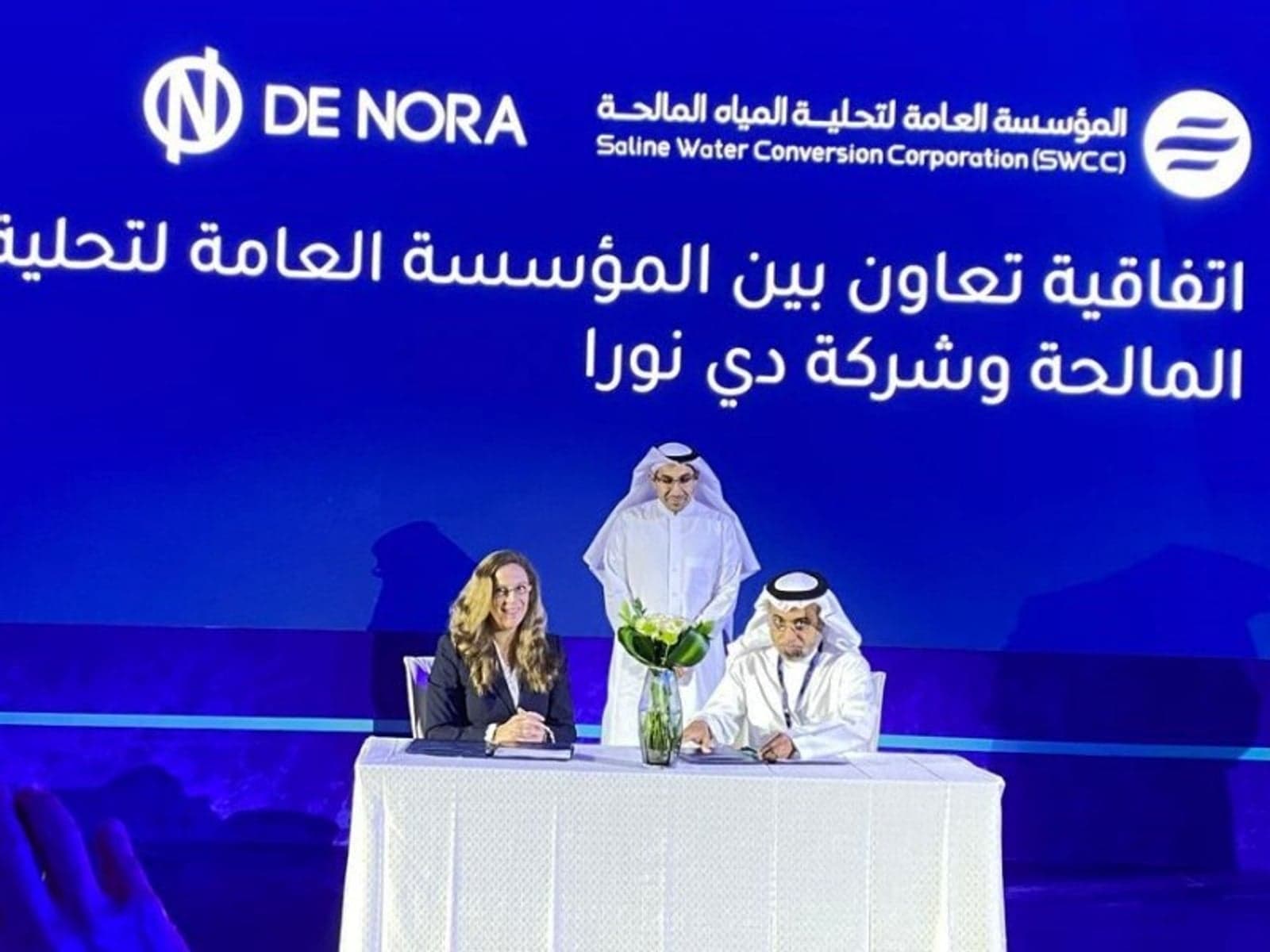
In the latest step, the Saudi government Saline Water Conversion Corporation (SWCC), one of the largest desalination corporations in the world with responsibility for supplying desalinated water in the Kingdom and beyond, and Italian multinational De Nora Water Technologies are deepening a partnership on brine mining and water electrolysis research.
Specifically, the memorandum of understanding includes innovations to the vacuum-based Capital Controls chlorine dioxide generators used in desalination pre-treatment and disinfection, which were approved by the SWCC’s Desalination Technology Research Institute (DTRI) earlier this year.
“We feel honoured to broaden our partnership with SWCC and as their governor, Abdullah Al-Abdul-Karim recently stated, share the vision of making the most out of every drop,” said Dr Mirka Wilderer, CEO of De Nora Water Technologies.
“Water electrolysis will play a key role in helping countries achieve net-zero goals in the energy transition, and as freshwater sources become more scarce, seawater desalination and brine mining will play a critical role.”
SWCC, which currently uses chlorine dioxide generators for disinfection, intends to expand its use of these systems in the MOU to purification plants for pre-treatment of iron and manganese – common elements associated with ‘hard’ water sources.
Earlier this year, De Nora’s technology demonstrated a yield ratio of 95-97% during the DTRI approval process as a test of its efficiency in treating the region’s contamination concerns.
Chlorine dioxide in the form of chlorine gas or hydrochloric acid and sodium chlorite (bleach) used for the pre-oxidation of water oxidises iron and manganese.
Such continuous improvements to the technology should lead to improvements in the overall economics of hydrogen production via water electrolysis when seawater is used.
As an example of a project currently underway in Saudi Arabia, the joint venture of De Nora and thyssenkrupp Nucera was recently awarded a contract for what is currently one of the world’s largest water electrolysis plants that will produce 650t/day of green hydrogen at the Neom development on the shores of the Red Sea.
In March 2021, SWCC became a Guinness world record holder for a record low energy consumption for a water desalination plant of 2.271kWh/m3 of desalinated water.