Ending the ICE age to put EVs in the fast lane
Yusuf Latief
Posted on: 25 November 2022
Philippe Vangeel, Secretary General of e-mobility association AVERE discusses Europe’s EV challenges and potential with Yusuf Latief.
Philippe Vangeel of e-mobility association AVERE discusses Europe’s EV challenges with Yusuf Latief.
With EU ministers having agreed on phasing out internal combustion engines (ICEs) by 2035, e-mobility and its implications for our energy system have become a hot topic for consumers and stakeholders alike.
Of particular interest are the areas of smart grid integration, policymaking and virtual power plants (VPPs) and how they affect and are affected by the continuous proliferation of electric vehicles (EVs) across Europe.
Philippe Vangeel, Secretary General of AVERE, the European Association for Electromobility, explores the continent’s current state of electrification and what will be needed as the race to net zero approaches us at a staggering pace.
Do you own an EV?
Of course. You need to experience it if you intend to defend the industry. It’s also just a very great experience and performs really smoothly. It’s a different world.
Do you have range anxiety?
Never. Range anxiety is the old world. Now, we are experiencing charging anxiety. We know that charging points are in place. We know where to find them. It’s Just a question of: “Is it occupied? How long do I have to wait for it to become free? Do I have access to a charging point? Do I have the right charging pass?”
These are questions of capacity and it is up to the policymakers to address them. If the industry doesn’t do it, somebody else has to.
Technology is moving much faster than policy.
EU has proposed phasing out ICEs by 2035. From what you’ve seen, is this realistic?
It is definitely possible. Many EU countries already have phase-out plans for before 2035; and even Norway, which is not in the EU geographically, has a phase-out plan for 2025.
Technologically, everything is in place. Whether this technology has been developed as necessary across the entire EU though is a different question. But we know what needs to be done and how to do it. The rest depends on the right collaborations. States need to look at what needs to be done, determine their decarbonisation target and take it from there.
On this we can take an example from the Netherlands. They have a phase-out plan for 2030. They have a national action plan for EV charging infrastructure. And they have clarity; they are clear on how much public charging infrastructure is required and they know how many electric vehicles are coming onto their roads by 2030.
And the Netherlands is but one case study of how things are progressing.
There are low emission and even zero emission zones where consumers are not able to enter with an ICE. And there are more of these than one might think. There are cities like Paris, which has changed drastically over the last decade. People are not welcome if they have a polluting vehicle. Which shows just how much the landscape is changing.
And this change isn’t about punishing drivers who don’t use EVs, but rather acknowledging that there is a certain level of commitment that is needed from all to get to net zero.
Have you read:
Project BATRAW – raw material recovery from EV batteries
Energy Transitions Podcast: COP27 – From debate to delivery
What is the role of policy in this mix?
On a certain level, technology is moving much faster than policy. And there are classical complaints that are coming from industry
Depending on the member state in question, these include access to public charging points, permitting and even getting access to the grid. This isn’t a question of the grid’s capacities but rather of access; the administration involved here is sometimes so slow that it can actually be very demotivating. What’s needed is to expedite the transition; to make it possible in the shorter term.
Poland is an interesting example of this from a charge point perspective: here it takes two years to gain permission for installation. For someone starting a company to base their business model on such uncertainty is simply unfeasible.
This needs regulation and stimulation from policymakers to get the ball rolling faster.
What are some of the pain points barring e-mobility and how can they be resolved?

Obviously, prices are too high. The answer? Uptake. The more EVs are sold, the more are produced. The more are produced, the cheaper the product. And this is definitely an enabler.
There is also the issue of awareness. Awareness needs to spread fast that this is possible and that it is also a good choice. This is what I think made the case in Norway so successful; the country has had concrete policy with a long-term view.
For industry, another pain point is stability and commitment. Knowing that 2035 is the deadline for full electrification means that stakeholders will understand what needs to be done. And this, I think, is one of the best enablers. Industry needs to know that ICEs are no longer viable or acceptable.
Knowing that battery EVs are the way forward will also provide a very clear signal to transform factories, put the necessary infrastructure in place and thereby reiterate to consumers that EVs are the right choice.
Also of interest:
Powering biodiversity through electrification
Honda plugs into German VPP for grid stability proof of concept
When ICE’s are completely phased out, will there be implications for the grid?
Many simulations have been done on this. Technology is ready and mature enough for any implications from widespread EV use to be significantly lessened.
For example, smart charging and bidirectional charging – although not yet fully implemented – will ensure that there are no issues after 2035. And while this type of charging is not fully in place right now, we can trust that it is coming fast.
Smart charging especially is key. And in bigger terms, the battery vehicle will start to play more of a wider role. With the warnings against integrating more renewables, EVs provide a perfect source of storage, if done smartly.
When there is too much wind or solar input, the vehicle can be charged and used to store this energy. At a later stage this same energy can be used across the average household to power any other activities. But one issue that arises with this is consumer acceptance.
Financial incentives are needed to have widespread consumer acceptance and buy-in.
Range anxiety is the old world. Now, we are experience charging anxiety.
Virtual power plants have been making quite some headway across the US and in certain parts of Europe due to their ability to guide distributed energy resource management, including for EVs. Is this a fad or do you think VPPs will gain more prominence as e-mobility progresses?
I have no doubt that they will. VPPs allow for battery EVs to be used as a part of the solution.
There are several millions of vehicles on the road in Europe. But the vast majority of these are not actually in use. Depending on the area, only 5–10% of vehicles are in use. It is only for 5% of the average car’s lifespan that it is moving. The rest of this time it is just standing still.
Consider then that 10 million of these vehicles – which are standing still in Europe or in a country such as Germany – are connected with an average of 40kW battery capacity. That makes for a huge power plant.
And when this is put into calculation, the tone of the conversation itself changes.
It goes from a conversation about EV charging to a conversation about nuclear-level power capacity potential.
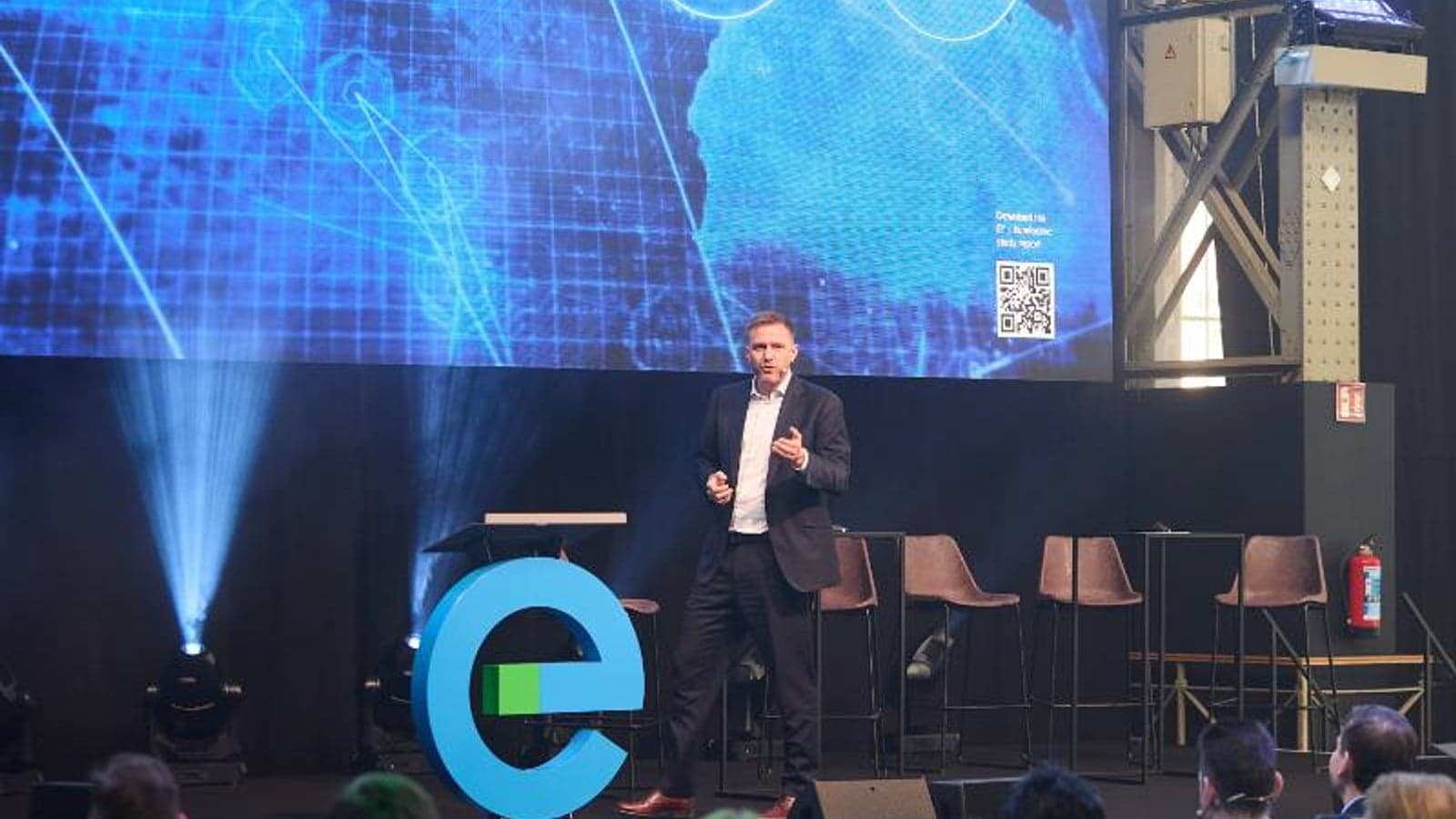
Phillippe Vangeel will be speaking at Enlit Europe (29 Nov to 01 Dec).
Register and attend his session EV for the Grid and more.