Home
/
RE-WITCH: Delivering cost-competitive, game-changing solutions for sustainable industrial cooling and heating
RE-WITCH: Delivering cost-competitive, game-changing solutions for sustainable industrial cooling and heating
Guest/partner contributor
Posted on: 15 August 2025
RE-WITCH aims to develop and demonstrate innovative adsorption and absorption cooling technologies using waste and renewable heat.
RE-WITCH aims to develop and demonstrate innovative adsorption and absorption cooling technologies using waste and renewable heat.
RE-WITCH is a Horizon Europe funded programme, gathering 26 partners from across Europe to develop advanced industrial cooling technologies based on sorption processes, i.e. adsorption and absorption, thermally driven by an optimised mix of low grade waste heat and renewable sources.
The project addresses regulatory barriers, supporting policy integration and industrial decarbonisation across sectors with high cooling and heating demand. Early findings show cost-effective, compact designs.
Industrial pilots
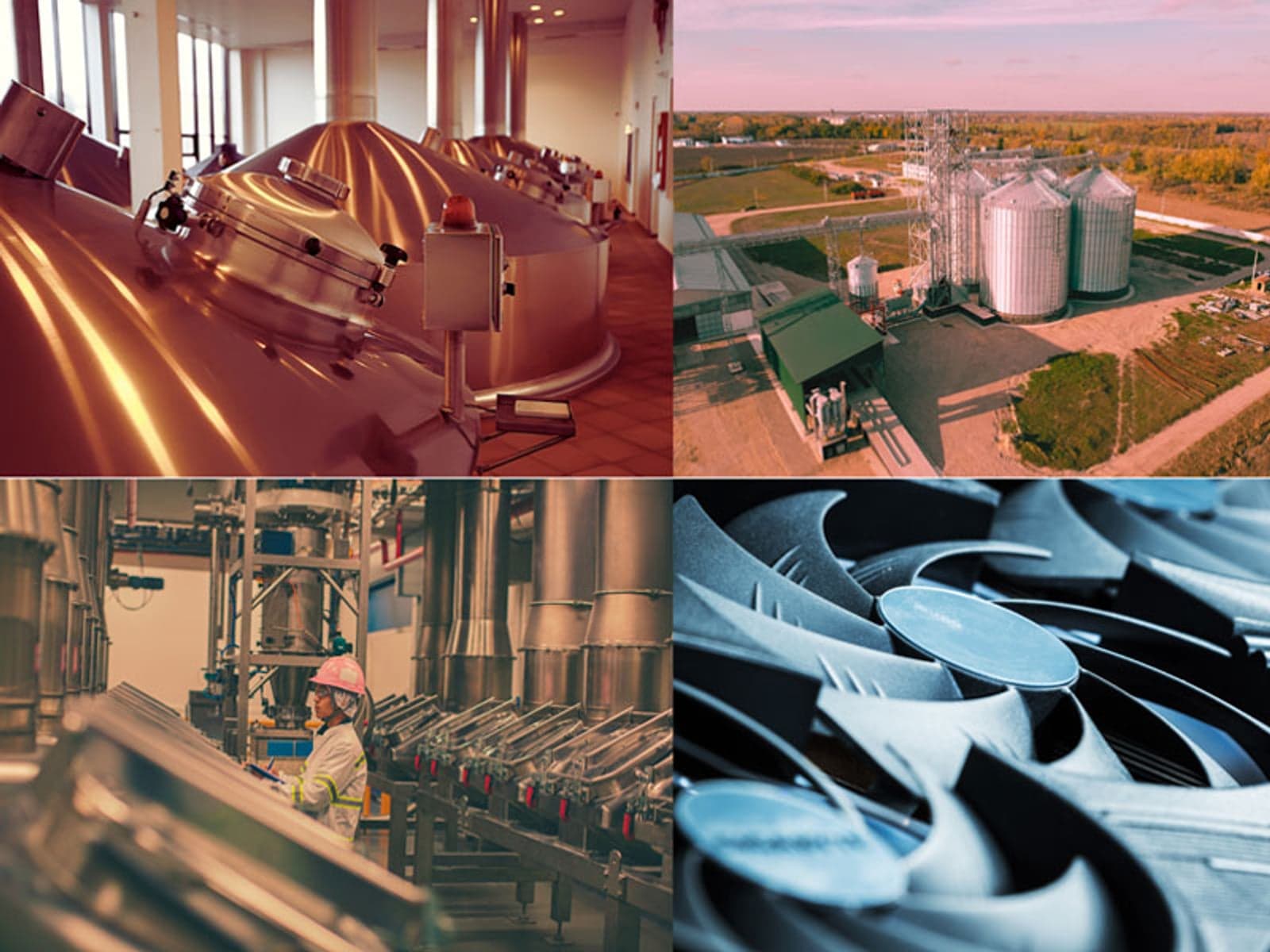
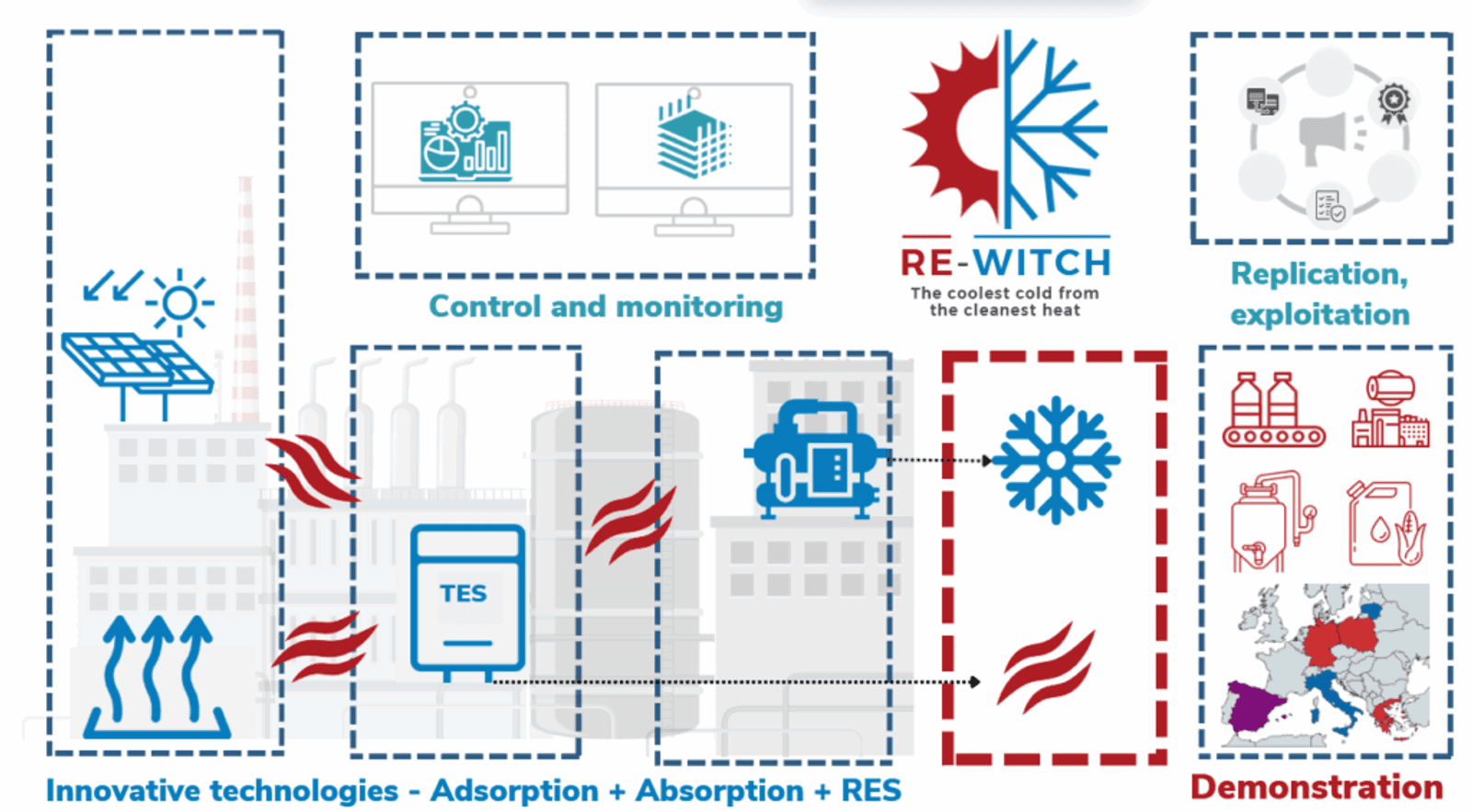
RE-WITCH will demonstrate its innovative ad/absorption cooling solutions in four demonstration sites, covering typical industrial sectors with high cooling demand – in food and beverage in Poland and Spain, biofuels production in Greece and paper production in Italy.
Browar Głubczyce, Poland – Tapping into waste heat for cooler brewed beer
At the Głubczyce Brewery in southwest Poland a low temperature cooling system has been installed and to exploit the waste heat provided by the wort cooling along with renewable heat from solar collectors, an innovative adsorption chiller will be used to cool the wort to the fermentation temperature.
COVAP, Spain – Using waste heat to cool down the dairy industry
In this demo at the Cattle Cooperative of the Pedroches Valley (COVAP) in southern Spain, RE-WITCH will mostly exploit renewable heat from solar thermal collectors to drive a hybrid absorption/compression heat pump providing both heating and cooling to the industrial process.
Mil Oil, Greece – Harnessing waste heat for cooler renewable fuels
In this pilot at the Mil Oil oil company in Thessaloniki, RE-WITCH will exploit a large amount of waste heat from a cogeneration plant, integrated with renewable heating from solar thermal collectors, to drive a dual-cooling temperature absorption chiller, providing cooling energy at two different levels to two processes.
ICP, Italy – Keeping the pulp and paper industry cool with waste heat
At the ICP paper company in Marlia in central western Italy an adsorption chiller system will be directly driven by the waste heat recovered from the air compressing units, providing space cooling to large technical rooms in the industrial plant.
Now, what?
After 18 months of preparation and modelling work, setting up all the activities and advancing the first design tasks, the focus now is on:
● First manufacture of the prototypes along with their testing.
● Design and implementation of the first actions in the demo sites for readiness for the RE-WITCH technology installations from the end of 2026.
● Delivering the monitoring platforms to start the proper analysis of the current situation in the demo sites.
At this stage of the project, the most significant innovations are related to the design of the sorption cooling devices that will later be demonstrated.
The RE-WITCH cooling technologies are being evolved from the existing concepts of adsorption and absorption chillers already available on the market, with the aim to improve them either through more cost-effective approaches or by providing specific services to the industrial end-users.
Absorption or adsorption?
The innovative adsorption chiller technology, developed by the German SME Sorption Technologies with support from CNR, is based on a patented solution of a novel chiller architecture in which the refrigerant, i.e. water, is distributed inside the system in its liquid phase instead of the vapour phase.
This allows evaporation and condensation to occur directly inside the adsorber reactor and thus to maximise the compactness of the technology while, at the same time, reduce the cost by avoiding large and expensive vacuum valves and lowering the number of components.
Easy integration with the industrial process is obtained, since all the hydraulic circuits are interfaced with standard plate heat exchangers, providing cooling to the process.
Regarding the absorption chillers, these are developed to fulfil specific end-users’ requests. The hybrid absorption chiller, developed by Hochschule Munich in collaboration with the manufacturer BS-NOVA , integrates within the refrigerant (i.e. water) cycle a turbo-compressor operating between the evaporator and the absorber.
This compressor allows increasing the pressure of the refrigerant leaving the evaporator, thus delivering a dual benefit, on one side limiting the risk of crystallisation of the lithium bromide solution in the process, and on the other allowing an increase in the operating temperature differential between evaporator and condenser. This then allows the possibility of providing both heating and cooling at the same time to the process.
The integration of the compressor also allows increasing the flexibility in operation, since the contribution of the mechanical energy for the vapour compression can also extend the system operation under variable driving heat temperature levels.
Regarding the dual-cooling temperature absorption chiller, the design, developed by the Technical University of Berlin in collaboration with BS-NOVA, starts directly from an existing commercial product whose cycle is further modified to allow the provision, with the same device, of two different cooling temperature levels.
Overall, the concept will be able to satisfy the specific need of many industrial processes employing a single cooling machine, thus achieving a lower investment cost and a more compact solution. This will require, in the coming months, a dedicated effort to optimise the control strategy to come to a final design of the prototype.
Regulations and standards
Aside from the technology development, the RE-WITCH project is also focused on promoting these innovative solutions by tackling the various challenges, both technical and non-technical, that hinder their market adoption. An essential part of this is understanding the regulations and standards that guide these technologies and shape market conditions.
Standardisation plays an important role in boosting innovation in the market; it acts as a bridge connecting cutting edge research with real-world applications.
The last project report assesses the current regulatory landscape governing waste heat and industrial cooling technologies. It provides a comprehensive overview of the current state of standardisation and EU policies relevant to the RE-WITCH technologies.
The report highlights guidelines and standards specifically relevant to thermally driven absorption and adsorption chillers, hybrid solutions and solar thermal technologies. It also discusses EU policies and key reference documents affecting refrigeration systems for industrial cooling.

Looking forward
The project is highly relevant in a moment when Europe’s focus is increasingly on competitiveness and the need for energy security and independence through innovation: the solutions developed and tested in the project will demonstrate how we can, with existing resources, i.e. waste heat and renewables, decarbonise the economy.
The project can lead various industries to unlock the combined potential of low grade waste and renewable heat use in industries, with the integration of heat-to-cold technologies into relevant EU policies.
About the authors

Andrea Frazzica from CNR ITAE is the Project Coordinator of the RE-WITCH project. He has a strong background in the development of technologies for renewable and waste heat thermal energy conversion and storage and has led and coordinated multiple high-impact research projects.

Marine Faber Perrio leads operations at IEECP, in charge of soft HR aspects, including the gender inclusivity taskforce. She has 15 years of experience in communications and sustainability and also works on communication and engagement activities of projects IEECP is coordinating/involved in.

Elpida Filippaiou is a Junior Communications Expert at IEECP, working on communications and dissemination strategies for RE-WITCH and other EU-funded projects. Her experience includes roles in marketing and sales and she is skilled in various digital tools and languages.
Latest content
+1
Heat recovery steam generators design options and benefits
The heat recovery steam generator (HRSG) is a heat exchanger designed to recover the exhaust ‘waste’ heat from power generation plant prime movers, such as gas turbines or large reciprocating engines, thus improving overall energy efficiencies.
- Power Engineering International
- 01/05/2008