Europe’s energy sector digitalisation and AI roadmap out
Jonathan Spencer Jones
Posted on: 4 June 2026
The roadmap addresses the increasing energy demand of digital infrastructure and outlines how AI can support a clean, competitive and secure EU energy system.
The keenly and long anticipated roadmap is set to underpin the advance of AI as it is coming to play an increasingly important role in the energy sector and in advancing the energy transition.
Drawing on extensive industry input over the past year the roadmap is structured around three pillars – I addressing the sustainable integration of data centres into the energy system, II setting out measures to deploy digital and AI solutions across the energy system, and III addressing the data governance framework needed to enable smart energy services and AI at scale, with 'flagship actions' to deliver in each of these areas.
Pillar I – Energy for AI
Pillar I is built on the premise that data centres are critical to the EU’s competitiveness and digital sovereignty. Currently data centres account for around 2.5% of EU electricity consumption but their demand is expected to increase substantially with their installed capacity expected to more than double from approximately 12GW in 2025 to around 28GW by 2030.
Moreover, the current demand is geographically concentrated in a limited number of hotspots. Connection requests are increasing sharply, with individual sites requiring capacities like those of major industrial sites.
Also of interest
Skeleton unveils tech to keep the AI data centre lights on
Integrating data centres into the energy system requires the efficient management of grid connections, coordinated grids planning and operation, demand side flexibility and a sustainable supply of energy.
To drive this forward the action indicated is a model tripartite agreement that can be rolled out as a local agreement between data centre operators, energy-related parties and public authorities.
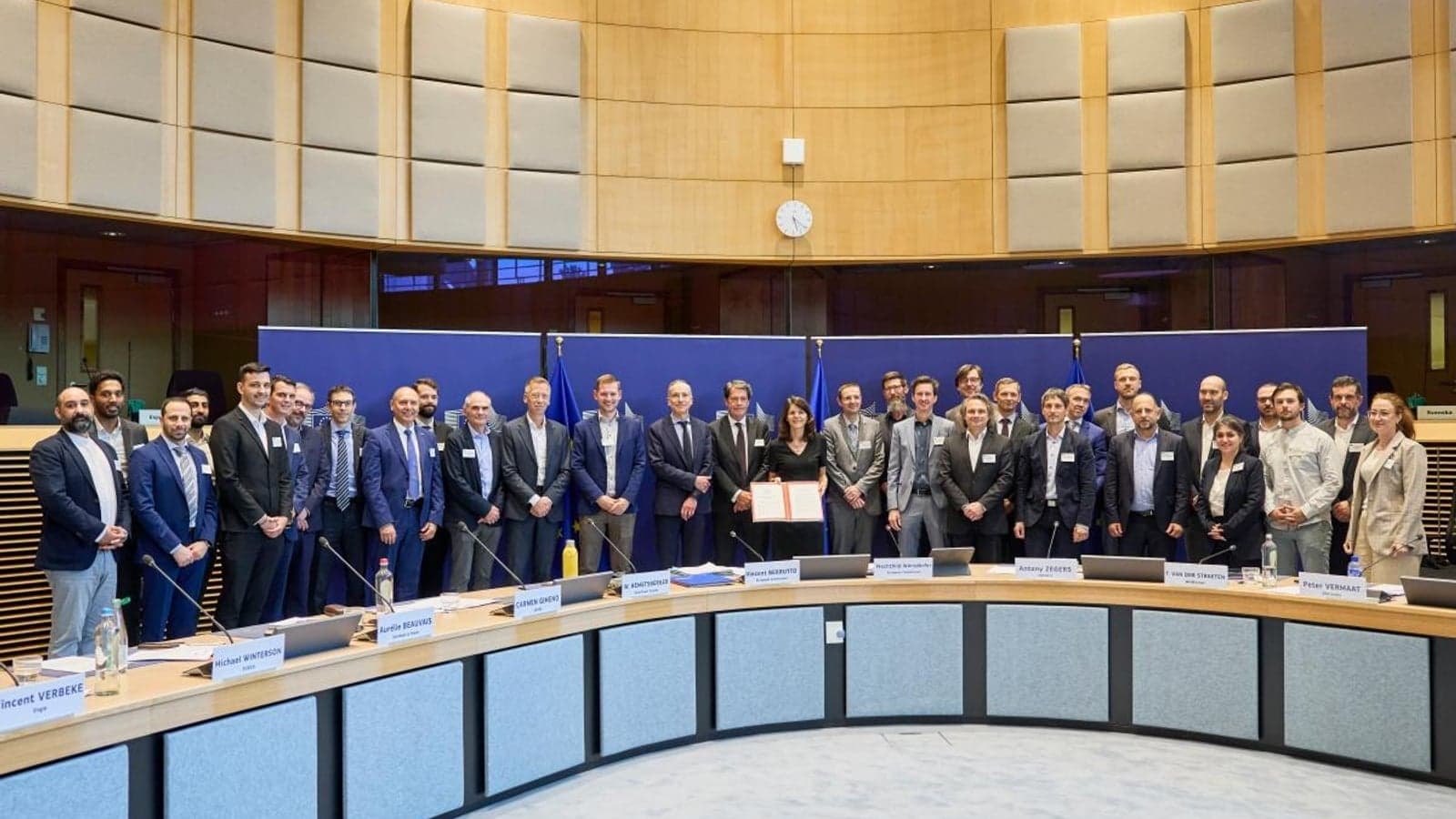
To set this in motion an initial 14 industry associations have signed a declaration of intent with a further six companies having signed a declaration of support indicating their willingness to work together.
The intent is for the model tripartite agreement to be published and promoted in the second half of 2026.
In addition, the Commission intends to adopt a data centre energy efficiency package, including a report on improving energy efficiency of data centres, a delegated act establishing an EU rating scheme for the sustainability of data centres with the first labels issuing in 2027, and the launch of a public consultation for minimum performance standards for new and existing data centres in the EU.
Pillar II – Digitalisation and AI for the energy system
Pillar II is focussed on the specific actions to make the energy system smarter and more data-driven by deploying digital and AI solutions.
Much of the development of Europe’s grids being addressed in the grids package, including inter alia investment and the promotion of non-wire and digital solutions in network planning.
Additional actions set out are an acceleration of the rollout of smart meters to achieve minimum coverage in all member states, for which a legislative proposal will be presented later in 2026, and the finalisation of the KPIs for smart grids, with an EU catalogue due by mid-2026 and the tasking of ACER to provide recommendations on smart grid indicators in 2028 with regular monitoring of progress afterwards.
To advance AI the proposal is to build sovereign, secure AI models for the energy sector, trained on European data and developed by EU firms.
In particular the Commission will support the development of AI foundation models for grid management and planning through the AI.grids project launched under CRESYM with an initial 48 partners including grid operators and research institutes – among them Fraunhofer FIT, INESC TEC, NTUA, TUCN, Alliander, ELES, ESO, RTE, Swissgrid, HEDNO, IPTO and Artelys.
For this dedicated Horizon Europe calls will open with €30 million in 2026 and €20 million in 2027 with the intent for proof-of-concept AI models to be developed and tested in Q1 2027 and delivery of the first operational models by the end of 2027.
In addition, for 2026–2027, Horizon Europe is due to provide around €75 million for AI technologies in energy, notably for grids, self-consumption, energy sharing and grid-scale storage, plus a further €190 million for broader digital solutions in renewables, building renovation and energy efficiency.
A further action under the pillar is to develop digital portals for member states, using generative AI technologies to streamline permit review for renewable energy, storage and grid projects. Design is planned for 2027 with rollout for public authorities to use in 2028.
Pillar III – Data for AI and the energy system
Pillar III is aimed to identify the concrete actions to establish a comprehensive framework for data exchange and interoperability.
While the EU legal framework already covers the primary use of energy data, that for the secondary use of energy data, i.e. the pooling and reuse of energy data beyond its original operational purpose such as for research, analytics or AI model development, is less developed and the Commission intends to coordinate actions to streamline and simplify energy-specific data exchange for both primary and secondary uses.
A key action is to establish an EU framework for simplified cross-border energy data exchange for smart energy services and AI model training, with development starting in 2027.
A second is to strengthen safety of AI and the cybersecurity of critical devices with both a risk assessment of solar installations in the EU and a review of the energy security of supply framework planned in 2026.
Finally, the Commission commits to requesting its group on ethics in science and new technologies to provide an opinion on the trustworthy and responsible governance of AI in the EU energy system and how to safeguard public trust, transparency and fairness.
Implementation and monitoring
Last but not least in the roadmap is the stating of actions to ensure a balanced development across member states and the Commission plans to convene an annual 'Energy digitalisation forum' starting in 2026 to review progress, identify barriers, share good practices and address emerging developments that may require further action.
The Commission also intends to examine how to better integrate digitalisation and AI into the energy union governance framework and to develop concrete objectives and indicative targets with member states and stakeholders to monitor the progress of digitalisation and AI adoption in the energy system over the coming decade.
In addition, a better energy data initiative to map and address gaps in energy data availability is planned to launch in Q4 2026 and a fuel observatory to track the supply and stock availability of relevant transport fuels has been announced also for a 2026 launch.
Commenting on the launch of the roadmap, Commissioner Dan Jørgensen said: "Digitalisation and AI is opening new opportunities but also new challenges and we need to be clear that if we want to secure Europe's digital sovereignty, we need to use its energy responsibly.
"We need to find a European balance that enables us to navigate the challenges and maximise our opportunities and that is why the roadmap has been adopted."