Space bubbles – the solution for a warming Earth?
Jonathan Spencer Jones
Posted on: 29 March 2023
Space ‘bubbles’ that deflect solar radiation away from the Earth are being investigated as a possible option to support other actions to limit the global temperature increase.

Space ‘bubbles’ that deflect solar radiation away from the Earth are being investigated as a possible option to support other actions to limit the global temperature increase.
The ‘seeding’ of clouds to modify precipitation patterns has been talked about and experimented with since as far back as the 1890s.
Now such geoengineering, i.e. manipulation of the Earth’s climatic processes, is increasingly coming to the fore as an option for helping to contain the rising temperatures.
But while cloud seeding has generally been on a limited scale, an initiative for a global response requires an altogether wider scale approach.
Have you seen?
Entering a new orbit of data
IPCC: ‘Limiting global warming will require major transitions in the energy sector’
Thus, so far, research on geoengineering for climate change has focussed on the injection of aerosols into the stratosphere, the second ‘layer’ going up ranging from between 10 to 20km to 50km from the ground, with the prospect of increasing the reflectiveness of the Earth’s atmosphere and thereby abating the warming.
Examples, which are still in the early stages, are the Stratospheric Aerosol Geoengineering Large Ensemble (GLENS) project led by the Boulder, Colorado-based University Corporation for Atmospheric Research, and the Rutgers-led Geoengineering Model Intercomparison Project’s (GeoMIP) G6Sulfur experiment.
Both involve injecting sulphur dioxide at low latitudes – between 30oS and 30oN for GLENS and above the equator for GeoMIP.
However, not surprisingly they are also controversial, with possible unintended consequences, such as acid rain from the sulphur and geographically uneven climate impacts, not to mention the absence of any governance mechanisms.
To overcome this, a more recent proposal has been made for stratospheric aerosol injection in the subpolar regions, where the deployments would be geographically limited at roughly 60oN/S, with the intention to arrest or reverse ice and permafrost melt at these latitudes and in turn yield global benefit by retarding sea level rise.
Such an approach would also be more practicable due to the lower deployment altitude at these latitudes and cheaper than an equatorial deployment, but still, there would be significant infrastructure requirements and no fewer governance concerns.
Solar shading
While research on these options is set to continue, an altogether different approach is gathering momentum, which was first expanded in detail back in 2006 by astronomer Roger Angel of using a cloud of small spacecraft with shields to shade and deflect away the sunlight.
With the blocking of 1.8% of the solar flux, Angel anticipated that the warming effects of increased CO2 could be fully reversed.
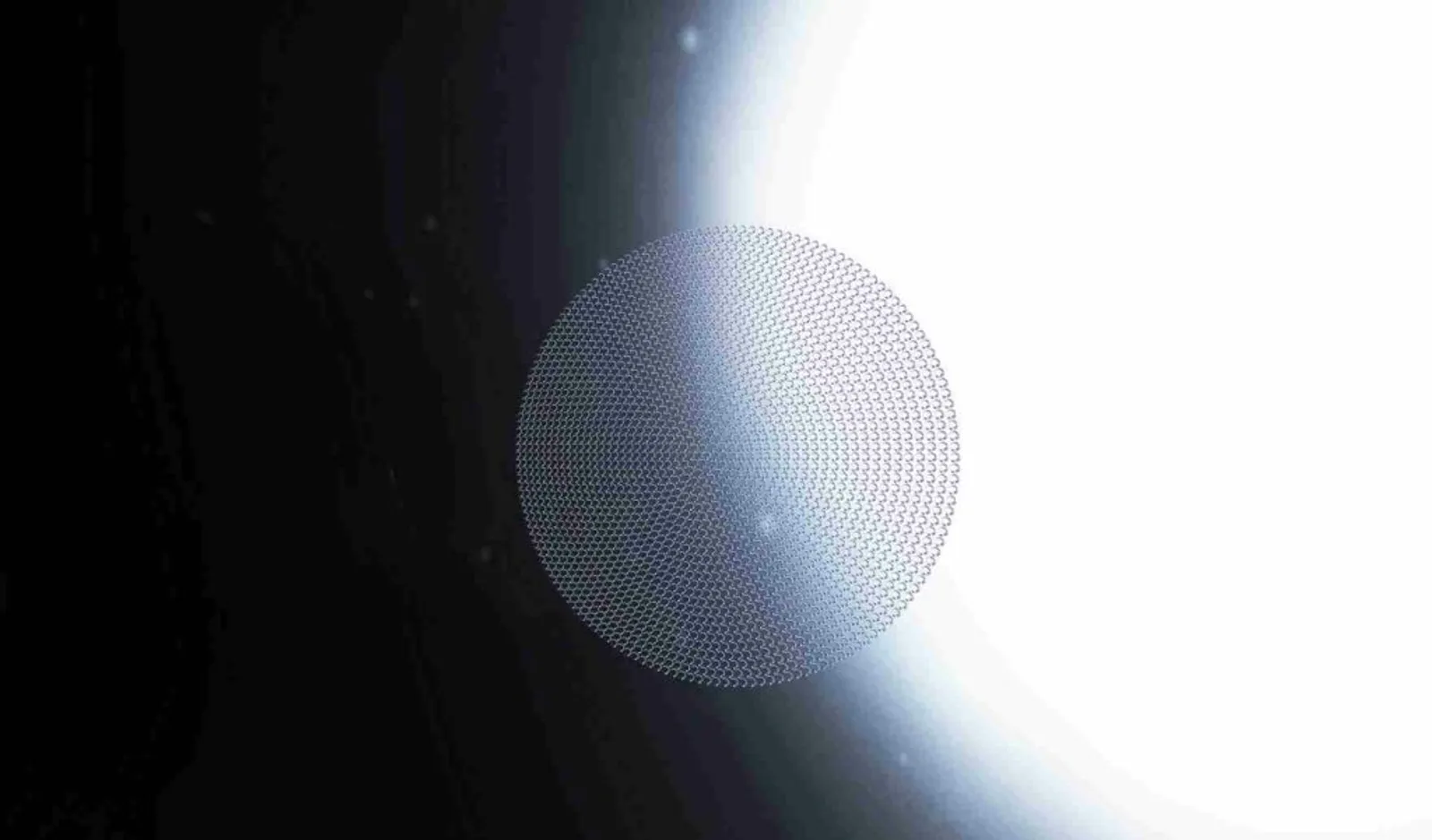
Now an interdisciplinary team at MIT’s Senseable City Lab led by its director Carlo Ratti are aiming to take the concept to the next level of feasibility with the proposal to shield solar radiation with a bubble raft composed of arrays of interconnected small inflatable bubbles.
This would be located between the Sun and the Earth near to what is known as the inner Lagrangian or L1 point at about 1.5 million km from the Earth and where the gravitational forces of the two bodies are in equilibrium. A raft positioned at the L1 point would ‘hover’ although in order to avoid the significant solar radiation pressure there, the preferred location in practice would be slightly closer to the Sun.
It's extent, according to Angel's calculations, would need to be at least 3.4 million km2 and increasing with increasing distance from the L1 point.
The scientists believe that inflating thin film spheres directly in space from a homogeneous molten material, such as silicon, can provide the variation in thickness that refracts a broader wave spectrum and would avoid the necessity of launching large structural film elements.
Moreover, the spheres could be directly manufactured in space, which would optimise the shipping costs.
And they can be intentionally destroyed by breaking their surface equilibrium, so the solution would be fully reversible and with limited space debris.
Project challenges
The project clearly involves an array of research problems in a number of disciplines, from the optics and mechanics of thin films in space to the impacts of shading on the Earth and public policy implementation.
A fundamental issue is selecting the right material and technology to fabricate and maintain the thin film spheres in outer space. The scientists report succeeding in preliminary experiments in conditions approximating space with the inflation of a 500nm thick thin film bubble at a pressure of 0.0028atm and maintaining it at around –50oC.
Further research is planned to investigate the use of other types of low vapour-pressure materials, including silicon-based melts and graphene-reinforced ionic liquids.
The scientists also intend to study whether a bubble-based shield is mass-efficient compared to other shading solutions. Initial calculations suggest that the proposed raft’s expected mass density would be <1.5g/m2.
Other focuses of research include novel methods such as magnetic accelerators for shipping the raw bubble material into space, an active positioning and stabilisation mechanism for the raft, the bubble maintenance and replenishment requirements and not least the possible impact on the Earth’s climate and ecosystem.
Despite the remote location from the Earth, some studies have indicated that a reduction of solar radiation could impact the climate, such as weakening the extratropical storm tracks.
A phase-out design also is planned so that an ecosystem shock could be avoided with the sudden termination of the programme when it is no longer needed. Needed lifetime estimates are in the range of 50 to 200 years.
The scientists say that to its largest extent, the system could offset 100% of the effect of greenhouse gases in the atmosphere and that once a technical solution is identified, implementation could happen before the end of the century.
“In short, we believe that advancing feasibility of a solar shield to the next level could constitute a supplementary plan for a low carbon transition on Earth – and in any case help us make more informed decisions in the years to come should geoengineering approaches become urgent.”