How quantum computing is disrupting power utilities
Jonathan Spencer Jones
Posted on: 29 October 2024
Dr Giorgio Cortiana of E.ON Digital Technology talks to Jonathan Spencer Jones about the company’s pioneering investigations in quantum computing.
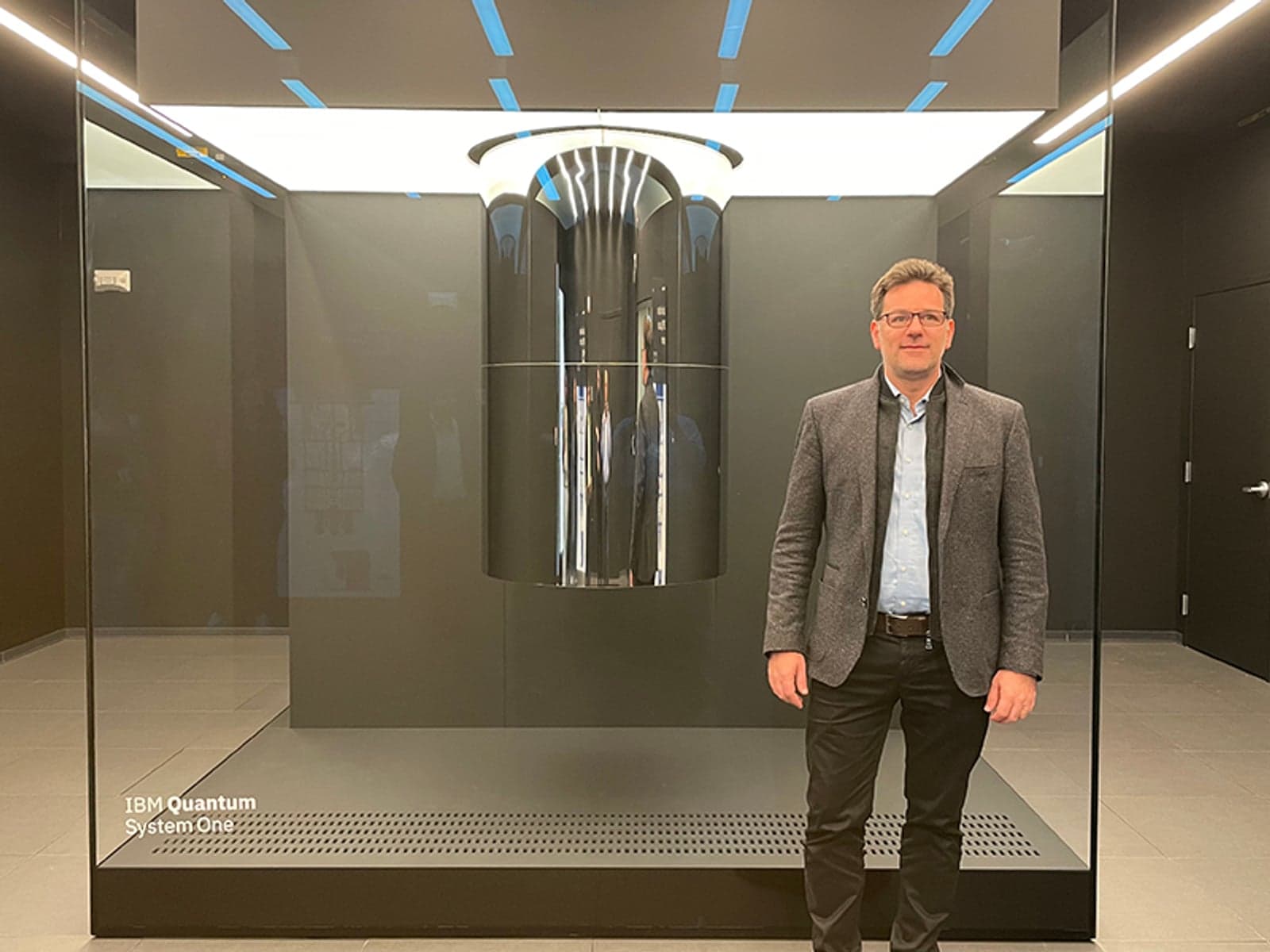
Dr Giorgio Cortiana of E.ON Digital Technology talks to Jonathan Spencer Jones about the company’s pioneering investigations in quantum computing.
Giorgio Cortiana is a particle physicist by training, with a background in fundamental research at the Fermi National Accelerator Laboratory in Illinois and later CERN in Switzerland.
After joining the company to work on applications of AI to data, he has led E.ON’s journey as one of the first utilities, if not the first, to explore quantum computing.
That journey started in 2019, triggered by an electric vehicle-to-grid project with the goal of optimising both the charge and discharge cycles of a fleet of EVs with bidirectional charging and the delivery of energy to the grid at times of low renewable generation.
Cortiana, who is head of data and AI for energy intelligence at E.ON Digital Technology, explains: “We were modelling dynamic containment and frequency restoration for the grid, and we found that depending on the size of the vehicle fleet considered and the complexity of the constraints, the time to solution for the optimisation problem could increase beyond practicability, so we started looking at alternative ways to perform the computation.
Read more
Tech Talk | The rise of supercomputers and quantum computing
“Thanks to the quantum-mechanical properties exploited to perform calculations in quantum computers, we felt quantum computing could complement the technological stack we were using in our projects.”
With quantum computing still emerging and access to machines limited and not yet within the ownership reach of individual companies, E.ON then formed partnerships with developers, entering into two such agreements with IBM and D-Wave.
In addition to priority access to the quantum computers themselves, such partnerships, which Cortiana says are “key”, also open up access to the other resources and expertise within those companies – for example, in the case of IBM, to application co-development opportunities.
“We are looking at a range of different applications: D-Wave’s technology is based on quantum annealing, which is specifically designed to solve optimisation problems, whereas IBM provides a universal quantum computer that allows the full spectrum of calculations, including optimisations but also others such as system modelling and quantum machine learning.”
Working with quantum ‘qubits’
Cortiana explains that the differences are due to the underlying physics of the machines. In quantum computing the operations are performed with quantum bits or ‘qubits’, which are the analogues of ‘bits’ in the standard information system, but they also have special ‘quantum’ properties that enable them to be in superposition or different states simultaneously, i.e., ‘0’ and ‘1’ as well as any combination between them, enabling parallel computation.
They also can be ‘entangled’, i.e., one qubit’s state depends on the state of the other. This property means that an entangled qubit state contains more information than the qubits do independently.
“The way IBM’s, and other universal quantum computing, works is that those basic units of information are manipulated with gates analogous to those in traditional computing,” Cortiana explains. “But in the annealing devices, one basically constructs a quantum version of the problem one is wanting to solve and then evolves it towards its physical ground state.
“So it’s a bit different in the way the problem is formulated, implemented and executed at the hardware level.”
Cortiana says it is necessary to be clear from the outset about the problem one wants to solve, which can then be written mathematically for encoding into the quantum computer.
“The current generation of machines are small-scale and noisy, and one has to find a way to translate the operation that would be done on a classical computer to one that is manageable for the current quantum devices but still relevant for the business.
“As quantum computers do not allow long calculations, one needs to be very wise in the way the algorithms are written as they are slightly different from classical computation. That is where companies such as IBM and D-Wave come in, as they have those resources.”
He adds that these partnerships, as well as others with academia, have also proved important for accelerating the upskilling of the internal quantum computing team, both directly and through learning by doing.
Use cases
E.ON’s quantum computing focuses on three areas, one of which is the general broad spectrum of scheduling problems, Cortiana comments.
“For example, which battery or which generator should I turn on or off at a particular point in time to deliver the electricity that my customers require, and that we can investigate with both the D-Wave and IBM machines.”
Closely related, and within that spectrum, are ‘matching’ problems such as peer-to-peer energy trading, in which people with resources such as EVs, storage batteries or solar PV can form a self-sufficient energy community.
“Deciding who should be included in that community is a very complex task, as there are many combinations of matches and the more households that are included, the more the number increases. They also change over time, when for example someone is on holiday and their vehicle is not there. So one needs to try to model the community according to the production and consumption changes over time.”
A second area is the implementation of system and scenario modelling techniques, mathematically termed Monte Carlo simulations, with an example use case being to manage the weather risks for large user energy contracts.
“As a utility we provide contracts for the supply of electricity or gas, but the user’s consumption can change or go and down, and that exposes us to market risks so we need to undertake a risk evaluation to put in countermeasures to compensate.
“This involves a lot of Monte Carlo simulations, taking account of factors such as future energy prices and weather variations in different locations. The more precise the evaluation, the more granular the input data needs to be, and the more simulations are needed.”
In this case E.ON is building the algorithms with IBM to speed up the weather risk calculations, with the possibility of eventually leading to real-time decision making and reassessment of risks as new information becomes available.
The third broad area is quantum machine learning and AI, with one area of investigation being anomaly detection on assets such as large power plants.
“It’s critical to understand if something is not working properly so that steps can be taken to rectify it. We did a comparison of classical and quantumenhanced algorithms, which found that the latter could outperform their classical counterparts in terms of accuracy.” Cortiana adds that these areas of work have been small-scale proofs of concept so far, in line with the limits of the current quantum computers, but the intention is to run some larger-scale use cases as the technology matures.
“As the current generation of quantum computers is limited in size we do not yet have the enhanced applications integrated into the business flow, but that will soon change as quantum hardware becomes more powerful and more stable.”
Quantum for utilities
Looking ahead, Cortiana says one of E.ON’s goals is to understand the real-world use cases in which quantum computation can outperform classical computation.
“For specific types of problems, there is theoretical proof that the quantum approach has an advantage in terms of speed, but the size of the problem that we could run so far was so small that it didn’t make sense to put it in production.
“But great progress is being made within the quantum ecosystems, from both the application development and quantum hardware sides. It’s important to keep up with and leverage the latest research and advancements in the field to deliver business values as soon as possible.”
He says that, ultimately, quantum is an additional tool in the toolbox, and that in the future it is unlikely to be necessary to think about where to run a task. Instead, it will be delivered to an intelligent operating system that will decide whether it goes to the CPU, the GPU or the quantum machine.
“It’s no different from today’s laptops, where the tasks are allocated internally without the user being aware.”
And the computational resources will be located in cloud-based centres for access according to need.
“The discovery of the application that will show the superiority of quantum computing is set to be our ‘ChatGPT’ moment. It’s what E.ON and the full community are working towards, and I’m really looking forward to that moment, which I expect in the next two to five years.”