Revolutionising the European energy landscape: TwinEU's digital twin ambition
Guest/partner contributor
Posted on: 31 January 2025
The TwinEU project, part of the Horizon Europe framework, is pioneering a bold vision: to create a federated digital twin of the European electricity system – its aim to enhance grid management and facilitate the transition to renewable energy sources, ensuring a sustainable energy future for Europe.
The TwinEU project, part of the Horizon Europe framework, is pioneering a bold vision: to create a federated digital twin of the European electricity system – its aim to enhance grid management and facilitate the transition to renewable energy sources, ensuring a sustainable energy future for Europe.
The European energy sector stands at the cusp of a significant transformation, driven by the integration of digital technologies.
Its energy system is vast and complex, with myriad challenges ranging from ageing infrastructure to integrating renewable energy sources. Managing this complexity requires innovative solutions that can bring greater efficiency and resilience.
TwinEU addresses these needs by leveraging digital twin technology, which allows for real-time monitoring and simulation of physical systems.
TwinEU’s approach involves the development of local digital twins across 11 countries, which are interconnected to form a comprehensive, pan-European model. This model will facilitate improved decision-making and resource management across Europe’s power networks.
TwinEU will provide actionable insights for optimising energy distribution and consumption by simulating different scenarios and outcomes.
Several key technological innovations are at the heart of TwinEU:
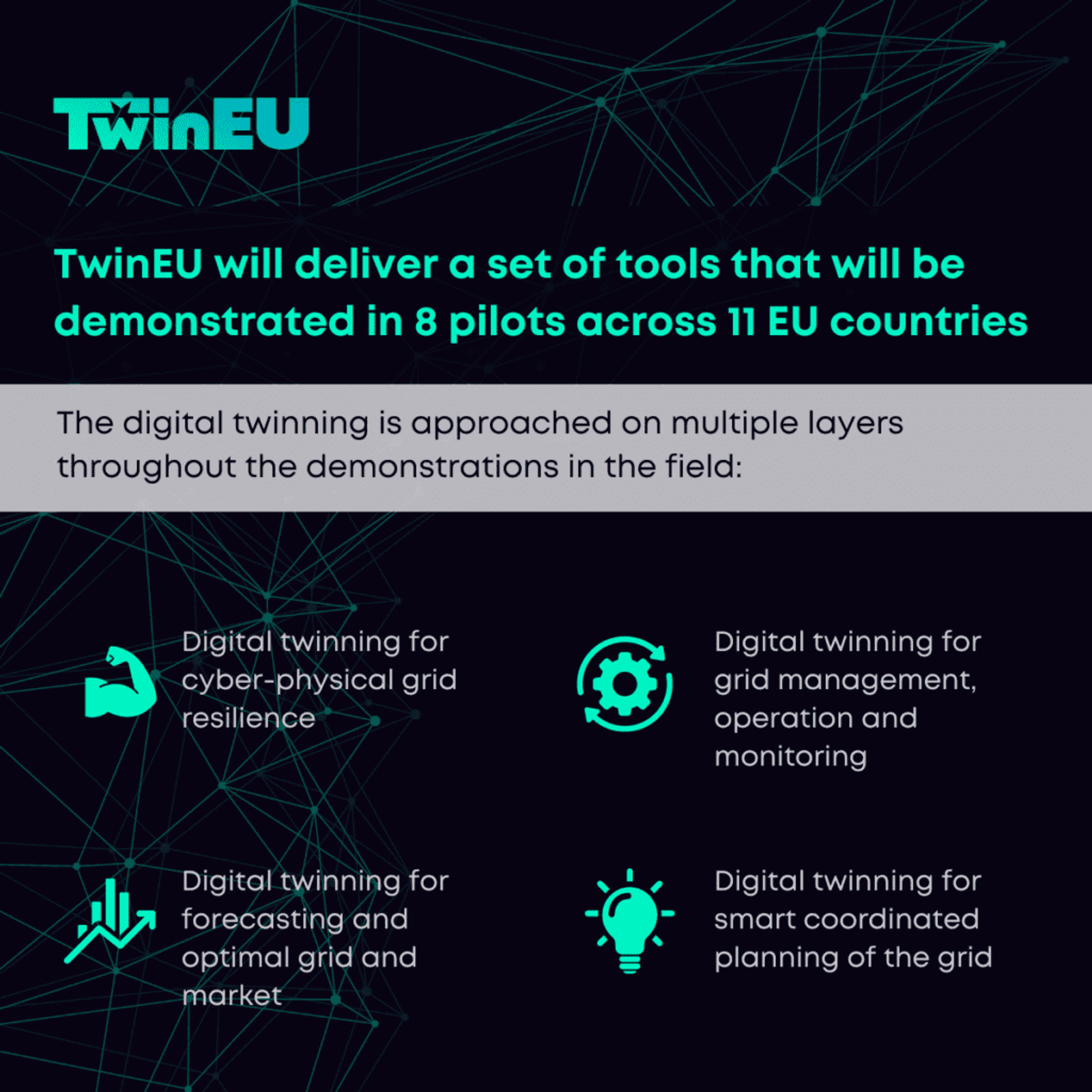
- Cyber-physical grid resilience – enhancing the ability to withstand and quickly recover from faults or attacks.
- Advanced forecasting tools – utilising AI and machine learning to predict energy needs and weather impacts, ensuring optimal grid operation.
- Smart coordinated planning – enabling better resource allocation and infrastructure development through integrated planning tools.
- Enhanced grid observability and controllability – adding a digital layer to the control centres for optimised grid operation.
The impact of the TwinEU project is profound. By improving the observability, controllability and resilience of the grid, the project helps to minimise downtimes and enhance the security of supply. It also supports the integration of renewable energy sources, which is crucial for meeting Europe's ambitious climate targets.
The adoption of digital twins will set a new standard in energy system management, potentially reducing costs and enhancing the reliability of power supply across the continent.
TwinEU is not just theoretical; it includes eight demonstration sites with multiple pilots across 11 EU countries, each tailored to address specific local and regional needs.
These demonstrations serve as real-world applications and testing grounds for the developed technologies, providing tangible proof of concept and showcasing the scalability of digital twins.
• Iberian Peninsula (Spain, Portugal): TwinEU will enhance the Iberian energy system's security and resilience using digital twins from generation to consumers, featuring tools for probabilistic power scenarios and improved operation coordination.
• Eastern Mediterranean (Greece, Cyprus): This demo develops an integrated market model for Greece and Cyprus, enhancing system flexibility and monitoring through extensive scenario simulations and market coupling prototypes.
• Hungary: Developing artificial neural network-based temperature monitoring for transmission lines, this demo enhances grid capacity and efficiency with a focus on intraday market dynamics and improved congestion management.
• Bulgaria: Aiming at high digital density, this pilot focuses on grid resilience and proactivity, providing non-discriminatory market participation for low voltage energy actors and enhancing predictive management.
• Germany: Focused on grid monitoring, planning, and end-to-end flexibility management, this pilot builds on the Intelligent Grid Platform to enhance TSO-DSO data exchange and congestion management.
• Italy: Taking place in Sardinia and Rome, this pilot utilises a digital twin for real-time updates and tests flexibility sources in high RES scenarios, fostering multi-actor collaboration.
• Slovenia: Upgrading network operation and stability, this demo enhances system flexibility with new fast frequency response services and tools for real-time security assessments.
• Netherlands-France: This pilot develops tools to anticipate and mitigate instability under high RES penetration, focusing on the control room of the future for system resilience and cybersecurity training.
TwinEU is setting the pace for the future of Europe's smart energy sector. With its innovative use of digital twin technology, the project promises to revolutionise how we manage, use and understand energy in the 21st century, making European energy networks smarter, more efficient and ready for the challenges of tomorrow.
As TwinEU continues to evolve, we invite energy professionals, policymakers and technology enthusiasts to join us in this transformative journey.
To learn more about the TwinEU project and how you can be a part of this exciting venture, visit our website and subscribe to our updates. Together, we can power a smarter, more sustainable Europe.