Home
/
Accelerating sustainable hydrogen storage: MOST-H2 and the MOFSynth tool’s breakthrough in MOF design
Accelerating sustainable hydrogen storage: MOST-H2 and the MOFSynth tool’s breakthrough in MOF design
Guest/partner contributor
Posted on: 15 September 2025
The MOST-H2 project advances hydrogen storage by computationally designing sustainable metal organic frameworks (MOFs) using the MOFSynth tool, which evaluates synthesisability based on energy and geometry differences.
The MOST-H2 project advances hydrogen storage by computationally designing sustainable metal organic frameworks (MOFs) using the MOFSynth tool, which evaluates synthesisability based on energy and geometry differences.
Widespread use of hydrogen as an energy carrier is a key priority for the EU, in order to achieve its climate and energy transition goals. However, developing sustainable, efficient and safe hydrogen storage technologies has yet proven to be challenging.
Here is where MOST-H2 comes into play. The project combines advanced synthetic strategies and sophisticated computational techniques, including molecular simulation and machine learning, with a cyclic materials development approach to deliver new high performance, sustainable-by-design monolithic MOF adsorbents for hydrogen storage.
This integrated multiscale lab-to-tank approach develops, validates and demonstrates innovative, low cost cryo-adsorptive MOF-based hydrogen storage with an optimal combination of volumetric and gravimetric capacity, but also a small environmental footprint while operating at low pressures.
One of the key pillars of the project is the computational design of the MOFs. Although there have been major advances in the past decades in high-throughput computational studies of materials and over a million hypothetical MOFs have been designed in silico, only a small fraction of these have actually been synthesised in the labs.
This gap inspired the MOST-H2 project to create a valuable and powerful tool that evaluates synthesisability based on the disparities in energy and geometry between the linker conformation within the MOF structure and its isolated, free-gas state.
The user-friendly MOFSynth tool helps researchers with minimal expertise to distinguish MOFs that are more likely to be synthesised and prioritise MOFs with the best potential for real-world applications. Recently, the tool was used in a widespread study on different MOF databases [1].
The MOST-H2 methodology
Over 40,000 MOFs from databases, including QMOF, CoRE MOF and ToBaCCo, were deconstructed to analyse key parameters defining the linker strain within the MOF unit cell and identify optimal linker candidates for highly synthesisable MOFs.
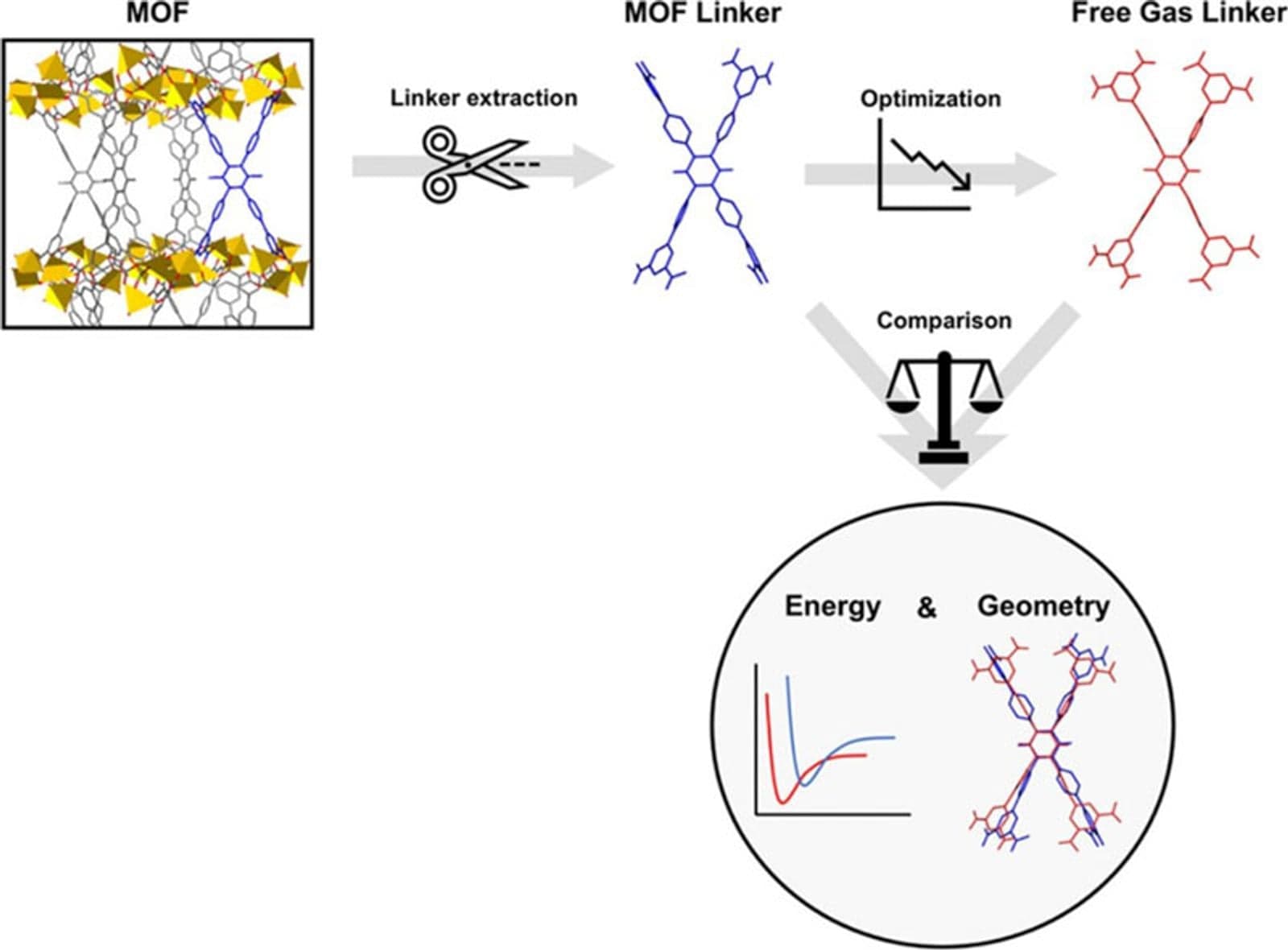
The synthesisability evaluation was done in four steps (Figure 1):
1. Creation of a super cell by expanding the unit cells dimensions by a factor of 2 to ensure comprehensive investigation of complete linkers only.
2. Fragmentation and extraction of a single linker representative of the MOF under examination.
3. Single-point calculation and an energy optimisation procedure to yield two distinct conformations: one representing the initial state of the linker within the metal organic framework and the other showcasing the optimised configuration. These conformations provide valuable insights into the structural changes and energy surface during the optimisation process, contributing essential data for the overall assessment of the synthesisability.
4. Calculation of energy and geometrical changes. The linkers were grouped based on their SMILES codes and each group was compared with regard to optimised energies and retention of the conformation with the lowest optimised energy. The energy difference for each linker was determined by computing the disparity in its single point energy and the lowest optimisation energy of its group. Subsequently, the geometric deformation was quantified with the root-mean square deviation (RMSD), which is pivotal to ensure accuracy by subjecting the two monomers to a recentring process and rotation to achieve true minimal RMSD.
As part of the project, an open-source code was released on GitHub, which includes an implementation of the MOFSynth procedure analysed above. In addition, the tool is provided in a web interface, which allows researchers with minimal computational knowledge to use the evaluation tool and extract information on MOFs of their choice.
Materials with high hydrogen storage potential
In summary, different databases such as QMOF, CoRE MOF and ToBaCCo, covering over 40,000 MOFs, were analysed using MOFSynth. While QMOF and CoRE MOF contained the most promising candidates due to optimised, stable materials, ToBaCCo showed lower synthesisability due to non-optimised hypothetical structures. These findings could guide researchers toward instances with higher chances of synthesisability.
From the perspective of MOST-H2, the tool enables the identification of MOFs that are stable, synthesisable, and optimised for hydrogen storage. By focusing on materials with high hydrogen storage potential, the study accelerates the discovery of efficient and cost-effective solutions for sustainable energy systems.
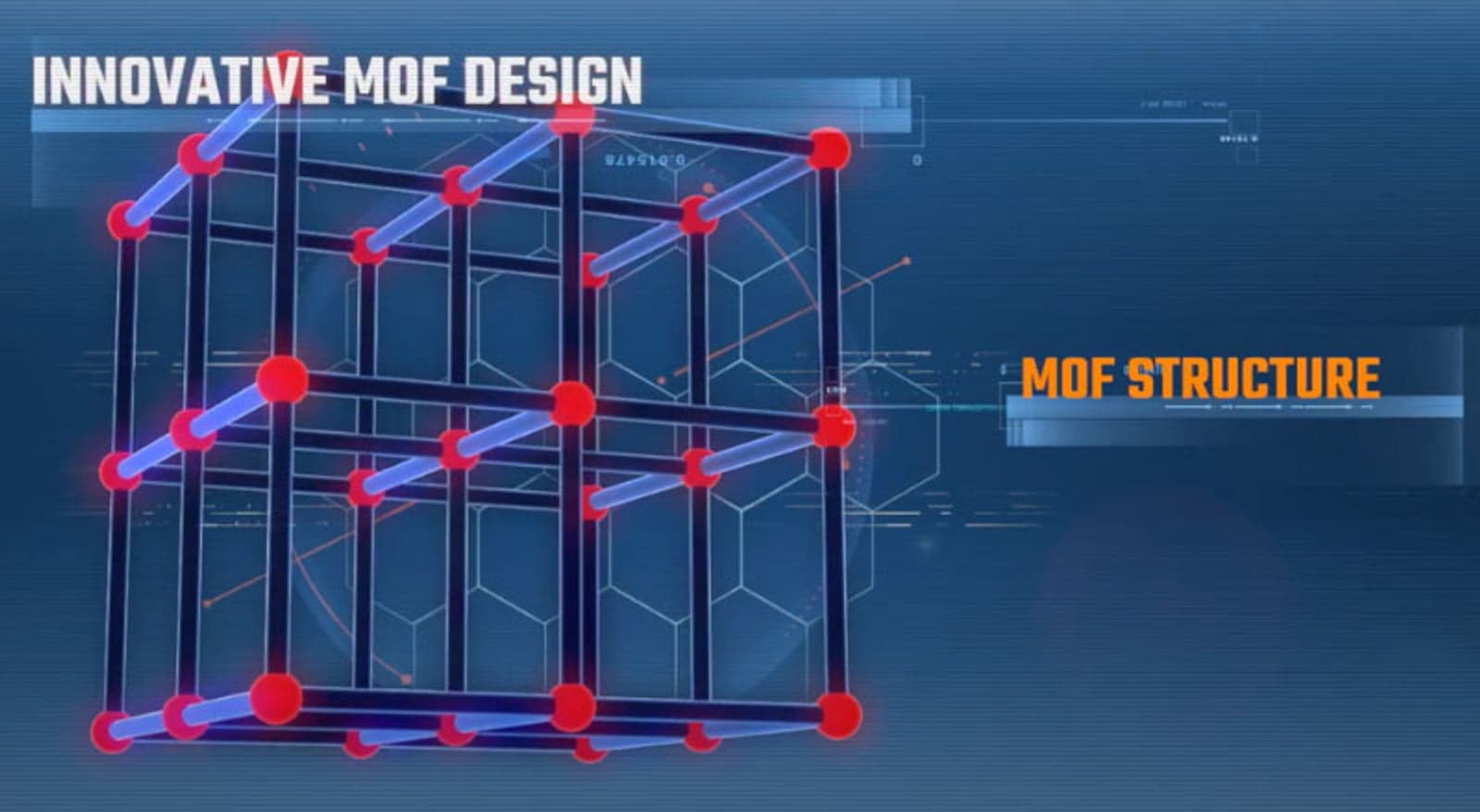
The tool also enables efficient MOF screening for applications like gas storage, catalysis and drug delivery. It also generates data for machine learning, paving the way for AI models to predict synthesisability more accurately. With AI, researchers can explore underutilised areas of MOF design and discover materials with exceptional properties.
MOFSynth tool potential
In conclusion the MOFSynth tool has demonstrated significant promise in accelerating the discovery and application of synthesisable MOFs, particularly for hydrogen storage. This not only supports the EU's sustainability and energy transition targets but also pushes innovation across diverse fields such as gas storage, catalysis and pharmaceutical delivery.
As the integration of machine learning and AI continues to advance, tools like MOFSynth will be instrumental in driving the future of materials science, enabling the design of breakthrough materials with real-world impact.
Future plans include enhancing synthesisability predictions through advanced machine learning approaches and expanding the tool to other materials like COFs (covalent organic frameworks) and ZIFs (zeolitic imidazolate frameworks).
Recent developments, such as the integration of quantum chemical methods in the new MOFSynth-QM workflow, available on GitHub, have already improved the efficiency of energy calculations. This ongoing evolution will broaden the tool’s impact, supporting interdisciplinary research and driving discoveries across a wide range of advanced materials.
Reference
Charalampos G. Livas, Pantelis N. Trikalitis, George E. Froudakis, in: Journal of Chemical Information and Modeling. 10.1021/acs.jcim.4c01298. Open Access.
About the author

Charalampos Livas is a PhD candidate at the University of Crete, focusing on the development of AI approaches for studying gas adsorption and storage in nanoporous materials. His work covers applications ranging from clean energy storage to advanced material design. Recently, he has been involved in developing new computational tools for large-scale screening and synthesisability assessment of MOFs.