Hydrogen-fuelled green freight
Areti Ntaradimou
Posted on: 18 February 2022
H2 Clipper, a California based aerospace and alternative energy company, has the hydrogen-based technology to revolutionise green transport.
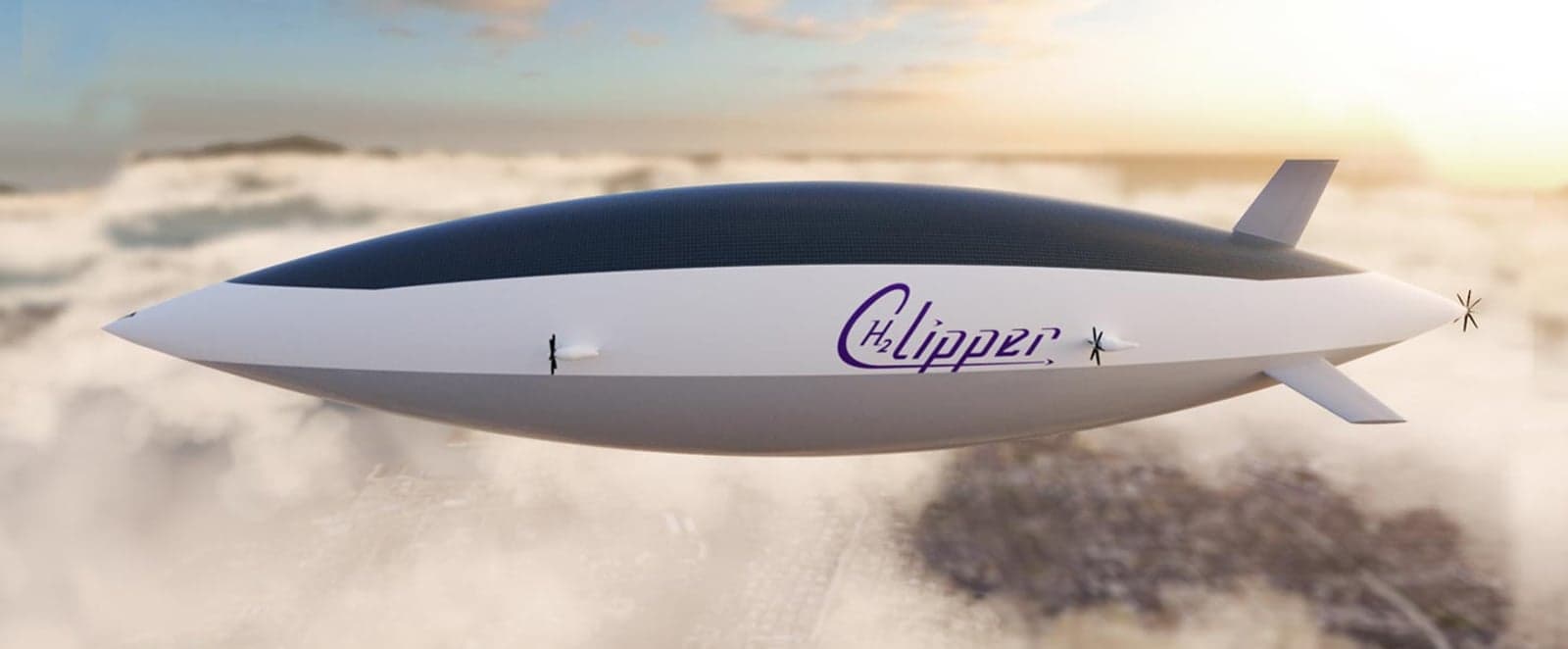
H2 Clipper, a California based aerospace and alternative energy company, has the technology to revolutionise green transport and they are currently immersed in two big projects. First, creating the biggest, fastest hydrogen-powered airship fleet. Second, in the words of the founder, chairman and CEO Rinaldo Brutoco, “to move large quantities of hydrogen from where it’s least expensive to produce, to where the customers live”.
The vision behind H2 Clipper is so vivid and exciting that Ángel Gurría, former Secretary-General (2006-21) of the Organization of Economic Co-operation and Development (OECD), who also formerly served as Minister of Finance and Public Credit and Minister of Foreign Affairs in Mexico, is now part of the team.
How he got convinced? “First of all, because I strongly believe that this is the way to the future,” Gurría says."[The company] is addressing one of the most important issues that follow hydrogen. From the production to the consumer.”
“For me,” he adds, “this is like one step down in terms of specificity. Because, so far, I have been looking at the overall issues, the bigger picture problems that governments have to face regarding climate change. And here is this company, that was looking into some of the most relevant challenges and that has the potential to solve them. That is what makes H2 Clipper so exciting, and that is what convinced me to join.”
The area that H2 Clipper will revolutionise
Transitioning away from fossil fuels is necessary in order to battle against climate change, but it can be quite difficult for some industries. While road and rail transport are focusing on electrification and get (relatively) fast results, in aviation, things are not that simple. Batteries are still nowhere near providing the weight to power ratio required. Especially when discussing long distances.
Hydrogen is increasingly being seen as the solution to these problems that the hard to decarbonize aviation industry is facing. However, hydrogen comes also with ‘baggage’. For starters, unless it's green, hydrogen can be as polluting as fossil fuels. And secondly, it needs to be transferred fast and far to make a difference. That is, from areas rich in wind and sun – to produce green hydrogen – to areas where the hydrogen will actually be needed.
Related Content
Rotterdam – hydrogen gateway to Europe
Green hydrogen hub for rural northern Germany
Enter H2 Clipper. At least for the second part of the equation. The company plans to build airships that simultaneously transport and use hydrogen to power their engines. And though still at a pilot stage, the company’s CEO is confident that “within a year we can start building it in a major plant, and within five to five and half years from now, the prototype will in all probability be ready”.
The benefits of H2 Clipper
While it will probably not be as fast as a conventional plane, the H2 Clipper will be able to ship hydrogen anywhere in the globe within two days, thus being de facto faster than shipping by sea, rail or truck. It boasts costs less than one-fourth of traditional air freight and an easy cruise of approximately 175mph. It has a cargo volume of 265.000 cubic feet and can carry up to 340.000 pounds of payload at 6.000 miles.
This way, not only the airship could carry a ton of cargo between distances of 1.000 to 6.000 miles for a quarter of the cost of traditional airfreight, but in addition, because it can take off and land vertically, it can potentially carry the cargo straight to its final destination, instead of transferring it onto other vehicles at the airport.
The pipe within a pipe technology behind H2 Clipper
This newly patented technology aims to solve the last mile issues of transporting hydrogen distribution while, at the same time, assuring that its purity is maintained. It covers the system, method, and apparatus for safely and efficiently transporting hydrogen up to 1,000 miles inside virtually any existing oil and gas pipeline, water pipe, sewer line, storm drain, or other pipelines.
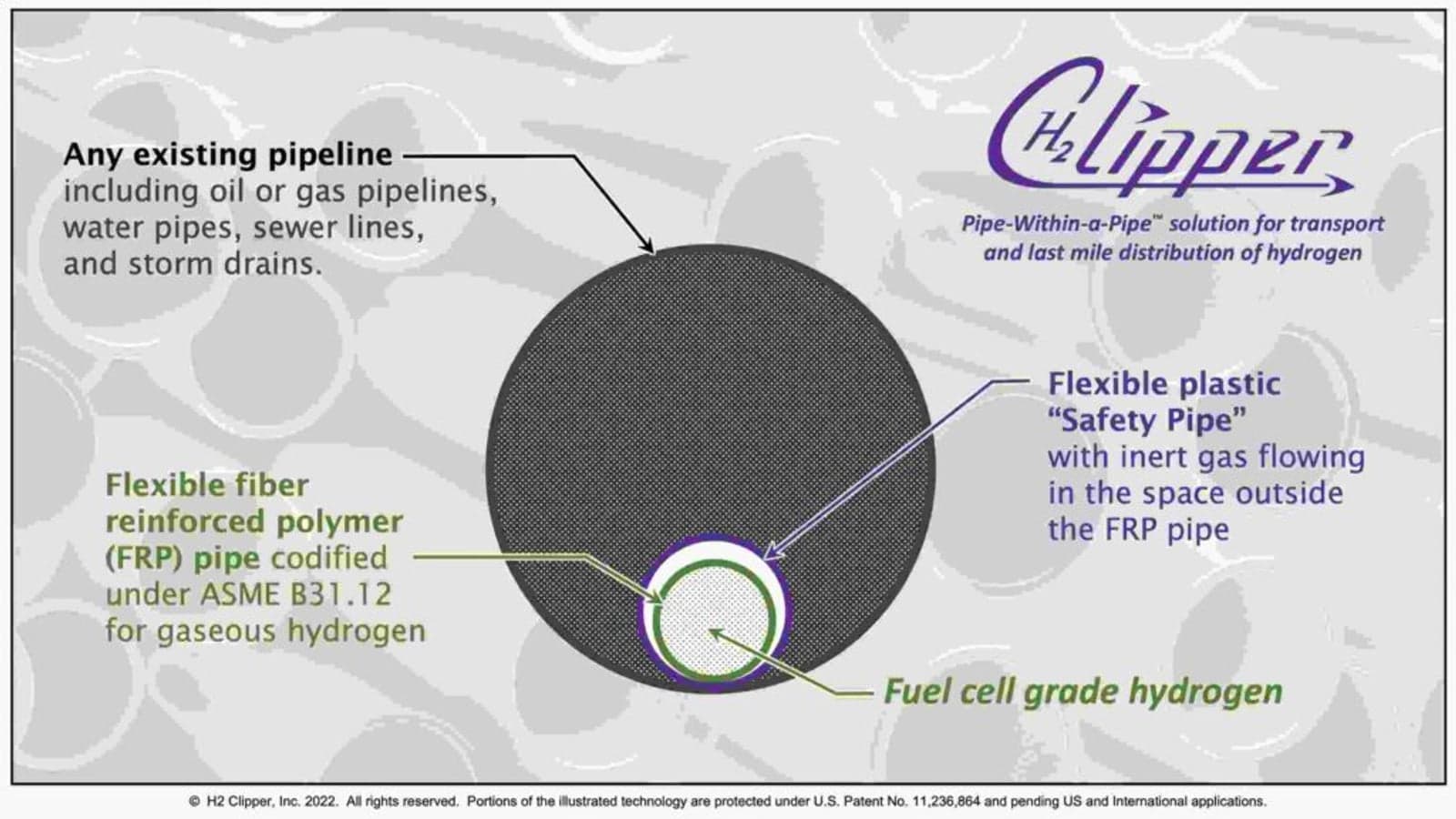
Now, keep in mind that such lines run below ground under virtually every major city in the world. According to H2 Clipper, having a reliable way to safely utilize them to distribute pure hydrogen effectively solves the problem of distributing fuel cell grade hydrogen from regional depots and local production facilities to where it can be used as a carbon-free replacement for gasoline, diesel, natural gas, and other fossil fuels.
In the words of Rinaldo Brutoco: “With the safety pipe, sweeper gas, and our proprietary continuous monitoring system in place, hydrogen can be run inside nearly any existing pipeline without interfering with the continued commercial use of that line. Our Pipe-Within-A-Pipe will save companies and governments hundreds of billions of dollars by avoiding the construction of new hydrogen pipelines or retrofitting existing ones for hydrogen. Taken together, these measures will dramatically accelerate the hydrogen economy, which is our mission and commitment at H2 Clipper.”
The environment comes first
Both Rinaldo Brutoco and Ángel Gurría mention with passion that the environment is the source of their interest and the reason why they are part of H2 Clipper. “I came to this as an environmentalist first, not as an aviation engineer,” says Brutoco. “That’s what motivated me from the beginning. And still does. I've been writing books on climate change for literally 17 years and I became convinced that governments of the world would not be capable of executing on their own the agreed-upon climate goals, not the Paris accord, not COP”. Hence H2 Clipper’s help.
“You can have intermediate steps in the transition,” Ángel Gurría says, “but in the end, this is the single most promising element in terms of climate change”. And he should know because as Secretary-General of OECD, he started mentioning the need for net-zero, long before net-zero became a thing.
Gurría: “At the OECD, we used to work 24/7 on the question of climate change, on transitioning towards new technologies that would assist us in our battle. And it became obvious that hydrogen was the way forward.”