Ørsted joint venture signs deal for 100MW Scottish floating wind project
Pamela Largue
Posted on: 23 May 2023
Salamander has signed an exclusivity agreement as part of Crown Estate Scotland’s Innovation and Targeted Oil and Gas (INTOG) leasing round.
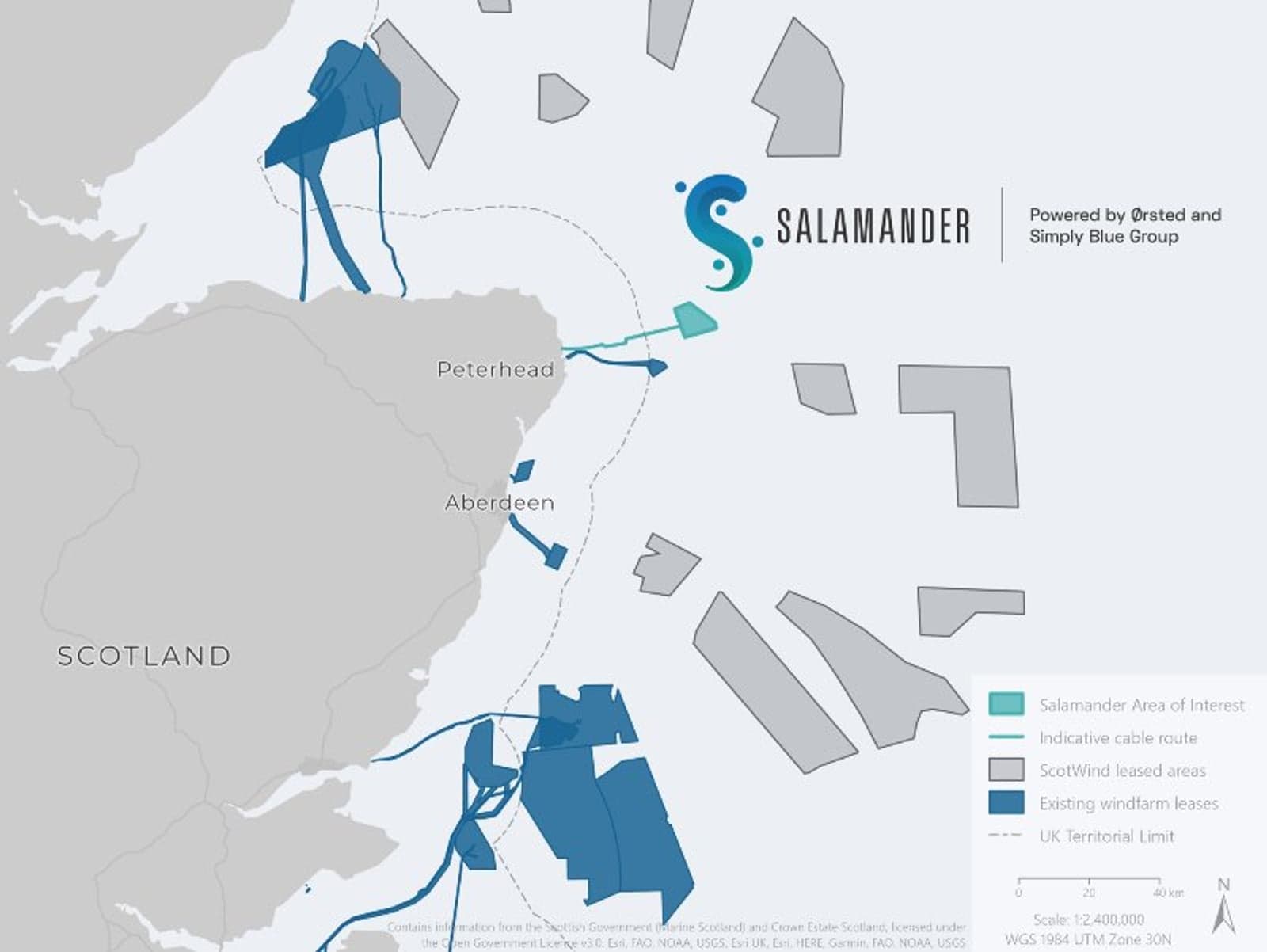
Salamander, a joint venture between Ørsted, Simply Blue Group and Subsea7, has signed an exclusivity agreement as part of Crown Estate Scotland’s Innovation and Targeted Oil and Gas (INTOG) leasing round.
The INTOG leasing round, announced in February 2022, presents an opportunity to secure seabed rights to develop offshore wind projects for the purpose of providing greener electricity to power oil and gas installations.
To this end, the 100MW Salamander floating offshore wind project is located 35km off Peterhead on the East coast of Scotland. The project is focused on supply chain development, as well as de-risking floating wind technologies for future commercial projects.
Have you read?
Floating wind developer acquires naval engineering firm F. Carceller
A $25bn renewables grid to green oil & gas platforms in the North Sea
The exclusivity agreement that is now in place will allow offshore wind development work to begin while Marine Scotland’s planning process for the INTOG Sectoral Marine Plan (INTOG SMP) is completed.
According to Salamander, the project will be used to demonstrate technologies at commercial scale, readying them for roll out in utility-scale projects such as the ScotWind leases.
Furthermore, the Salamander project will help Scotland reach the target of 11GW of installed offshore wind by 2030.
A series of public, in-person consultations are set to be held by the Salamander floating offshore wind project next month.
According to the Innovation and Targeted Oil and Gas Decarbonisation report published by Crown Estate Scotland, considering the recent technological advancements within the offshore wind sector, "the trajectory for floating offshore wind to reach cost parity with fixed bottom offshore wind, and therefore other forms of renewable energy generation, will be considerably faster than that followed by fixed bottom offshore wind."
The report also states that floating offshore wind "represents the best opportunity for deployment of marine technology at scale. No other form of technology is capable of exploiting the advancements made by fixed bottom offshore wind to the same degree and therefore able to reach cost convergence at the same rate.