Cars instead of cables: V2G’s potential to enhance a flexible energy system
Guest/partner contributor
Posted on: 1 May 2024
While unmanaged electric vehicle charging would require significant grid and power generation investments, vehicle-to-grid can enhance network flexibility, lower system costs, and reduce system emissions. All while simultaneously delivering benefits to consumers, explains Francesco Nobili.

Although the electrification of road transportation represents a significant challenge to our energy systems, adding pressure on power grids at the national and local levels, V2G provides immense potential as a source of flexibility to support the energy system of tomorrow, explains Francesco Nobili of Charles River Associate (CRA) Energy.
While unmanaged electric vehicle (EV) charging would require significant grid and power generation investments, vehicle-to-grid (V2G) can enhance network flexibility, lower system costs and reduce system emissions, all while simultaneously delivering benefits to consumers.
Multiple EV charging solutions currently exist, ranging from managed charging tracking live power prices through smart charging (V1G) to utilising EV batteries at times of high prices for powering our houses (V2H), or appliances (V2L).
However, this article focuses on V2G, discussing its current evolutionary position, the major hurdles to its rollout at scale, and its potential to support tomorrow’s energy systems.
Current position within the V2G evolutionary journey
V2G is a mature technology, with proven technical and economic feasibility as demonstrated through multiple pilot projects across Europe and, more recently, by the launch of commercially available V2G solutions on the markets.
In the United Kingdom, Nissan worked with Ovo Energy, Kaluza and Cenex already in 2018 on the largest domestic V2G trial to date, finding benefits for both customers and the grid. Nissan also separately worked with E.ON and demonstrated how commercial fleets could play a role in supporting the UK power system. Analogous projects have been conducted in the Netherlands and Germany, respectively by Hyundai and Porsche.
Today, commercial V2G offerings are being launched to the market. Earlier in 2024 Octopus Energy introduced Power Pack, a V2G tariff for residential customers which provides free EV charging in exchange for leveraging a customer’s EV for energy arbitrage during high-price times. Likewise, Renault launched its new Renault 5 model bundling it with an optional V2G package in collaboration with Mobilize and the The Mobility House. Overall, V2G has reached full commercial maturity. However, multiple complications may slow down its rollout at scale.
Major blockers pertain to the widespread adoption of V2G
Hurdles to the further adoption of V2G can be identified at different stages of its value chain as depicted in Figure 1.
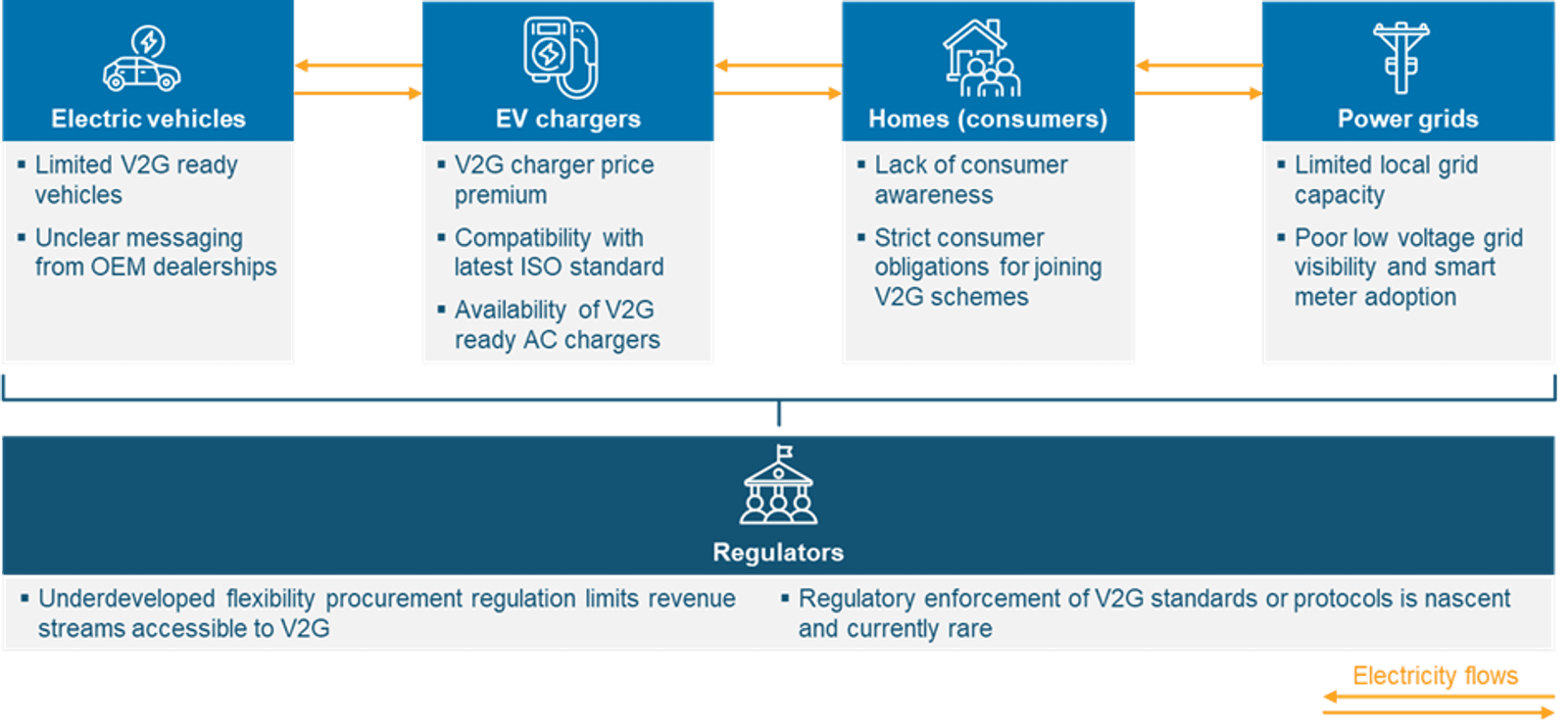
Electric vehicles - Starting from the vehicle, only few EV models on the market are truly V2G compatible, and car dealerships often do not yet have a consistent offering to enable V2G for the consumer straight from the forecourt. While some EVs can facilitate V2L and/or V2H, such as the Ford F-150 and Hyundai’s Ioniq 5 and Ioniq 6, Octopus Energy’s V2G tariff is only compatible with three EVs, highlighting a compatibility shortfall.
Compatibility between EVs and chargers is also a challenge; in Europe, most charging infrastructure relies on the CCS standard, and only chargers that comply with the latest ISO 1511820 standard introduced in 2022 can support V2G. As a consequence, delays in the adoption of updated ISO standards from OEMs and charging providers may slow down the implementation of V2G.
EV chargers – A cost barrier remains for V2G-capable chargers as they on average tend to cost five to ten times more than unidirectional products. Furthermore, most V2G chargers available on the market are direct current (DC), which as standard have higher prices than alternating current (AC) chargers. While AC V2G-capable chargers have recently been launched, they are only compatible with EV models equipped with onboard V2G chargers, which is rarely the case today.
Consumers - Consumer behaviour can slow down V2G adoption. Stemming from the technical complexity of bi-directional power flows to consumers not familiar with the electricity system, public appetite, or even awareness, remains scarce. While early adopters tend to better understand the benefits of V2G, concerns around battery degradation are still common among the wider public. Moreover, poor coordination among stakeholders, such as utilities, charging providers and OEMs, on raising consumer awareness may also slow down the process.
While V2G can unlock considerable savings for EV drivers, it also comes with specific duties: customers may be required to leave their vehicle plugged into a charger at specific times of the day or for a determined number of hours daily. Similarly, limitations on the allowed minimum state of charge may prevent widespread adoption, particularly if coupled with persisting range and charging anxiety.
Power grids - Due to their bi-directional power flow and strict regulatory requirements, V2G chargers may take longer to be connected to the power grid. In turn, while larger depots and charging hubs can follow similar grid connection procedures to Battery Energy Storage Systems (BESS), fewer processes are in place for the rollout of distributed on-street V2G chargers. To be deployed at scale, V2G needs to be integrated into a smart energy system, capable of communicating with EVs in real-time.
Have you read?
UK innovation project assesses ‘Thames-to-grid’ tech
How Orlando Utilities Commission has been testing grid tech innovation
Accordingly, to leverage V2G, the DSO needs to have granular visibility over the low-voltage grid as that allows them to identify available grid capacity at the local level, streamlining the connection of V2G chargers where the network is less constrained.
Furthermore, widespread visibility over the low-voltage network would enable DSOs to procure short-term flexibility services, for instance on an hourly basis, giving V2G access to additional revenue streams while enhancing the stability of local networks.
Conversely, the limited rollout of smart meters and low-voltage network visibility technologies may impact a local grid’s ability to accommodate V2G chargers. More broadly, limited grid capacity at the distribution level is also preventing the connection of V2G chargers or delaying it due to grid upgrade needs.
Regulators - Underdeveloped regulation is hindering the commercial feasibility of V2G across geographies. The business case for V2G relies on regulated flexibility markets on top of revenues from energy arbitrage.
As of today, flexibility services procured by TSOs and DSOs rarely include V2G. Consequently, V2G currently mainly leverages electricity arbitrage to generate revenue, curbing revenue differentiation and the possibility of stacking multiple revenue streams as other energy flexibility solutions, such as BESS, regularly do.
The potential of bi-directional V2G charging
Despite the numerous challenges to its implementation at scale, V2G has the potential to support the development of greener and more flexible energy systems, while simultaneously benefitting different stakeholders.
V2G can enhance electricity network stability and sustainability while reducing investment needs. It can unlock the CAPEX avoidance of not developing further generation and energy storage assets while lowering OPEX costs given the storage is behind the meter.
In the UK, a study by Imperial College found that the rollout of one million V2G units could accomplish up to £900 million ($1.1 billion) of savings per year by 2030 compared to a counterfactual scenario with no EVs. The same study also uncovered that the V2G case would reduce the UK power system’s carbon footprint by 12% compared to the counterfactual scenario.
Similarly, research by Kaluza found that V2G could realise up to £3.5 billion ($4.4 billion) of grid investment savings per year in the UK. At the same time, V2G offers benefits to consumers as EV drivers could achieve noticeable fuel cost savings, or even be able to charge their EVs for free as in the case of Octopus’ V2G tariff. That is noticeable considering that the average household in the UK spends £1,500 ($1878.7) on fuel every year, making an EV coupled with V2G particularly appealing.
Similarly, commercial fleets could leverage V2G to unlock cost savings, with studies suggesting that EV bus fleets could reduce charging costs, one of their main OPEX drivers, by more than 90% through V2G.
On top of savings, V2G could provide additional revenues to households and commercial fleet operators alike. Depending on local regulation, V2G can allow EVs to access multiple revenue streams, including wholesale energy arbitrage, flexibility services and capacity mechanisms.
While business models in these areas are still developing, the technology could be particularly lucrative when coupled with rooftop PV at the residential level and for larger depot-based commercial fleets.
Despite the complex landscape of existing hurdles, V2G undoubtedly offers the opportunity to further electrify our energy system, enhancing system-wide flexibility and sustainability while benefitting all stakeholders across the ecosystem.
With a total market value projected in the tens of billions, V2G represents an attractive segment for utilities, OEMs, charge point operators, fleet operators, investors and consumers. However, tailored strategies accounting for country-specific regulatory and market drivers will be necessary to succeed in this space.
About the author
Francesco Nobili is a consultant at Charles River Associate (CRA) Energy practice. He has an extensive experience advising clients on e-mobility and energy topics. He provides strategy and transaction support on matters such as fleet electrification, EV charging, battery second life, V2G and energy management.