China to dominate global solar manufacturing to 2026 says Wood Mackenzie
Yusuf Latief
Posted on: 8 November 2023
China will hold over 80% of global solar manufacturing capacity from 2023 to 2026 despite local manufacturing policies in overseas markets.

According to the energy researcher and consultancy, the Asian manufacturing giant will hold over 80% of global solar manufacturing capacity from 2023 to 2026 despite local manufacturing policies in overseas markets.
China’s dominating expansion will further widen the technology and cost gap for solar, states Wood Mackenzie in their report, How will China’s expansion affect global solar module supply chains?
According to the report, after investing over $130 billion into the solar industry this year, China will hold more than 80% of the world’s polysilicon, wafer, cell and module manufacturing capacity from through to 2026.
Commenting in a release, Huaiyan Sun, senior consultant at Wood Mackenzie, and author of the report, said how the country has seen their solar manufacturing expansion driven by “high margins for polysilicon, technology upgrades and for developing local manufacturing in overseas markets”.
According to Wood Mackenzie forecasts of annual demand growth, 1TW of wafer, cell and module capacity will come online by 2024, meaning China’s capacity is sufficient to meet annual global demand now through to 2032.
China’s capacity expansion will, they add, thus perpetuate its dominance in the global solar industry with its advanced technology, low costs and complete supply chain.
Have you read:
Startup wins €2m for hybrid wind and solar innovation
Iberdrola instals 735kW solar community project in Spain
Dominant despite competitive pushes
Strong government policies in overseas markets have started to increase local solar manufacturing, but they are still not cost-competitive compared to Chinese supply, states the report. A module made in China is 50% cheaper than that produced in Europe and 65% cheaper than the US.
The US and India have announced more than 200GW of planned module capacity since 2022, driven by the Inflation Reduction Act (IRA) in the US and the Production Linked Incentive (PLI) in India.
“Despite considerable module expansion plans, overseas markets still cannot eliminate their dependence on China for wafers and cells in the next three years,” Sun said.
According to Wood Mackenzie, China will continue to be the global technological leader with its announcements to build more than 1,000GW of N-type cell capacity, the next-generation technology after P-type.
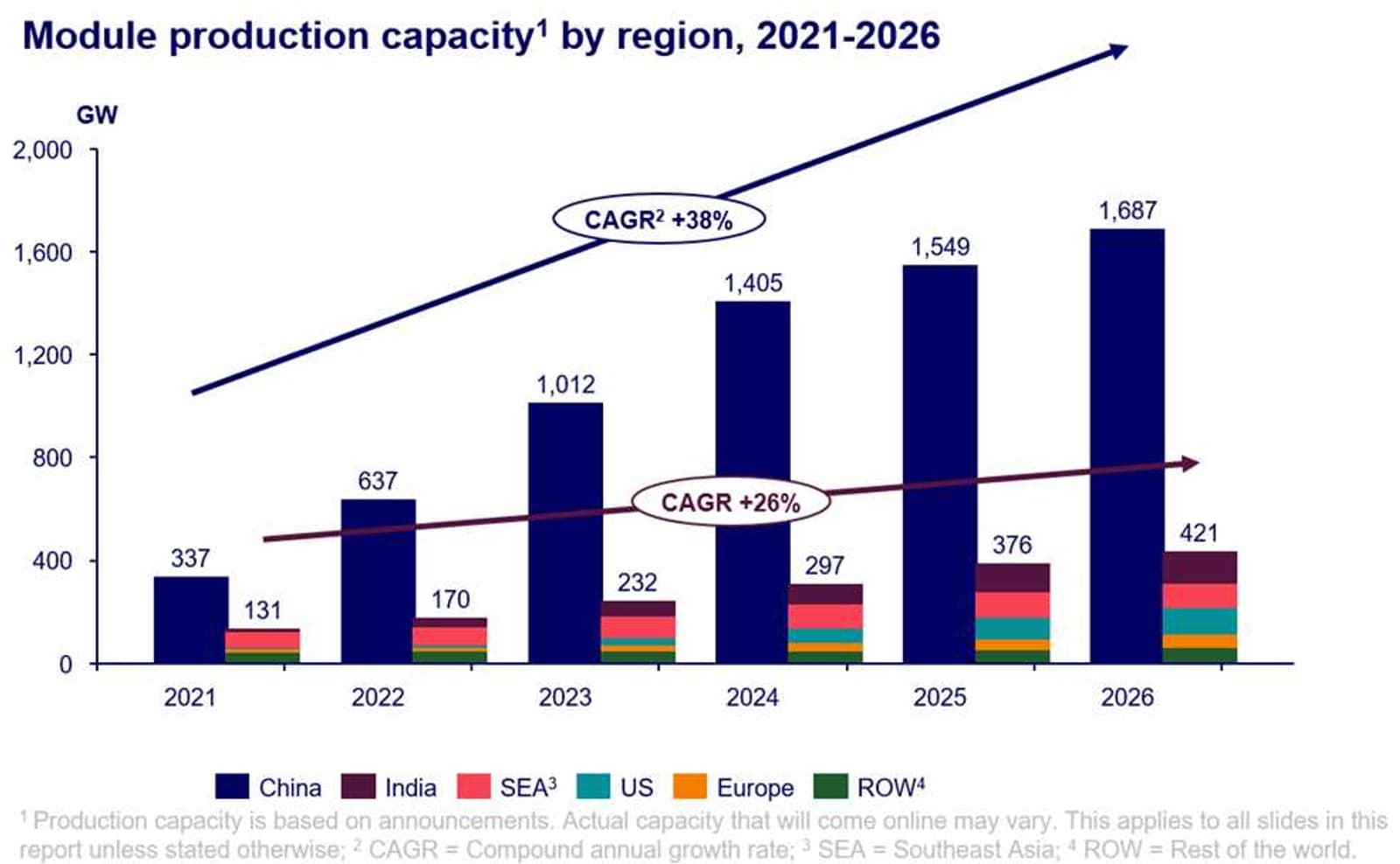
This represents 17 times more capacity than the rest of the world.
Wood Mackenzie adds how, going forward, the solar supply chain will be characterised by oversupply and intense competition.
Concerns about the market’s oversupply are mainly aimed at old production lines that produce lower efficiency products, such as the P-type and M6 cells. Demand for P-type cells began to decline in 2023 and Wood Mackenzie analysts expect it to be only 17% of supply by 2026.
Sun added: “Oversupply will undeniably hinder some of the current expansion plans. More than 70GW of capacity in China has been terminated or suspended in the past three months.”
The solar manufacturing industry in China is entering a challenging time. Module manufacturers will be forced to take orders at a loss, reduce capacity, or shut down entirely.
Looking outside China, adds Wood Mackenzie, India is forecasted to overtake Southeast Asia as the second-largest module production region by 2025, which will be driven by India’s strong PLI incentives.