Digital twin to address data centre cooling challenge
Jonathan Spencer Jones
Posted on: 31 May 2023
Nvidia has been awarded $5 million from the US Department of Energy’s Coolerchips programme to develop an advanced liquid cooling system for data centres.
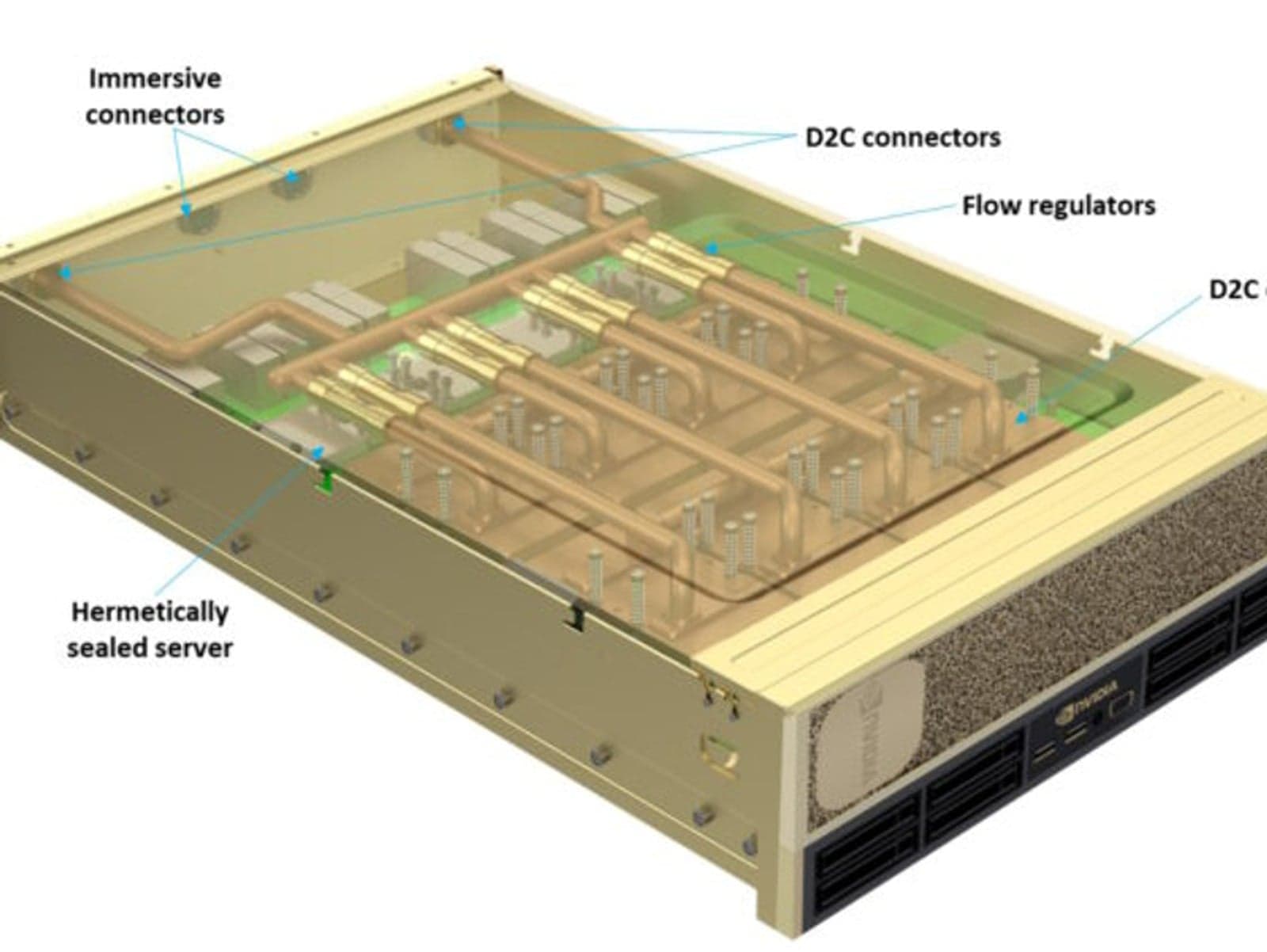
Nvidia has been awarded $5 million from the US Department of Energy’s Coolerchips programme to develop an advanced liquid cooling system for data centres.
The proposed solution combines two technologies using a green coolant commonly used in air conditioners.
First the chips are cooled with cold plates, whose coolant evaporates and then cools to condense and re-form as liquid. Second the entire servers with the lower power components, are encased in hermetically sealed containers and immersed in the coolant.
Accompanying the three-year project, which is proposed with three phases – component tests in year one, a partial rack test in year two and full system delivery in year three – will be the development of a full digital twin of the system using Nvidia’s Omniverse platform.
Have you read?
Dubai’s DEWA inaugurates solar-powered data centre
How the energy industry can take the lead on making the digital world more sustainable
“This is another example of how we’re rearchitecting the data centre,” says Ali Heydari, an Nvidia engineer, who is leading the project and brings experience of helping to deploy more than a million servers in previous roles at Twitter and Facebook among other organisations.
Nvidia’s approach is promised to cool a data centre packed into a mobile container, even when located in an environment up to 40oC and drawing 200kW – 25 times the power of today’s server racks.
It also is expected to cost at least 5% less and to run 20% more efficiently than the current air-cooled approaches, in addition to being quieter and having a smaller carbon footprint.
Data centre cooling
Nvidia’s project is one of 15 – and the largest award recipient – that is being funded with a total of $40 million in the Coolerchips programme.
In the US, data centres account for approximately 2% of total electricity consumption and data centre cooling can account for up to 40% of a centre’s overall energy usage.
The Coolerchips programme is aimed to develop transformational cooling technologies with the target to reduce the total cooling energy expenditure to less than 5% of a typical data centre’s IT load at any time and any US location for a high-density compute system.
This is to be achieved by dramatically reducing the thermal resistance of heat rejection, which will allow for coolants to exist at temperatures much closer to operating temperatures of the latest generation of chips (targeting <10°C difference between chip and coolant).
The programme is planned to develop solutions for high volumetric compute density systems of >80kW/m3, equivalent to about >3kW per server.
The four technology tracks are components pertaining to the secondary cooling loop that transfers heat from the servers to the facility water or primary cooling loop; cooling systems for modular/edge data centres that encompass the secondary and primary cooling loops, which transfer heat from facility water to the ambient; data centre cooling system software for modelling, etc.; and support facilities for testing the new technologies.
Among the other awards, Raytheon Technologies will investigate the use of using avionics cooling technology and Intel Federal is developing coral-shaped immersion cooling sinks, while the National Renewable Energy Laboratory is leading the consortium to develop the testing protocols including a digital twin.