European industry needs ‘emergency industrial policy measures’
Jonathan Spencer Jones
Posted on: 13 February 2026
Faced with a call for “urgent and bold action” on competitiveness from the Antwerp Declaration community, Ursula von der Leyen commits to discussing how to match the pace needed.
The call, made to the European Council ahead of the European Industry Summit, pointed to persistently high energy and carbon costs, as well as unfair trade practices impacting industry.
Stating the pace of site closures and job losses across vital sectors being unprecedented, the community – which issued the original Antwerp Declaration in 2024 calling for a clean industrial deal and is comprised of over 1,300 organisations spanning 25 sectors – indicated that the situation is worse than a year ago and expects the next five years to be the most challenging for Europe’s industry in many decades.
Calling to turn the Clean Industrial Deal into outcomes felt on factory floors in 2026, the community highlighted three key areas for action: bringing energy and carbon costs down, supporting fair global trade and improved access to finance, and being proud to buy products made in Europe.
In a LinkedIn posting, Christian Bruch, President and CEO of Siemens Energy, highlighted regulation as an issue, stating that the intent is often right, but the outcome too often isn’t.
Calling for a fundamental reset on how competitiveness is governed in Europe, he cited the regulation experience of onshore wind technicians, not as theory, but in permitting delays and project timelines and whether investment actually happens.
Speed, scale, power
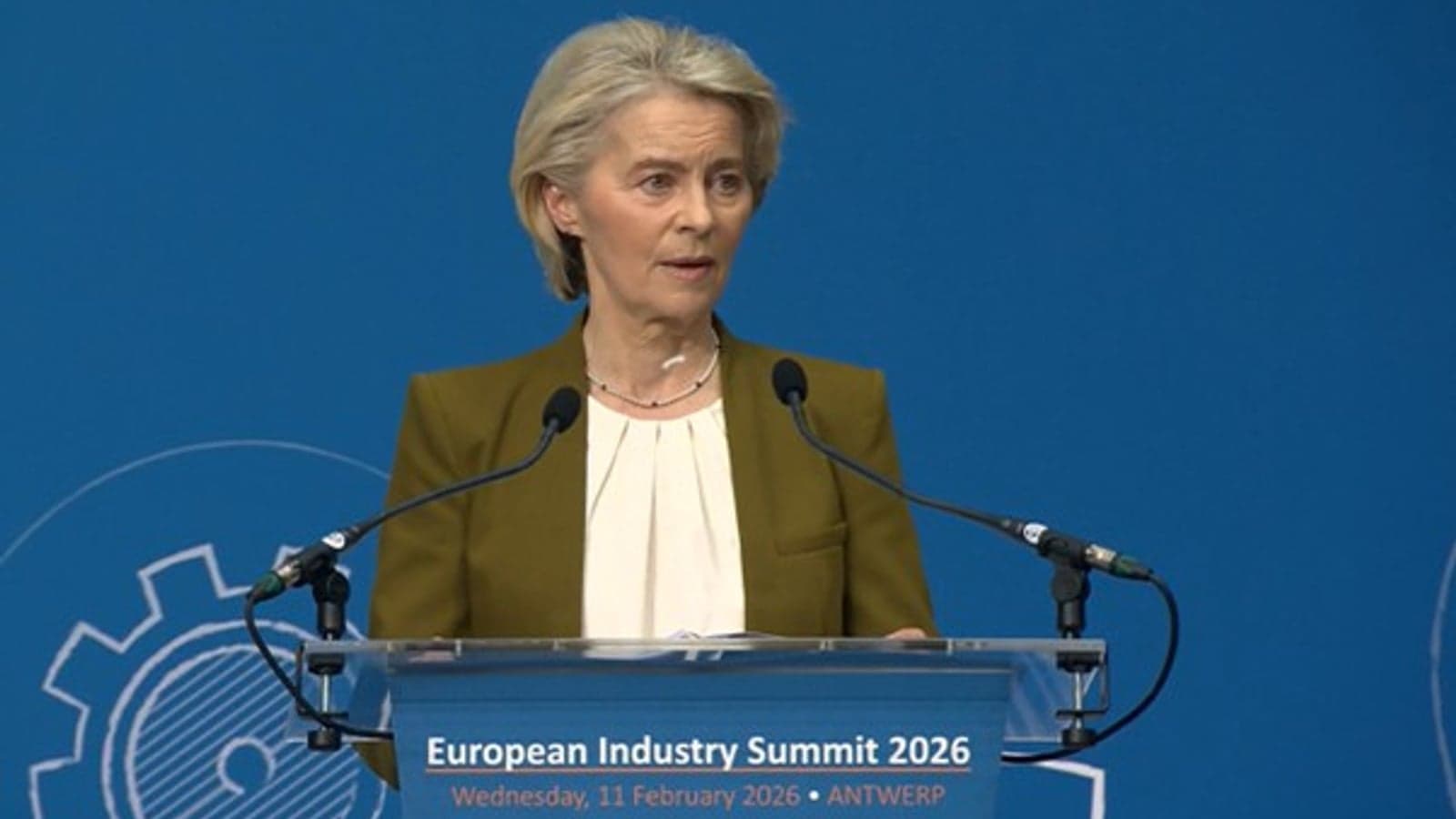
In her opening keynote at the Summit, EU president Ursula von der Leyen addressed some of these issues, commenting on the need for “speed, scale, power and new markets” to strengthen Europe’s business case.
First on speed and new markets, she referenced several new trade agreements, most recently with India, and the start of efforts to speed up energy projects, such as with the wind package, which introduced provisions on increased predictability and faster permitting.
Also of interest
Navigating the cost reality of industrial decarbonisation in the metal sector
Integrating hydrogen combustion in European glass manufacturing
However, she also pointed to the issue of ‘gold plating’, i.e. of EU member states having additional layers of national legislation, as a barrier to the single market.
“If we are serious about simplification, we must crack down on gold plating and fragmentation and it is time for deep regulatory housecleaning – at all levels,” she asserted.
She also promised that accelerating the uptake of European clean products would be a central focus of the forthcoming ‘Industrial accelerator act’ due this month.
Turning to scaling up investment, von der Leyen said that a ‘savings and investment union’ is in the works to build a capital market that could unleash up to €470 billion of investment, with an initial nine member states needed.
She also indicated channelling more resources from the emissions trading system into industries, with the Industrial Decarbonisation Bank concluding the first pilot auction worth €1 billion.
“It will finance the decarbonisation of how you fire furnaces, melt metals or mix chemicals. And more support to industries will be available once the Bank is operational.”
Last but not least, von der Leyen focused on affordable energy, stating that with gas prices dropping and expected to stay down, the time should be used to invest in a low-carbon energy system to protect when fossil fuel prices go up again.
“For that, we need the infrastructure for a true energy union. Because price spikes in one country could often be avoided if cheaper energy could flow across the border. And we have a blueprint to address this, the European Grids Package.”
She also commented on work underway to modernise the energy taxation regime and suggested making greater use of PPAs and contracts for difference to lock in energy prices.
“We need national governments, the European Parliament and the European Commission to play their part. And we need you, the business and trade union leaders, to keep advocating for bold action,” she concluded, committing to “discuss with leaders how to match the pace you need.”
Hydrogen a driver
The issue of simplification was taken up by French president Emmanuel Macron, who said that EU legislation must be reviewed to remove "inconsistencies, redundancies and unnecessary burdens. Simplification to provide clarity, predictability and speed".
Highlighting hydrogen as an example, Macron said as a new market, "we decided to fragment the market by design".
"We have to simplify the hydrogen regulation with hydrogen being produced and based on tech neutrality. European content to protect and favour [industrial] growth. And a eurobond to finance innovation in critical sectors, especially hydrogen."
Commenting on Macron's remarks, Jorgo Chatzimarkakis, CEO of Hydrogen Europe, said that when a president engages at that level of detail, it sends a strong message: "Regulation must enable scale, not prevent it."
Suggesting Macron as the "new hydrogen guy in town", he continued: "This intervention shows that hydrogen is no longer a niche topic – it is at the centre of Europe’s competitiveness debate."
Direct electrification as a missing link
Wind Europe, in a statement, highlighted the key role of wind in electricity generation, stating that once governments remove existing barriers to wind energy development, the industry can quickly deliver the power Europe needs.
However, the missing link to make it available to industry is direct electrification. Calling for the European Commission to take the lead by publishing its guidance on energy taxation to enable governments to incentivise investments in electrified industrial processes, the organisation stated: "Europe needs targeted measures to match electricity supply and demand and de-risk crucial investments in direct electrification. It also needs to ensure that industry can procure wind energy at competitive prices."
Join Europe’s leading industrial energy users at the annual European Industrial Energy Days (EIED).