Integrating hydrogen combustion in European glass manufacturing
Guest/partner contributor
Posted on: 12 February 2026
The EU-funded project H2GLASS explores the challenges and solutions of replacing natural gas with hydrogen combustion in glass production.
Reducing carbon emissions in energy intensive sectors is essential for Europe to reach its ambition of becoming the first climate neutral continent by 2050. Hydrogen is a promising alternative, as it can deliver high temperature heat required for industrial processes without producing direct carbon emissions. Pure hydrogen can be synthesised by electrolyser for industrial use and to kickstart the decarbonisation process.
Here is where H2GLASS comes into play. The project is demonstrating the practical integration of green hydrogen through electrolysis into energy intensive industries by developing technological solutions, i.e. new burner and furnace designs, that enable glass manufacturers to use 100% hydrogen for combustion in their facilities.
Within the lifetime of the project, the developed technology will undergo testing and validation at five demonstration sites within the glass industry and one additional site in the aluminum sector (Figure 1). But the complete shift to hydrogen still presents several challenges and understanding these challenges and needs is key to achieving climate neutrality. Within H2GLASS, we studied and highlighted key factors to integrate hydrogen for glass manufacturing industry in Europe. [1]
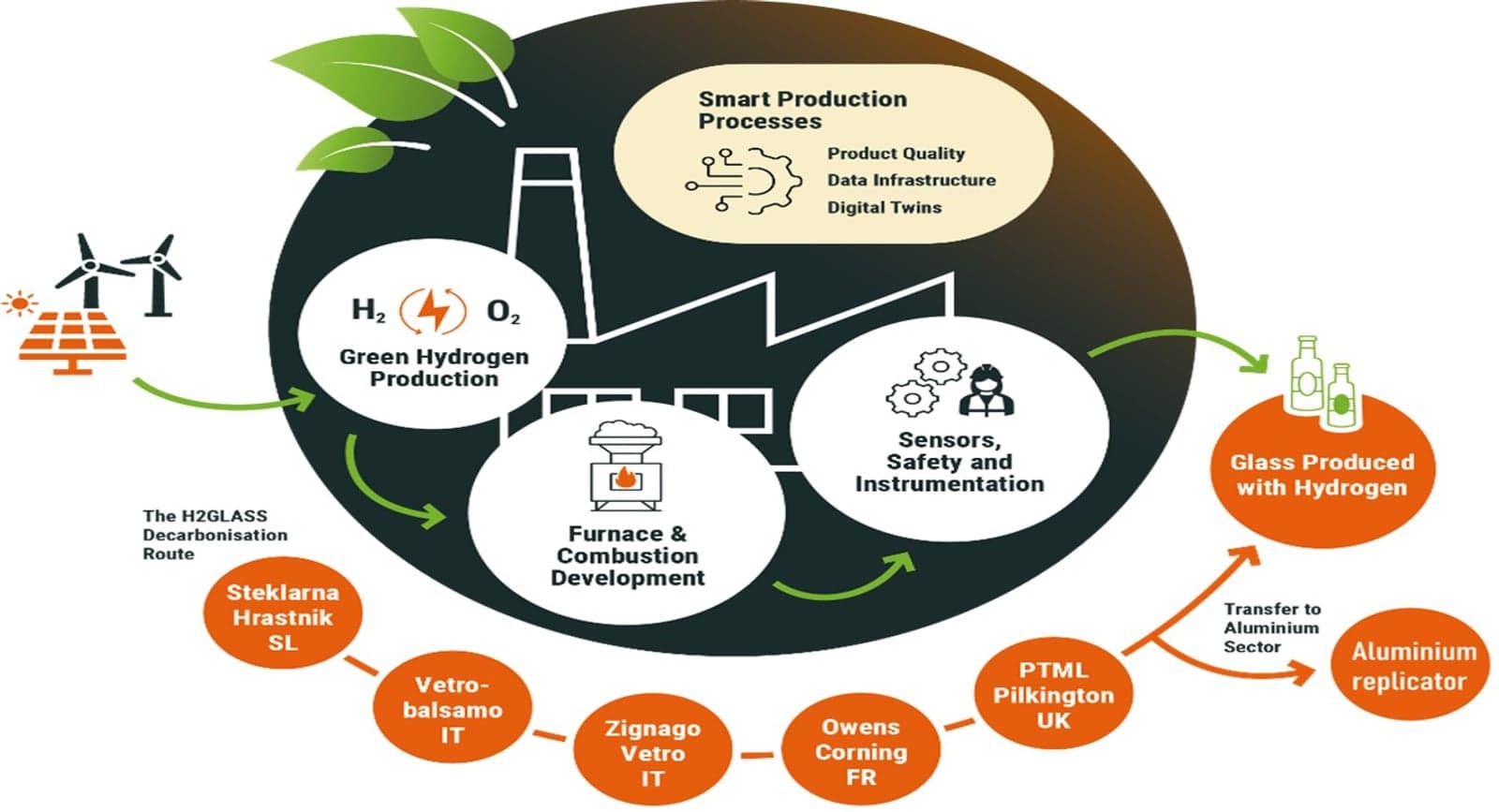
H2GLASS methodology
The case study was carried out with four glass manufacturers in Europe with unique requirements, conditions, and challenges.
- Manufacturer A: Produces container glass for spirit and perfume bottles with three production lines. It has two furnaces in production and at least one of the furnaces will be tested with hydrogen.
- Manufacturer B: Produces container glass for bottles with two production lines with five different forming machines to form the shapes. It has two furnaces in production and only one of the furnaces will be tested with hydrogen. Natural gas and electricity are power sources.
- Manufacturer C: Produces container glasses targeting cosmetics and perfumery and food and beverage. It has two batch-charger machines at the side of the furnace. Only one of the furnaces will be tested with hydrogen.
- Manufacturer D: Produces with two two production lines and manufactures two types of fibreglass, i.e. continuous or chopped fibreglass. It has one furnace which runs natural gas. Three container glass manufacturers were selected to better generalise a conclusion for glass manufacturers. The fibreglass manufacturer was to validate if the result is transferable to different types of glass manufacturers.
Empirical data was collected through different methods, such as questionnaires, online workshops, field visits and information retrieved from field documents. The focus was on safety management, furnace modification and smart production management for electrolyser installation.
Project results
Our investigation shows a common challenge among the four glass manufactures, which is the lack of knowledge in management of hydrogen in furnaces, as these were built and designed for natural gas. Concerns such as the impact on the refractors, the lifetime of the furnace, product quality, thermodynamic conditions such as temperature distribution, foam level and furnace stability as well as the need for furnace modifications were some of the points of concern.
All four manufacturers also highlighted the hydrogen safety operation conditions and relevant control systems for hydrogen are another operational challenge, given that hydrogen is odourless and highly flammable.
The lack of experience with hydrogen among current operators and other personnel is yet another challenge that manufacturers need to address.
Another key challenge was their current IT infrastructure, with the need for automated furnace controls and greater expertise in integrating hydrogen technology into existing equipment. For example, new digital tools may be needed to detect the weaker flame visibility during hydrogen combustion compared to natural gas.
The suggested solutions to overcome the challenges are as follows.
Safety of hydrogen
Hydrogen is explosive and requires proper on-site safety measures to prevent accidents and protect personnel and equipment. Equipment should be designed to minimise leak points, such as reducing flanged connections, and constructed from hydrogen-resistant materials like stainless steel.
Reliable and rapid leak detection systems, including automatic sensors and flame/temperature detectors, should be installed throughout the hydrogen supply and furnace areas. In the event of a fire, hydrogen supplies must be shut off and safely vented.
Regular inspection and maintenance protocols, including checks with gas detectors, are needed to ensure system integrity. Emergency shutdown procedures and an emergency response plan with trained staff should be in place to manage leaks or incidents quickly and effectively.
Furnace modifications
All furnaces of the use cases were originally designed for natural gas that require modifications for efficient hydrogen use. Experts suggest enlarging burner blocks and adjusting diameters, as well as modifying port geometry and considering alternative positions for regenerative gas injectors to optimise flame length and support staged combustion, which may help reduce NOx emissions.
As hydrogen use may increase NOx, additional measures like candle ceramic filters, more cost-effective over time, could be needed if emission levels are higher than expected.
Not all furnace features will need changes; components like the barrage, batch charger and tuckstones are likely to remain the same. However, testing is necessary to confirm these expectations.
Smart production management
Smart production processes rely on robust data architecture and digital infrastructure to monitor furnace operation and product quality during hydrogen use. Establishing on-site data acquisition and cloud connectivity enables predictive analysis and quality control.
Developing standards for data access and management, as well as implementing digital twins for predictive maintenance and production planning, are essential. Evaluating the thermodynamic behaviour of hydrogen and its effects on downstream processes ensures product quality, while sensors and infrared cameras can help detect hydrogen flames and optimise furnace conditions.
Looking ahead
Safety is a major concern for manufacturers integrating hydrogen, as all case studies revealed gaps in knowledge about safe hydrogen operation and emergency response.
Alongside implementing safety measures like using hydrogen-resistant materials, manufacturers must also face space issues for electrolysers, operator training and storage and refueling infrastructure. While smart solutions such as digital twins could improve maintenance and extend electrolyser lifespan, real-world applications remain limited due to a lack of relevant hydrogen data.
The environmental impact of hydrogen depends on its source; green hydrogen reduces emissions but can be unstable, requiring backup power, while grey hydrogen may undermine climate goals. Biogas offers another alternative, but its variable composition poses challenges for glass production quality with increased NOx emissions, highlighting the need for further research.
Concluding, while lower costs are expected due to the future development of hydrogen infrastructure in industrialised countries, factors as those mentioned above need to be considered during the deployment of hydrogen in the glass sector.
Findings and insights from H2GLASS may accelerate the transition to full hydrogen deployment in the glass industry and support similar solutions in other hard to abate industries like aluminum and cement.
Reference
1. Wan, P., Caccamo, C., Cattaneo, E., Lakube, X., Bucelli, M. & Fragapane, G. (2024). Key Factors To Integrate Hydrogen For The Glass Manufacturing Industry. Procedia CIRP, Volume 130, 2024, Pages 1821-1826.
About the authors
Paul Wan is a Research Scientist at SINTEF Industry. His work focuses on improving sustainability efforts through digital solutions in the manufacturing sector. He currently researches digital product passports to enhance product traceability and support circular economy initiatives. He has led tasks within EU and Norwegian national funded research projects.
Giuseppe Fragapane is a Research Manager in the Digital Production group at SINTEF. His work focuses on energy intensive production systems and the application of advanced digital technologies. He has contributed to numerous European research and innovation projects, where he has worked on digital transformation, data driven operations and next-generation manufacturing solutions.
Most popular
Join the community for freeAnd get access to all content
Related projects
H2GLASS
1 January 2023 - 31 December 2026
View project