Partner content
Europe’s energy grids need urgent modernisation
Jonathan Spencer Jones
Posted on: 4 November 2025
Ericsson’s Pilar Rodríguez López reveals why the company is sounding the alarm on the cost of inaction on Europe’s grids.

Blackouts in Iberia and the Czech Republic earlier this year exposed a hard truth: Europe’s energy grids are no longer fit for purpose. Ageing infrastructure, regulatory fragmentation and rising digital demand are converging to create a perfect storm of vulnerability. For Pilar Rodríguez López, Head of Energy and Utilities (EMEA), Ericsson, the message is clear — without urgent modernisation, Europe risks paying a steep economic and societal price.
This complexity, with fast growing integration of renewables like wind and solar, also is introducing intermittency and voltage stability challenges. Further rapid growth in electrification, data centres and AI-driven demand is intensifying the load on the grids.
There also are increasing cybersecurity threats and physical sabotage incidents – such as the vandalism in the Alpes-Maritimes region with a pylon sabotaged and arson attack on a substation also earlier this year – raising concerns for critical infrastructure protection.
Geopolitical tensions and consequent energy dependency concerns also have intensified, driving urgency for energy sovereignty and resilience.
At the local European level there is regulatory complexity, with limited harmonisation and cross-border coordination across member states, while there remains an increasing need for more interconnected cross-border transmission systems.
These issues indicate the need for action and are the stimulus to a forthcoming white paper titled, A Tipping Point for Europe’s Energy System: Why Resilience Must Power the Next Era of Energy, on grid modernisation by Ericsson, EUTC and European utilities companies. This white paper explores how telecommunications infrastructure, and in particular mission critical communications, can underpin a new era of reliability, security and visibility across the European energy system by enabling powerful tools thanks to connectivity and real time monitoring that allows preventing failures and speeding recovery.
“The underlying need for this complexity is digitalisation and telecommunications play a pivotal role,” says Rodriguez, commenting on why the company is sounding the alarm on the urgency of Europe’s grid modernisation.
“In coming years, the need for big investments in grid expansion and modernisation is agreed. This paper stresses the need to ensure that the telecommunication layer is emphasised in these investments because they are key to prevent incidents and to enable faster recovery.”
Sounding the alarm
The white paper is being prepared with the EUTC (European Utilities Telecom Council) and several leading European power utilities as an urgent call to action for a common effort from all energy sector actors, including governments, regulators and utilities, and is due to be released on 18 November at Enlit Europe 2025.
Utilities need both private and public networks to ensure their requirements are met for coverage and backup and in particular the smaller utilities that don’t have the resources for a private network depend on the public operators.
Role of technology
Technology is obviously key to grid modernisation, with the telecommunications backbone enabling end-to-end intelligence that is necessary to provide real time situational awareness and the ability to monitor and manage a sensor- and renewables-based grid.
To build a resilient telecommunications network, Rodriguez states that the adoption of mission critical communications is needed. These would be based on LTE and 5G networks tailored to private spectrum, with standardisation efforts aligned with 3GPP protocols to ensure interoperability across EU member states, between public and private networks and with cross energy value exchange (from generation, transport, distribution and meters), and integrated with advanced digital platforms and AI (for example for predictive maintenance).
Coupled with this is the need for enhanced cybersecurity measures, which should conform to EU frameworks such as the NIS2 and CER directives.
Rodriguez notes the significant role of telcos in technology, both the well-established vendors such as Ericsson, which design and deliver the networks and can be relied on for long term support, and the public operators, which provide back up to utility private networks and could provide services and support in operations.
“Utilities need both private and public networks to ensure their requirements are met for coverage and backup and in particular the smaller utilities that don’t have the resources for a private network depend on the public operators.”
Blockers preventing progress
Rodriguez remarks that preparation of the white paper has highlighted several blockers to progress.
Some are EU wide, such as regulatory fragmentation among member states slowing unified grid modernisation efforts and spectrum allocation and telecom regulation inconsistencies impacting utilities’ access to dedicated communication channels.
Others occur in individual countries, such as complex project funding mechanisms and long investment approval cycles, legacy infrastructure and slow policy adaptation to the decentralised, multi-directional energy flow approach.
Workforce shortages and skill gaps also are apparent, compounded by competition for talent within the energy and technology sectors.
Energy and telecoms alignment
Based on the findings, the white paper will make a series of recommendations, among which are fostering EU-wide coordination mechanisms for grid resilience and modernisation strategies and increasing funding for digital grid investments. At the same time there is a call to action to recognise the pivotal role of telecommunications in building resilience and to boost mechanisms and standards that allow utilities to have common frameworks to ensure accountability in meeting standards.
Rodriguez highlights an important recommendation as the need for closer alignment between the telco and energy sectors in Europe.
“These are both fully regulated but there needs to be a commitment between the utilities, telcos and regulators to managing the grid infrastructure with more digitalisation. The system cannot work in the same way as it has in the past – and that also is a lesson from Iberia."
This closer alignment also extends across member states as Ericsson has experienced with its growing private network piloting and provision to utilities. Currently regulation and standards are very much country based with each making their own decisions.
“We are involved with the majority of private networks in the US and are now moving forward in Europe,” asserts Rodriguez.
And Ericsson’s estimated cost of inaction? Spoiler alert: “Initial analysis of this cost – or the opportunity cost of doing nothing – is that every euro invested in the system brings €6 of growth to national GDP,” concludes Rodriguez.
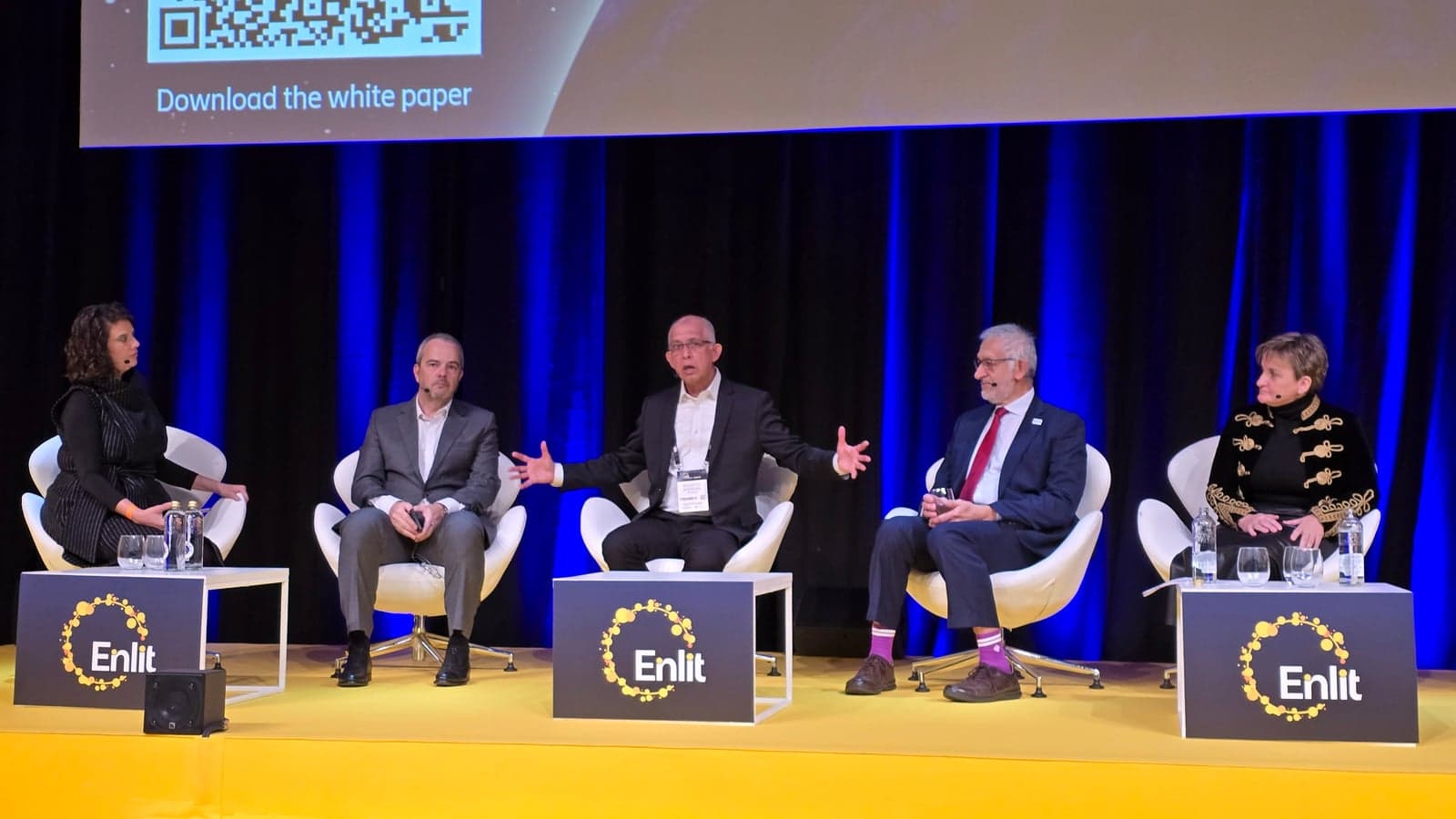
Pilar Rodríguez López is discussing these issues with more insights on the forthcoming white paper on 4 November 2025 at EUTC 2025 in Brussels.
Whitepaper launch | 18 November 2025
The white paper, A Tipping Point for Europe’s Energy System: Why Resilience Must Power the Next Era of Energy, will be released at Enlit Europe 2025 in Bilbao, Spain on 18 November.
All media are invited to join the press briefing on 18 November at 12h00 - 12h45 CET, Inspire Stage (Hall 5)
Related tags
Latest content
+3
Open source: The key to utility digital sovereignty
Open source collaboration is not merely a technological choice for the energy sector but a strategic imperative for navigating the complexities of today and tomorrow, writes Alex Thornton, Executive Director, Linux Foundation Energy.
- Guest/partner contributor
- 29/05/2025