Scientists surprised by data on Europe's solar radiation rise
Jonathan Spencer Jones
Posted on: 16 February 2026
Changing cloud patterns and reduced air pollution has led to increased surface solar radiation across Europe – an important shift for solar energy production.
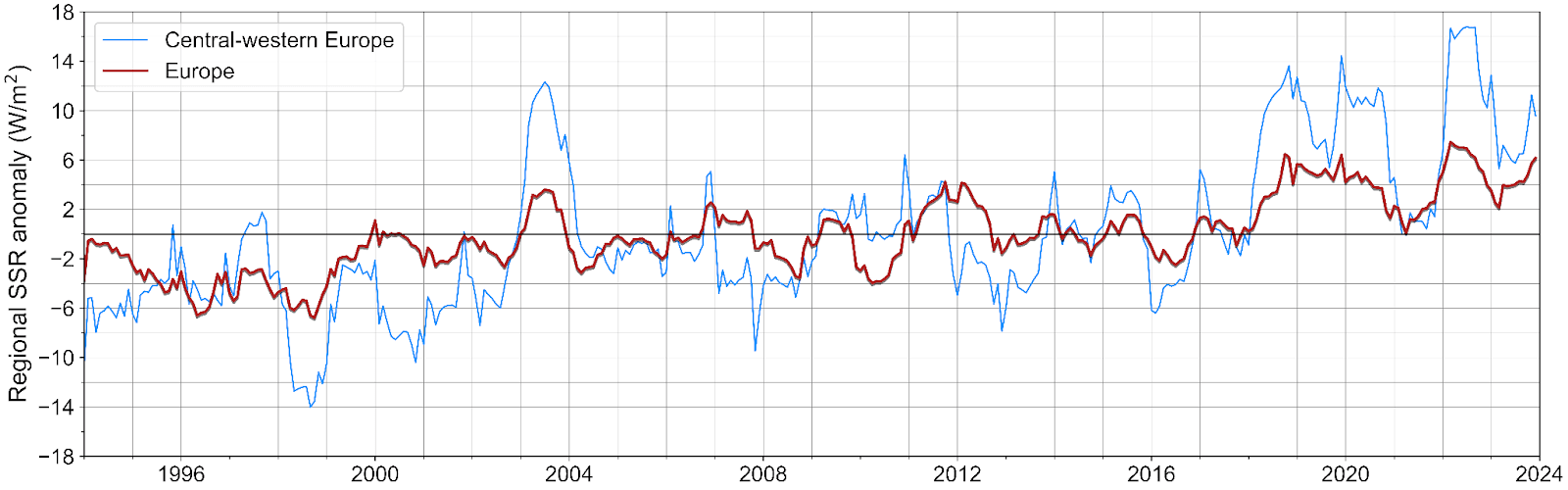
According to a new study by scientists at solar data company Solargis and the Universities of Malaga and Murcia, the amount of sunlight reaching the surface of Europe has increased by almost 5% over the last 30 years – equivalent to 3.1W/m2 per decade between 1994 and 2023.
This is larger than the 2.7W/m2 per decade found in an earlier study covering the period 1850 to 2014.
However, this surface solar radiation (SSR) increase has not been homogeneous across the continent or over time, the findings show.
The greatest growth has occurred in central-western Europe, especially during the last 20 years, with northeastern France, Benelux and western Germany experiencing an increase of nearly 11% or 4.7W/m2 per decade between 1994 to 2023, reaching 6.8W/m2 per decade over the last 20 years.
Other areas, such as Great Britain, Scandinavia, the Italian Peninsula and the Balkans have experienced less growth.
The findings also show that changes in cloud opacity and coverage account for around 80% of the increase, approximately half of this due indirectly to the reducing aerosol pollution levels over the past 30 years, with the reduced aerosols directly accounting for the remaining 20%.
Directly, aerosols absorb and scatter solar radiation, which affects the heating and cooling of the atmosphere and in turn influences cloud properties. Indirectly the reduced aerosols have led to clouds becoming less reflective and letting more sunlight pass through, as they are formed by larger but fewer water droplets, also altering precipitation patterns and cloud lifetimes.
Other changes in cloud coverage are attributed to the thermal effect of temperatures rising as a result of global warming, leading to lower cloud formation.
“When we embarked on this study we were already aware of the overall increase in solar irradiance levels, but our findings around just how much they have increased – and the factors driving this change – have certainly been surprising,” said José Antonio Ruiz Arias, Professor in the Department of Applied Physics at the University of Malaga and the lead researcher.
Also of interest
How climate change will shape the energy sector to 2050
EU Energy Projects Podcast: How space data is advancing the energy sector
“Changing irradiance levels impact the solar power industry greatly, with a direct influence on the long-term production, sustainability and bankability of projects. Beyond the energy sector, a ‘brighter’ Europe translates into more energy, rising temperatures and altered precipitation patterns. These factors have broad impacts on societal patterns and almost all economic sectors, from farming and tourism to education.”
The study was based on a comprehensive set of ground and space-based observations and projected data covering from 1994 to 2054.
Looking ahead over the next 30 years to 2054, although there is no evidence of a future plateau in the increase in surface solar radiation, the study anticipates that it should slow down, in accord with other model results – the uncertainty being due to the complexities of modelling the behaviour of the Earth’s atmosphere and limited knowledge of aerosol levels and their interactions in the atmosphere.
With further data and improved modelling with the new generation of supercomputers, further light may be shed in time.
Impact for solar PV
While the average person is unlikely to have been aware of the increase in surface solar radiation on a day to day basis – it is not in itself the only influence on temperature – and it is not necessarily indicative of an increase in the number of sunny days, it is significant for solar energy production since the output of PV scales in proportion to the solar input.
The study points to areas that are potentially favourable for future solar development. However, other factors also have to borne in mind, not least with the accompanying increased uncertainty of a changing climate, including extreme weather and other events such as heatwaves or droughts.
The study, ‘Past, current and future solar radiation trends in Europe: Multi-source assessment of the role of clouds and aerosols’, is published in the journal Remote Sensing of Environment.
Related tags
Latest in Digitalisation
All articlesPartner content
+1
Digital water management: Empowering utilities with scientific decision-making
As urban water distribution networks continue to expand and water resource management becomes increasingly complex, water utilities are facing growing operational challenges.
- Guest/partner contributor
- 03/07/2026