EUSEW 20: out of Brussels and into an empowered Europe
Jonathan Spencer Jones
Posted on: 9 June 2026
The 20th EU Sustainable Energy Week opened with highlighting of the EU’s progress and challenges in the energy transition.
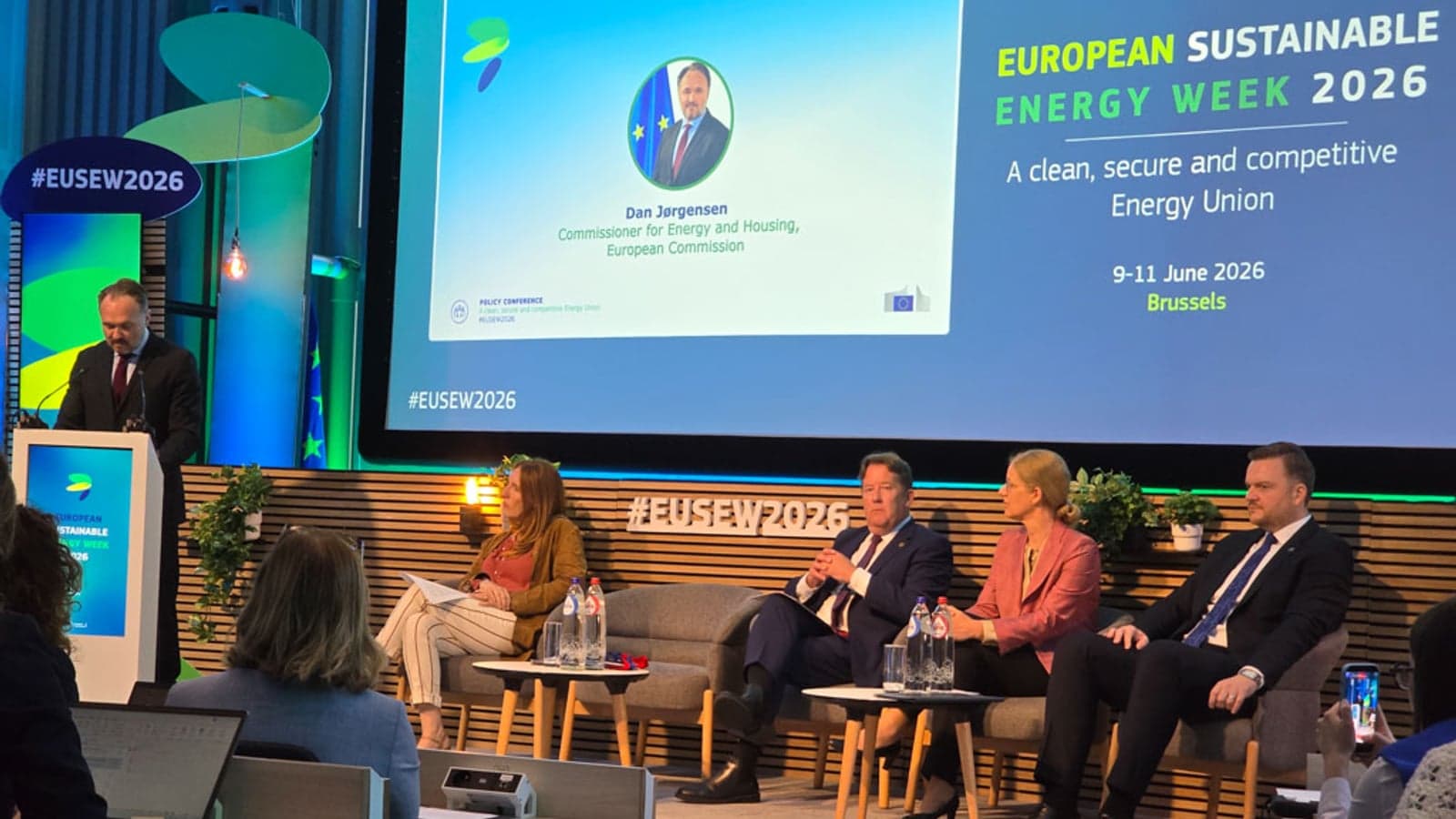
Delivering the opening keynote, Dan Jørgensen, EU Commissioner for Energy and Housing, set the tone commenting on the world today as a very different place with the current challenges being faced compared with the first event in 2006 .
Eschewing a repeating of the current and recent legislative output from the Commission, he said it is time to take the discussion out of Brussels and into the living rooms of Europe.
“Let us not only ask how we can lead the clean energy transition but instead ask how we can empower our people.”
There will be a battle for the hearts and minds in Europe in the coming months which will be played out in electricity bills, fuel bills and heat bills and the outcome will have far reaching consequences for society, the economy and democracies, he continued.
“We need to translate the clean energy transition into everyday language, real examples and pragmatic choices,” he said, citing as an example how energy labelling has helped the spread of energy efficient household appliances.
“We implement the rules, back them up with clear information and now we can see the fruits of this work.”
Jørgensen added that more than 500,000 EVs were registered in Q1 of 2026 and in the same period more than 400,000 residential heat pumps were sold in France, Germany and Poland, which shows that Europeans are ready for the transition.
“We need to ensure our citizens have the right tools and solutions available. We need to listen to their concerns and support them but more than this we need to open their ideas to the immense opportunities within our grasp.”
Also of interest
Jørgensen says Europe must ‘transform into electro continent’
Twin Transition initiative targets data centre planning
Ireland presidency
The second keynote Darragh O’Brien, Ireland’s Minister for Climate, Energy and the Environment and for Transport, highlighted Ireland’s readiness to assume the presidency of the EU council in July.
Promising to approach the role with “impartiality and integrity”, he said there are four central themes for the presidency for energy, viz delivering an integrated EU energy policy framework, advancing a package of climate measures towards climate neutrality by 2050, supporting EU energy sovereignty by positioning Europe as the first true electrical continent, and building a Europe that values and protects its natural environment.
“Europe’s energy future must centre on electrification,” he said.
“This can be achieved through unrelenting deployment of indigenous renewable and clean energy, supported by robust grids and a common ambition to electrify our societies.”
Industrial transition
Elena Donazzan, MEP and vice-chair of the parliamentary committee on industry, research and energy, delved more deeply into this topic highlighting that while clean and sustainable energy responds to the needs of the climate transition, it must be accompanied by a “fair social, economic and industrial transition”.
But industrial decarbonisation will only produce the expected results if it is complemented with taking account of all available energy sources.
“We must give due recognition to all energy technologies – and nuclear energy first and foremost but also hydrogen, geothermal, waste to energy and carbon capture and storage,” she said, adding that technological neutrality also means not demonising the refining sector..
Stating that Europe’s most advanced refineries are among the cleanest and most technologically sophisticated in the world today, she said that closing them would not only eliminate productive capacity but also expertise and know how that can be exported to the rest of the world.
Donazzan also commented that zero emissions does not exist as these need to be accounted over the entire supply chain, including any extraction, processing and transport that may be incurred.
“The real balance is never zero and our growth must be to reduce emissions as much as possible to improve the [emission] debt reduction, knowing that we share a global responsibility in which we are not just actors but among the most important ones – and it is on this basis we must build our energy policy, not on dogma or security and supply
Financing the transition
Marco Primorac, vice-president of the European Investment Bank, opened his comments stating that the Bank is contributing to the transition by turning ambition into action.
In 2025 almost 60% of EIB group financing went to green projects, with a record €33 billion financing Europe’s energy security.
And going forward the group intends to deliver more than €75 billion in financing over the next three years in support of the energy transition, he promised.
Primorac also highlighted EIB support for almost half of total investments in the grids and storage over the past year, the launch of the ‘energy efficiency for SMEs’ initiative aiming to provide €17.5 billion for up to 350,000 SMEs between 2025-27, with almost €6 billion disbursed in the first year, and outside the EU the pledge of more than €1 billion for financing renewable energy projects in sub-Sharan Africa.
“As the EU’s financing partner, the EIB group is ready to help deliver Europe’s clean energy transition for citizens, businesses and its competitors.”
Measuring the grids
Last but not least, Sabine Erlinghagen, CEO of Siemens Grid Software and vice chair of Digital Europe’s executive energy council, addressed the topic of the grids and how these have become the bottleneck of initiatives such as EVs, data centre connections and industrial electrification.
Highlighting the potential to get 20-30% more out of the existing grid infrastructure with digitalisation and initiatives including flexibility, she called for measurement and rewarding of grid performance.
“If we can measure the productivity of the grid and how much an asset in the field is already digitised we can then start to optimise and ultimately get to the 20-30%.”
But this needs a change in policy to a totex approach, in which software is rewarded as much as hardware is currently.
There also needs to be a change in legislation to be able to harness the smart meter data for productivity analysis.
Closing with a quote from Einstein that in the middle of difficulties lies the opportunities, Erlinghagen said the grids are very difficult but present huge opportunity.
“They have been put into much more focus with recent policy… this EUSEW is another opportunity to give the grids a push and advance the debate to unleash the potential for Europe.”